Pooja Ugrani’s Poems & The Architecture of The Quotidian
Review by Malini Bhattacharya
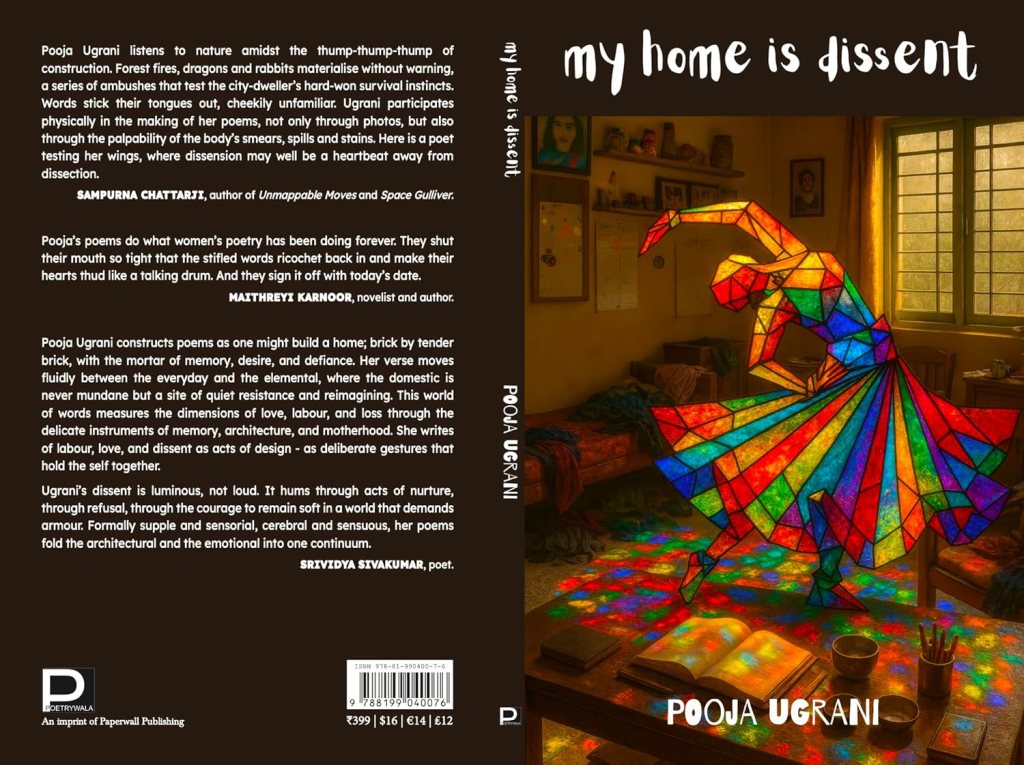
Pooja Ugrani’s debut collection, published by Poetrywala, is one of those books that carry the soft luminosity of a gemstone. There is no need for it to announce itself ostentatiously. The cover does it, with the dancing figure in the stained glass robe in a room quite like the ones you and I inhabit and immediately recognize.
But the home Ugrani constructs so deliberately in these poems isn’t a denotatum for the quick associations we make with the idea of home. It is no absolute refuge and no sturdy shelter from storms women must weather. Ugrani’s homes are spaces where conflict is lived out daily, and survived. The labour of performing dissent is her manual for living as she does—as woman, as mother, as architect, thus builder of spaces, some of which are not her own. It flares up in kitchens, swells in bathrooms, sends shockwaves across courtyards. This bright, heaving experience she orders with the architect’s discipline in six sections—on the go, everyday, inks of void, linger, qissa (fable), and motherhood. She shows you around her universe, stops at the special places, tells you stories that might be fiction or memory, and then she lets you explore on your own.
So, you see her rituals, the people who share territory with her—a bus driver navigating big city traffic with the poise of “a blindfolded dancer”, a child on her new red tricycle, “the boomer who called my baby a burden”, Thathi (grandmother) in Navi Mumbai—
She tells me how
her mother was stripped naked
on her wedding day
before being made to wear a new saree
Ugrani sends her love to spaces remembered, desired and inhabited—the “single loaded corridor” at her college, “a thatched house on an island between two canals”, a park bench where a mother and child sit, and certain rooms that exist only in the spirit, in the interior lives of people—
Your singing comes from a place of truth without pretentions.
It has made me knock on the door
of that room within me.
motherhood is where Ugrani’s praxis of dissent becomes the most explicit, relatable and persuasive, with some of the book’s most compelling images— of parents sitting on each other’s shoulders, a skull that has hit the floor and bounced up in Thud!, a bruised eye and a toenail dark with clotted blood. Ugrani doesn’t smooth over the hardest moments of mothering to make the book more comfortable, but celebrates its palimpsest quality
A new patch
stitched over old clothes
like fresh memories that cover older ones
into gentle oblivion
accepting, not negating, nor normalising
only, very, very selfishly, finding my peace.
If there is a minor occasional lapse in the writing, it is that images and metaphor sometimes arrive too quickly and too densely, at odds with Ugrani’s linguistic fluidity and clarity. At times, the rush of imagery ends up blotting out the sophisticated lightness and lucidity that make the book’s best poems memorable.
There’s a glossary Ugrani provides for the Tamil, Telugu, Kannada, and Hindi terms—a choice that keeps the poems comprehensible without flattening their texture with footnoted translations.
And I must mention the photographs scattered through the book. They make for a parallel, intimate semantic layer—a colour snapshot of a stone corridor with arches, a view of bare balconies, a monochromatic close-up of bare feet, a wall hung with vivid umbrellas, a courtyard fringed by trees. This has the element of ornamentation, but it is also an act of grounding Ugrani’s metaphor. The most striking art in the book, of course, is a crayon drawing of the colony she lives in by one of her children. It is the first visual material you meet in my home, and a clear statement that the poet will honor familial ways of mapping and naming space as much as she will architectural methods of doing so. It sets up the recurring idea, carried through to the title poem near the end, that home is something continually sketched and resketched rather than a fixed structure.
What holds my home together, ultimately, is Ugrani’s authorial position, her refusal to separate the personal from the political, and her insistence that dissent can be soft-spoken without losing its force. Srividya Sivakumar’s masterful foreword gets at this, when she writes, in the introduction, that the poet’s breed of dissent “hums through acts of nurture, through refusal, through the courage to remain soft in a world that demands armour.”
Ugrani is writing manifesto and documentary poetry about a contemporary and urban female subjectivity, about women’s historical labours, the shame and judgment that is their collective inheritance, mothering, and the female body and its possibilities. She writes so there’s no misunderstanding, and the truths she chooses to tell, the convictions that show through are as nuanced as they are unflinching.
With this she builds her book and (I suspect) her life.
I want to learn, share
watch us explode
when knowledge baffles, amazes
belittles and supports.
can we sit side by side,
sip without words?
My Home is Dissent is a remarkable achievement for any poet. If Ugrani’s metaphorical home is slightly too heavy with phantasmagoric images, that heaviness is a reflection of the clutter that accumulates when spaces are peopled, lived in, connected with memory and meaning. This is a poet who has a serious gift for transforming domestic minutiae into something like stream of consciousness in verse, and her best pieces promise the coming of a voice that can only become devastatingly precise over time.

Pooja Ugrani, is an architect, teacher and mother, lives her life in two cities, Bombay and Bangalore. Her poems are included in the anthologies The Shape of a Poem- The Red River Book of Contemporary Erotic Poetry, The Kali project anthology – Invoking the Goddess within/ Indian Women’s Voices by Indie Blue Publishing LLC, the Yearbook of Indian Poetry 2022 and Po’try, an anthology of Bangalore poets. Her poem, Gundalamma Palem was shortlisted as one of the forty poems out of over thousand international entries for the Alpine Fellowship 2023. Her poetry has been published in The Punch Magazine, Cafe Dissensus Everyday, Mom Egg Review (New York), Hākārā, Voice and Verse Poetry Magazine (Hong Kong), The Tiger Moth Review (Singapore), The Alipore Post, The Woman Inc – TWI Poetry, and the RIC Journal (Jaipur-Paris). Ugrani was invited to read at the Bangalore Poetry Festival and by the Champaca bookstore at the Bangalore International Center on the occasion of International Womens’ Day. She was a featured poet at Tuesdays with the Bard at Urban Solace, Ulsoor, in December 2019. While she is relaxing, Pooja explores origami with children and adults, sings Bollywood songs and dreams of a trek in the Himalayas.

Malini writes fiction, creative nonfiction, and, very rarely, poetry, and translates the work of contemporary women writers to and from English and Bengali. Her work has appeared in Palette Poetry, Coldnoon Travel Poetics, Litro, Tehelka, Cerebration, The News Minute, The Bangalore Review, The Better India, Agony Opera, and Aparjan, among others, as well as in the anthology of mental health writing, Side Effects of Living. She published her first book of short stories, Irregular Love, in 2022, and her second, Despite All That, in 2026.


Leave a comment