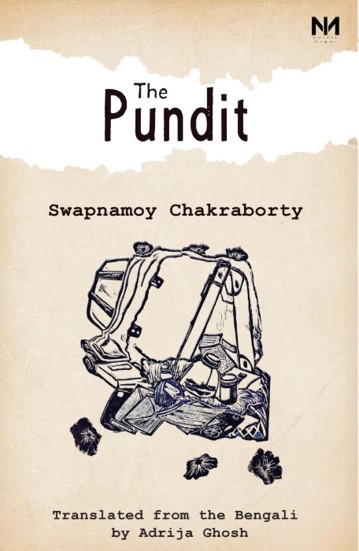
Title: The Pundit
Author: Swapnamoy Chakraborty
Translator: Adrija Ghosh
Publisher: Moving Words, An imprint of The Antonym Collections
Year: 2026
Pages: 310
Price: Rs. 599
ISBN: 978-93-47783-34-0
“Then where do I go? I flee from life to religion, and then from religion back to life. But what is it that I could do? What is it that I could truly do?” (pg.198)
When I first held the book in my hands, the first thought went back to U.R Anathamurthy’s novel published in 1965, Samskara translated into English by A.K Ramanujan – I had read it during my university years and it gave to me an early, formal introduction to the workings of social hierarchy, caste and orthodoxy in twentieth century Karnataka. Reading Swapnamoy Chakraborty’s The Pundit translated by Adrija Ghosh that moves into the world of 1960s Bengal, brought back some of that experience. For readers like me who might not be familiar with this particular social and literary landscape, this novel opens up a world that is unfamiliar but at the same time recognisable.
It becomes a reality check for us as readers about how limited our engagement has been with Indian literature(s). I cannot but repeat here my emphasis on the necessity of opening up our own worlds to spaces that might seem unfamiliar but will help widen our own understanding of the concerns that riddle the hearts of people. Coming from the Hindi-speaking belt, the encounters with writings from other parts of the country in other languages can be limited. I use the word ‘can’ here to emphasise that there are also readers who actively seek out writers from across the country. But for many, recommendations – a handful of names that circulate – becomes the pathway through which one encounters literatures from beyond one’s linguistic world. Thereby making the act of translation very important. It helps create an opening of literary and social worlds that would otherwise remain outside one’s immediate field of reading.
And this is one of the contributions of Adrija’s translation of The Pundit from the Bengali into English. The novel travels beyond its original language to bring to its readers its social world, the tensions and the deeply embedded hierarchies. The novel’s continuing resonance is very unsettling as some of the worldviews and social norms that it talks about do not entirely belong to the past. It is the recognition of those structures in the present times that make the setting in the novel feel as if it is not from another time or place, but how those structures continue to shape us. The novel traces the lives of people living in Baghbazar, a world where no one has been left untouched by the changes taking place around them. The shifting social landscape unsettles long held ideas about how the world is supposed to be. That makes it increasingly difficult for people living there to hold on to the certainties they have inherited.
‘But when Swapna sang, Shikha would scoff, “ Aren’t you ashamed? Singing our songs?” Swapna, indignant, would run to complain to their grandfather, Anangamohan, who with his usual disdain, would retort, “ Why sing Tagore’s songs? Sing D.L Roy, sing Hemchandra, Nabin Sen!” But Bilu’s mother would simply shrug and say, “ Why? Who does Tagore belong to? Someone’s father? He belongs to everyone.” (pg. 16)
Anangamohan Bhattacharya, a Sanskrit pundit who runs a Sanskrit tol, is the protagonist of the novel and it is through him that the readers come across the most compelling tensions. The slow unravelling of long held beliefs and ideas have been brilliantly shown through this character. There is a quiet struggle within him that keeps rising to the surface with regards to the social conventions and what his clan expects him to conform to. On one hand, there is a gradual loosening of those structures that have defined his world, and on the other hand, there are instances where these is an instant recoil from those very constraints he seems to be resisting. An example from the novel occurs during a ceremony at home, the arrival and the presence of a man from the lower caste exposes the boundaries that govern the gathering. The discomfort is communicated through the atmosphere, through those who have gathered and through what remains unsaid. The tension amongst the upper caste has been very effectively conveyed and the reader is brought closer to witness the caste hierarchy. A few extracts from the novel –
‘“We were coming to a holy event! How could we arrive empty-handed?” And with that, Mondal babu made it clear that he, too, had contributed to purchasing those two gifts.
As Anjali left with them, Priest Kamakhya took out a small bottle of Mahabringraj oil from his own pouch. There was a bit of water in it. Holy water. Sighing deeply, he said. “Shall I sprinkle a little, then?”…Anangamohan’s gaze was empty. At this very moment, a transgression had occurred. A Shudra had entered the upanayan ceremony…” (pg.43)
—
‘Smriti-Tirtha slowly muttered, “ In a city of transagressions, yah palayati palayati sa, jivati (he who flees, survives).” Then, he began to cackle. It was meant in jest. But Anangamohan couldn’t appreciate the humor. To him, the words were pungent.
So what if a non-Brahmin has entered? So what if a celibate student has set eyes on a Shudra? Does that taint the sacred rituals? There are no true ashrams or penances like in ancient times. Everything now is mere symbolism. These scholars of Smriti obsess over Manu’s decrees. And they lack humour as well. They are mere practitioners of ritualistic priesthood. If only they had read Dandi, Bilhana, or Kalidasa, they would understand that customs and traditions evolve with time.’ (pg. 44-45)
The narrator holds the threads of this novel as he weaves it all together, but the bringing in of caste not as an abstract social structure but as something that is experienced in a room, in a gathering, in a presence; shows to its readers an uneasy recognition of who is allowed to belong within. This idea of belonginess extends to bring in the movement of people from one border to another.
“You lot are the bangals from across the border, you left everything behind and came here. No jobs to begin with, and now you’re snatching away what little there is from us! Bidhan Roy went and gave all you refugees public sector and state jobs. Look at the hawkers on the footpath! Eighty percent are bangals…” (pg. 26)
The story of migration is embedded as deeply within the pages of this novel as the question of caste. The experience of living at the margins is marked through the way one speaks, the pronunciation of certain words and the ease with which these differences become markers of an us and a them. Alongside this is the question of a younger generation that is growing up without having witnessed or experienced migration themselves. For them, the memories, losses, dislocations as felt by their elders can feel distant, or alien. Bilu who is Anangamohan’s grandson is a character through whom the novel explores this chasm. At the upanayana ceremony, one catches a glimpse of this –
‘Yash kaku smiled. “ He looks just like Nimai. A modern-day Nimai of Kali Yuga.”
Kamakhya and Taranath exchanged glances.
Kamakhyacharan suddenly shouted, “ Cover your head, Bilu! Pull the veil down!”
Yash babu objected, “Why should he? Is he a new bride?”
Taranath firmly replied, “ It is tradition. Our tradition.”
Saying this, he reached over and pulled the veil over Bilu’s head himself.
Yash leaned in close to Mukherjee’s ear and whispered, “ These bangals have such strange customs.” Bilu overheard it. He knew he was a bangal from East Bengal. Yet, he had never seen the land of the bangals. All he knew were the stories from his grandfather and mother. Legends of Chaumuhani, Diwanbari, Goaland.
Bilu was born in Baghbazar, but still, he was a Bangal. Every time East Bengal lost a match; he would hear the familiar taunt:
“Bangals perish over puti fish!”
Khogen pagla, too, had a knack for rhymes about bangals.
“Bangal drank the juice, broke the cup,
Ran away quickly, didn’t pay up!” (pg. 42)
Language becomes a means of separating people. The politics of location runs quietly though the novel surfacing at particular moments through speech, and the ways in which people identify each other. What appears to be a simple difference in language or accent becomes a marker of place, belonging and exclusion.
‘One day Anantanath sent him to Tarakeshwar to attend a scholarly gathering. There, during their meal, Anangamohan had requested the waiter, “ Please add a little chira (flattened rice) to my curd.” The waiter immediately corrected him, “ It’s not chira, say chire.” A little later, Anangamohan said, “ Just a bit of gur, please.”
Hearing his pronunciation, the waiter burst into laughter. A scholar from Bhatpara had quipped sarcastically, “ Bangala yadi manusa, hari-hari, pretsstada ki drsa? ( If the bangal is a human, then alas, what must ghosts be like?)” ( Pg. 91)
If language is creating barriers, it is also in a way leading to questioning the very grounds on which it stands.
‘Anangamohan said, “Listen Kamakhya, let me tell you the truth right here, right now. The truth is, we are utterly helpless. Beyond Sanskrit, we know nothing. Sanskrit is like our aged mother, far too frail now to feed and clothe us. And yet, we cling to her desperately. We have no knowledge of the material world.”’ (pg. 146)
For Anangamohan, his love for Sanskrit language stands on its own but when it begins to seep in through the socio-cultural lens, through a history, a hierarchy and a set of inherited meanings, it is then that the language, as he realises stands no longer on its own.
‘Does a job mean a step down? Down as in to descend? That isn’t fair! What else could I have done? I’m at my wit’s end. I know nothing but Sanskrit. I’m utterly helpless, trapped like a deer in a net. Sanskrit has no value in the real world. It’s disconnected from the practical rituals of the yajna or even worshipping, which is just ceremonial fluff. A demeaning job. I couldn’t even secure a position as a school teacher. Without passing matriculation, one cannot teach in a school….. Without a matriculation degree, one couldn’t become a ‘Pundit Sir.’ And to top it off, Sanskrit exams asked you to translate from English to Sanskrit.’ (pg.74)
The scriptures that he has studied begin to loosen their hold over him when he begins to question certain passages and the ideas contained within them. Yet, he returns to them seeking in them a justification for the beliefs that he is beginning to question. And it is here with this movement between doubt and certainty, and between rejection and return that gives his journey much of its complexity.
‘ “…The same ancient syllabus, unchanged for centuries, How much relevance does it even hold anymore? I wonder. Take Hitopadesha, for instance. It was meant for children. But how am I supposed to explain passages like ‘For an old man, a young woman is like poison’ to a boy now? And then there’s that verse : ‘Sthanam nasti ksano nasti ( There is no place, there is no time)’ which claims that all women, when given the opportunity, will consummate irrespective of time and place? That the very nature of a woman is greed when she finds a man, that she will indulge in pleasure the moment a chance presents itself! ‘Gavas trnam ivaranye prarthayante navam navam ( Just as a cow in the wild always craves fresh grass, so too does a woman seek new men)!’ Tell me, Kamakhya, what kind of logic is this? My daughter-in-law is a working woman. There are men in her workplace. Many of them! So, what does that mean?…”’ (pg. 148)
It would have been easier to depict an upper caste man as someone who largely remained unquestioning the inherited traditions, of the social environment without stopping to examine the structures that sustain them. This novel takes a more complicated route. There is a refusal to offer easy resolutions to the contradictions that lie within Anangamohan. At a time when women’s education was slowly opening up the new possibilities, he teaches his wife to read and write, another instance of his engagement with the changing social world around him.
His awareness as a migrant remain in the background, and at times comes to the fore through reminders he receives from those around him. His questions produce a continual push and pull between what he has been taught and what he begins to perceive for himself.
To translate a novel that has numerous passages in Sanskrit and its negotiations between an older textual world and the present is not an easy task. Adrija’s translation attends to this with a lot of care. Her translator note, which I believe, should have appeared at the beginning of the novel, talks about the negotiations and the choices that as a translator one has to make. Translation is an art that demands creativity and attentiveness. It becomes necessary for a translator to bring their understanding of the text to task when looking at the original and the language into which it is going to be translated into. Instead of thinking of a translator as a bridge between two languages, it would be better to recognise the translator as also a writer and a creator of worlds; as someone who is working at a point where two linguistic and cultural worlds meet and can overlap while times resisting each other.
The novel can be read in part as a kind of bildungsroman. Not simply of a man acquiring knowledge but of someone undergoing an internal process of growing up. A process that demands the dismantling of inherited ideas, the courage to question those ideas and a willingness to confront what is difficult instead of softening that blow. His journey then is more about learning to live with the discomfort of questions.
‘Ananga, this world is truly a marvel. Sure, it has its share of riots, partitions, floods, and crimes, yet the Ganga flows serenely, and after winter, the koel’s melody graces the Krishnachura branches. This world, soaked in divine play, wasn’t meant for you to merely die in…Life, if you are not here, who’ll I be fond of, then?’
About the Author: One of the most renowned literary voices of contemporary Bengali prose, Swapnamoy Chakraborty was awarded the prestigious Sahitya Akademi award for his novel Jaler Upar Pani in 2023. With a prolific writing career spanning over five decades, he has had the unique honor of being both critically acclaimed and well-received by Bengali readers. Among other recognitions, his novel Abantinagar won the Bankim Puraskar in 2005. He has over thirty novels and numerous short stories to his name. He lives in Kolkata.
About the Translator: Adrija Ghosh, a poet and translator, is currently pursuing a PhD in English at the University of St Andrews, United Kingdom. Adrija has published two poetry pamphlets, Heir of Sisyphus (2023) and the Commerce Between Tongues (2022) with Broken Sleep Books, and debuted as a literary translator with Tilottama Majumdar’s The Prisoner (translated from the Bengali to English) in 2024, published by The Antonym Collections. Adrija holds an M.Sc. in Comparative Literature from the University of Edinburgh and an M.A. in Creative Writing from the University of East Anglia, and B.A. (H) in English from Lady Shri Ram College, Delhi University. Adrija’s work has appeared in Wasafiri, Modern Poetry in Translation, bath magg, Gutter, The Dark Horse, among others. In May 2022, Adrija was awarded a translation residency at Dragon Hall, Norwich, by the National Centre for Writing. In 2021, Adrija wrote the short-film Sifr, which was named runner-up for the Kashish Q Drishti Film Grant.
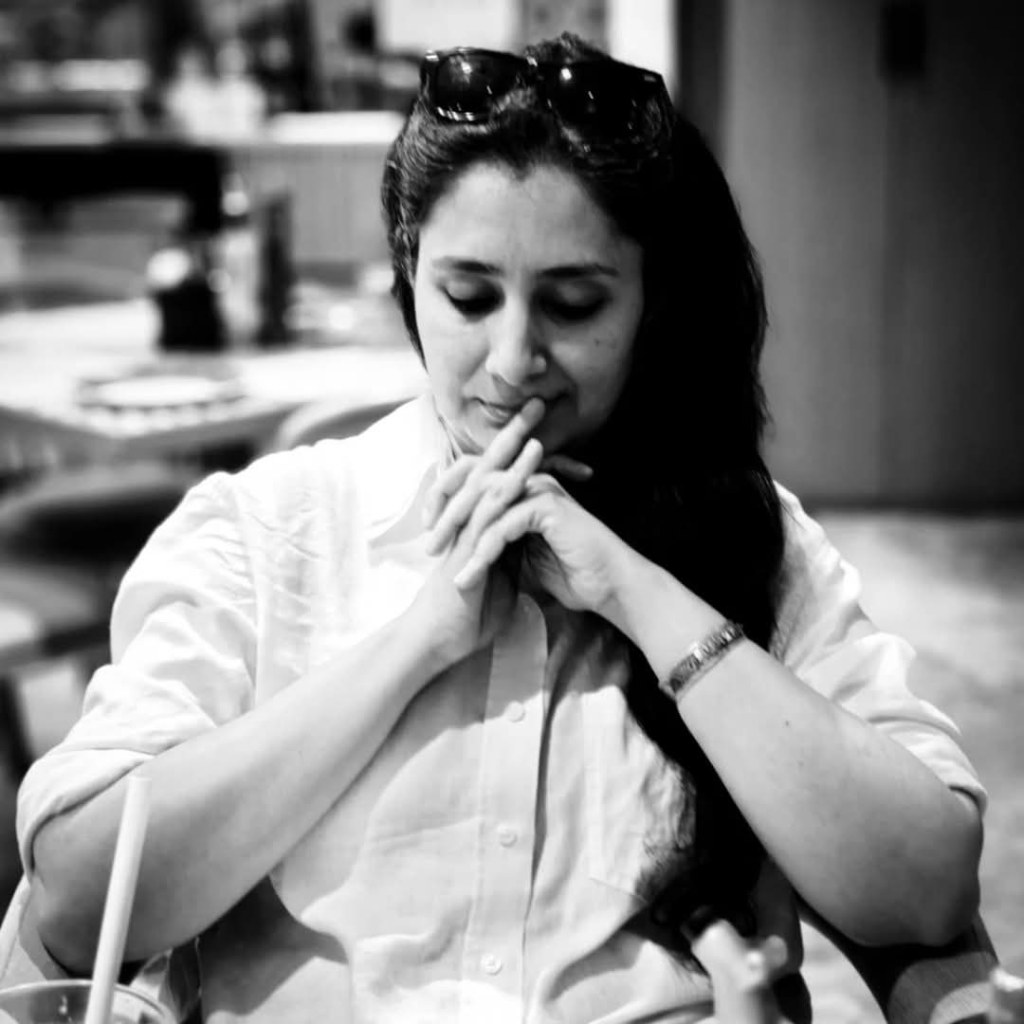
Dr. Semeen Ali is an editor, translator, critic, and poet. She is the Poetry Editor at Muse India, and is associated editorially with the literary journal Parcham and the publishing house Red River. She is the author of four poetry collections and has edited and co-edited several significant anthologies, most recently a co-edited volume on loneliness published by Yoda
Press in collaboration with Simon & Schuster (2025). She regularly reviews books for leading literary platforms, and her work has appeared widely in journals and anthologies,
including publications by Oxford University Press.


Leave a Reply