

The Vampires Who Remember: Tanushka Roy
Naxalism, Memory and the Haunted Kolkata of Indian Vampire Fiction
There is something strange about Kolkata’s vampires. They do not simply emerge from crypts, abandoned mansions or European Gothic mythology. They emerge from a city with a particular relationship with its past. In two contemporary vampire narratives set in Kolkata—Debaloy Bhattacharya’s Dracula Sir (2020) and Pratim D. Gupta’s Tooth Pari: When Love Bites (2023)—the supernatural becomes entangled with memories of a city shaped by the political turbulence of the Naxalite period. The coincidence is striking because the two works are otherwise radically different. Dracula Sir is an abstract, nonlinear psychological film in which a schoolteacher becomes entangled with the memory and mythology of a Naxalite revolutionary. Tooth Pari is a fantastical romantic series about a vampire and a dentist, complete with an underground vampire society beneath contemporary Kolkata.
Yet both make the political past part of their supernatural worlds. This raises a more interesting question than whether vampires and Naxalism simply make an unusual combination: why does the vampire work so well as a figure through which Kolkata can revisit its political past? The answer may lie in what a vampire fundamentally is. A vampire is something that should be dead, but isn’t. That makes it an almost perfect metaphor for historical memory.
The Naxalite movement began with the 1967 peasant uprising at Naxalbari in northern Bengal and,
within a few years, spread across West Bengal. Calcutta became a major site of Naxalite activity,
particularly among students and sections of the urban youth. The period was marked by
revolutionary politics, state repression and intense political violence. The movement and the
conflicts surrounding it left traces in the city’s political and cultural memory. But history does not disappear when the historical moment ends. It survives through memory, stories, political identities and cultural representations.
The political movements of the 1960s and 1970s remain part of how Calcutta’s past is remembered, even when their physical traces have become less visible. Historians have pointed to the paradox of a city in which the remains of these turbulent decades can be difficult to see, even though the period remains important in literature, film and political memory. This is where the vampire becomes useful.
The vampire is neither completely alive nor completely dead. It belongs to the past while continuing
to inhabit the present. Its existence violates the ordinary boundary between what has ended and
what continues. The vampire therefore becomes a figure for the persistence of the past—for the way something apparently buried can continue to exert an influence on those who come after it.
This is not to suggest that the vampire is a direct metaphor for the Naxalites. The metaphor is more
complicated. The vampire represents the condition of being haunted by history: the inability of the
present to completely separate itself from what came before.
Dracula Sir: When history becomes mythology
In Dracula Sir, that relationship between history and the supernatural is intensely personal.
The protagonist, Raktim, played by Anirban Bhattacharya, is a schoolteacher living an ordinary and
increasingly isolated life. His fascination with Amal, a revolutionary from the Naxalite period,
gradually destabilises the boundary between his present identity and the world of the past.
The film’s nonlinear structure deliberately complicates the distinction between external reality and
internal reality. Director Debaloy Bhattacharya has described Raktim as someone who takes refuge
in a story, caught in an oscillation between memory and forgetting. He has also explained that the
film ends at the point where imagination takes over. More revealingly, Bhattacharya has acknowledged that the Naxalite backdrop was not intended to function as a serious historical account of the movement. He describes it as a cerebral construct of the protagonist, who uses the movement to create his own myth and, in his words, “grossly” romanticises it.
That admission changes the way the film can be read. The Naxalite past is not simply something Raktim remembers. It is something he needs to imagine. His present life offers him little sense of significance. The revolutionary past, by contrast, offers an enormous narrative: rebellion, sacrifice, danger, ideology and the possibility of changing the world. Raktim therefore turns history into mythology and mythology into identity. Raktim’s fascination with Amal similarly allows him to imagine himself as connected to a world larger than his own. The supernatural consequently becomes psychological.
The question is not simply whether Raktim is a vampire. It is what his imagined vampirism allows him to become. The vampire gives him a way to escape the limitations of his ordinary existence and enter a story that feels larger than life. In this sense, Dracula Sir is not merely about the supernatural return of the past. It is about the human desire to resurrect the past and make it meaningful in the present. That also introduces an important tension. Historical memory is never neutral. People do not simply remember events; they select, reshape and reinterpret them. The revolutionary becomes an archetype. The underground becomes mysterious. The political struggle becomes mythology.
The vampire intensifies that process because Gothic fiction is already concerned with turning history into haunting. The danger, therefore, is not that the vampire metaphor makes the Naxalite movement monstrous. It is that myth can make complicated history appear simpler, cleaner or more romantic than it really was.
If Dracula Sir internalises the past, Tooth Pari gives the supernatural world a physical location. The series, starring Tanya Maniktala and Shantanu Maheshwari, divides its world between “Upar”, the human world above ground, and “Neeche”, the underground world inhabited by vampires. The idea of these two worlds, connected through a manhole, was central to Gupta’s conception of the series. He has described the world of Neeche as both an exclusive resort and a kind of luxury prison, emphasising that incarceration can be psychological as much as physical. This geography becomes particularly suggestive when the series is read alongside Kolkata’s political history.
The metaphor is almost architectural. The present is above. The past is below. The contemporary city continues to function on the surface while something older survives underneath it. The vampires have not vanished. They have been buried. And that distinction is crucial. The underground can therefore be read as more than a setting for fantasy. It becomes an image of historical memory itself: things pushed beneath the surface of the modern city may remain capable of returning.
The metaphor extends to the vampire’s most fundamental requirement: blood. It is both biological and symbolic. It connects generations, carries inheritance and creates ideas of kinship. For a vampire, however, blood is also survival. This creates an uncomfortable question that vampire fiction repeatedly returns to: who survives, and at whose expense?
Tooth Pari does not simply use blood as horror imagery. Blood can therefore be read as a metaphor for inheritance, but also for dependence. One generation survives partly through what it receives from another. One society builds itself upon what came before it. History, too, is inherited. The present does not create itself from nothing. It receives stories, wounds, ideologies, silences and memories from previous generations. The vampire makes that inheritance literal. It carries the past in its body.
The vampire also occupies an unusual social position. It lives alongside humans without fully belonging to their world. That makes it an effective figure for marginalised or suppressed histories. The Naxalite past exists within Kolkata’s history, but it does not necessarily occupy the centre of contemporary everyday life. It can become something people know about without necessarily confronting directly. In Tooth Pari, the separation becomes literal. The vampires form a parallel society, close enough to interact with humans but distant enough to remain hidden. This produces another useful metaphor: History can exist inside a society without being fully visible within it. The supernatural world simply makes those layers visible.
Gupta has described Tooth Pari as a genuinely Indian take on a concept that has traditionally been less rooted in Indian storytelling, emphasising the use of real locations and historical context rather than making the show feel borrowed or adapted. The result is not simply Dracula transplanted into Kolkata. It is a different kind of vampire—one whose mythology can absorb the history of the city around it.
Placed beside each other, Dracula Sir and Tooth Pari offer two different models of historical haunting.
In Dracula Sir, history is psychological. It enters Raktim’s imagination. He reconstructs it, romanticises it and uses it to create a larger identity for himself. In Tooth Pari, history is spatial. It exists beneath the city in the physical world of Neeche. The supernatural inhabitants are literally separated from the human population above. One turns history inward. The other pushes it underground. But both reach the same fundamental idea: The past survives because the present continues to carry it.
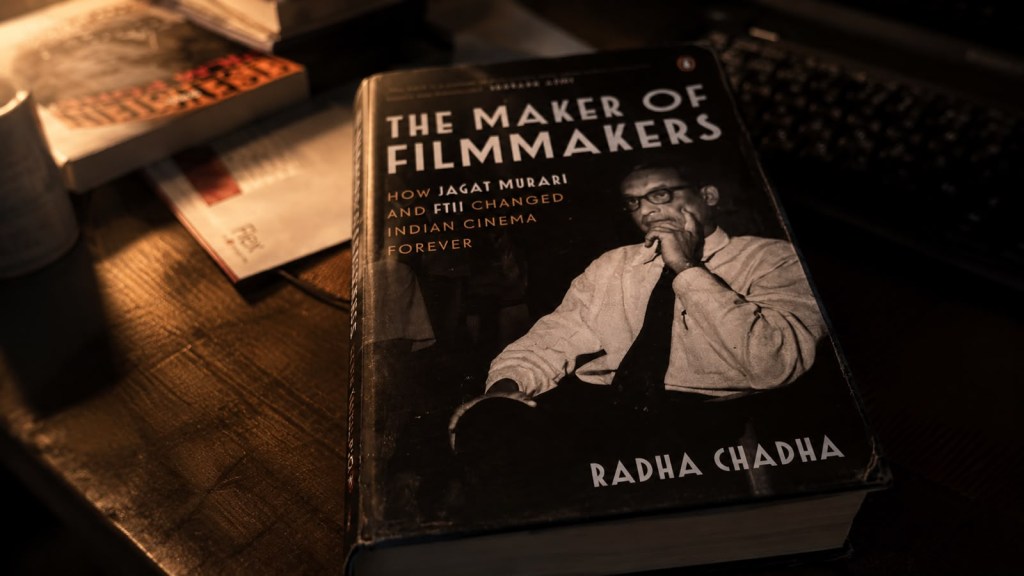
Ashish Kumar Reviews “The Maker of Filmmakers“
Author: Radha Chadha
No of Pages – 535
Price – ₹1,290
Publisher – Penguin Viking
Jagat Murari (5 October 1924 – 13 April 2007) was a distinguished Indian documentary filmmaker, known well for his contributions to Indian cinema as a producer, director, educator. Written by his daughter and enriched by the testimonies of eminent people who shared his professional and personal journey, the book is not merely a biography of an individual, it is an account of how one human being can become inseparable from the cultural institutions he helped create and nurture.
To read this book is to understand that India’s film heritage did not simply arrive with time. Institutions such as FTII, the National Film Archive of India and the Film Division were shaped through labour, conviction, persuasion and sacrifice. Jagat Murari emerges from these pages as a strong and principled man who worked with extraordinary dedication and loyalty towards cinema, society and the larger idea of India.
The strongest impression the book leaves is that Murari was never merely an administrator. He was a filmmaker who understood that cinema requires institutions if its memory, craft and future are to survive. He worked through different spaces of Indian cinema, whether in film education, film archives or film production, but his larger project was always greater than the designation he held.
One may be tempted to read his story as the story of FTII, or of the National Film Archive, or of the Film Division. That would, however, reduce the scale of his contribution. Murari was not working for one institution alone; he was working for the nation through cinema. His labour was a form of nation-building in which the camera, the archive, the classroom and the institution became different instruments of the same larger purpose.
What gives the narrative its moral force is the manner in which Murari continued to hold on to his principles despite repeated friction with political and administrative power. The book portrays a man who could negotiate when circumstances demanded negotiation, but who refused to surrender the principles that gave meaning to his work. His tenure was repeatedly marked by friction over resources and authority, yet the narrative presents him as someone who did not allow practical difficulties to become a surrender of principle.
There is something deeply philosophical in this resistance. Power is often temporary, while institutions, ideas and cultural memory can outlive generations. Murari appears to have understood this distinction. His adamancy was not simply stubbornness, it was fidelity to a principle. He was willing to struggle with authority, face limitations and accept practical defeats without allowing those defeats to become moral surrender.
In that sense, his life suggests an important distinction between ambition and responsibility. Ambition asks what one can gain from an institution; responsibility asks what one can leave behind for those who come after. Murari’s life, as represented in the book, belongs to the latter.
The story of the National Film Archive reveals perhaps the deepest dimension of his vision. A nation’s films are not merely objects of entertainment. They are fragments of collective memory. A lost reel is not simply a damaged piece of celluloid, it can be a lost fragment of a society’s imagination, language, history and identity.
Murari therefore emerges as an architect of memory. His work with international figures and institutions, including Georges Sadoul, Jerzy Toeplitz, Ernest Lindgren and Donald Richie, demonstrates that he understood preservation as a collaborative and intellectual enterprise. He brought knowledge from different cinematic cultures into conversation with India and built bridges where there had previously been gaps.
Archiving, in this sense, becomes a sociological act. What a society preserves reveals what it believes is worth remembering. To preserve cinema is therefore to preserve the possibility of remembering ourselves.
Another remarkable aspect of Murari’s contribution was his ability to recognise people. The book makes clear that he did not simply build structures; he built human possibilities. His choices regarding students and faculty were guided by conviction rather than administrative convenience. The presence of figures such as Ritwik Ghatak and Roshan Taneja within this history illustrates a willingness to bring difficult, authentic and uncompromising artistic voices into the educational environment.
This is perhaps why the metaphor of the house becomes so appropriate. A house is not built only with bricks. It is built with people, memory, argument, disagreement, learning and faith. Murari did not merely construct walls around cinema education; he helped create an intellectual and artistic home in which future generations could discover their own voices.
The book’s account of Basil Wright, Peter Hopkinson and John Grierson is particularly significant. Their engagement with Indian students represents more than a series of visits by celebrated documentary filmmakers. It represents the movement of ideas across borders. Grierson’s encounter with the students on 22 April 1971 becomes symbolic: the founder of the documentary tradition speaking directly to a generation that would reinterpret that tradition in Indian conditions.
Documentary cinema, in this understanding, is not merely a technical form. It is a way of looking at society. It asks the filmmaker to witness rather than merely decorate reality, to observe ordinary life rather than flatter power. Murari’s contribution was therefore not simply to bring international personalities to India. It was to create intellectual encounters from which Indian cinema could develop its own language.
The book becomes most compelling when the personal and professional dimensions of Murari’s life begin to merge. It is a journey through events, relationships, institutions, conflicts and decisions, but beneath these episodes runs a continuous philosophical question: what does it mean to dedicate one’s life to something larger than oneself?
Murari’s personal struggles cannot be separated from his institutional work. Every challenge becomes part of the larger story of how an individual attempts to protect an idea against circumstances. His journey is therefore not a straight road of success. It is a landscape of obstacles, negotiations, disagreements, disappointments and renewed commitment.
This is what makes the book human. Behind the institution stands a man; behind the man stands a conscience; and behind that conscience stands an idea of society and art.
One of the book’s greatest strengths is that it does not depend solely on the author’s personal memory. The author, being Jagat Murari’s daughter, naturally possesses an intimate relationship with her subject, but the narrative expands beyond that personal position through interviews and testimonies from prominent people who played significant roles in Murari’s professional life. The book therefore reads less like a single person’s recollection and more like a mosaic constructed from many voices.
Because multiple voices enter the narrative, the reader is not asked simply to accept the daughter’s memory; the life is reconstructed through the recollections of colleagues, students, filmmakers, administrators and other eminent personalities. This multiplicity gives the book its credibility and allows Murari to emerge not merely as a remembered father but as a public figure whose influence was experienced by many.
There is an important irony at the centre of Murari’s life. The more deeply he entered institutional work, the more one might forget that he remained a filmmaker at heart. Yet this identity is precisely what seems to have given his administrative and archival work its soul. The book itself makes this larger point: Murari’s work should not be confined to the institutions he served, because his deeper contribution was to Indian cinema as a whole.
To ask where Indian cinema stands today is, in some measure, to ask what Jagat Murari built. Wherever a student learns from a teacher shaped by the institutions he nurtured; wherever a researcher encounters a preserved film that might otherwise have vanished; wherever documentary cinema retains an instinct for truth rather than spectacle, the consequences of his labour remain present.
His influence is therefore like the foundation of a house. It is rarely visible once the building is complete, but every room depends upon it. The absence of visible credit does not mean the absence of influence.
This may be the most profound idea that the book leaves behind: institutions are often remembered through their names, buildings and official histories, while the people who gave them their first breath gradually disappear from public memory. This book reverses that disappearance. It gives a face to the foundation.
Jagat Murari’s story is ultimately a story about service. It is about what happens when art is not treated merely as a profession but as a social responsibility. He worked with dedication and loyalty, faced opposition, negotiated with power, protected his principles and continued to build even when circumstances were difficult.
The book does not present nation-building as a grand political slogan. It presents it as a daily act: choosing people carefully, preserving a reel, creating an institution, inviting a teacher, standing against pressure, giving students an opportunity, and knowing when to step aside for the institution’s greater good. His decision to resign as curator when he believed the Archive required a full-time successor is presented as an example of putting the institution above personal attachment or position.
In the end, what remains is not merely a catalogue of achievements. It is the image of a man carrying a house on his shoulders while knowing that the house did not belong to him. He was its builder, not its owner.
That may be Jagat Murari’s greatest legacy. He understood that the true measure of a life is not how long one’s name remains on a door, but how long the work continues after one has walked away from it. He nurtured FTII and the wider landscape of Indian film culture with his own hands, witnessed its struggles and transformations, and left behind something larger than personal recognition: an institutional memory, an artistic inheritance and a cultural foundation upon which generations could continue to build.
To serve art faithfully, the book ultimately suggests, is also to serve society. And to serve society through art is to participate in the making of a nation’s memory.
Price – ₹1,290
Publisher – Penguin Viking
The Many Forms of Violence: Bodies, Memory and Silence in Sri Lankan Cinema : Shashin Prabodh
“It’s all happened before and will happen again
And we the onlookers
But now I’m in it
It’s happened to me”
These lines come from Jean Arasanayagam’s poem “1958…’71…’77…’81…’83”. Even the title looks more like a list of dates than the title of a poem. But those dates carry the weight of lives. They recall periods of political and ethnic violence that marked post-independence Sri Lanka. Arasanayagam begins from a distance, remembering a time when violence was something she could watch. Gradually, that distance disappears. The violence enters her own life, and history becomes something very different when you are no longer simply watching it happen.
I keep returning to that movement from watching to experiencing when thinking about Sri Lankan cinema. How does a country represent violence when it has lasted for so long that it becomes part of the landscape? What happens when the gun is no longer visible but the fear remains? Can violence be found in a woman’s body, in a marriage, in a military uniform, in a ruined village, or in a memory that one person wants to forget while another cannot?
Sri Lankan cinema has often asked these questions without always showing violence directly. In some films, the battlefield is barely seen. In others, the war has already ended. Sometimes the violence is directed at a body. Sometimes it remains inside a memory. Sometimes it appears in the silence between two people who cannot tell each other what they have lived through.
Perhaps this is why some of the most unsettling Sri Lankan films about violence are not films filled with battles. They are films about what remains.
Vimukthi Jayasundara’s The Forsaken Land is a good place to begin because its war is felt more often than it is seen. Set during a ceasefire, the film follows people living in a remote landscape where peace never quite feels like peace. Jayasundara described the setting as one where there was no actual fighting, yet people felt closer to war than peace. The presence of the military hangs over the landscape, while ordinary life seems restricted by a tension that refuses to disappear.
One of the film’s most disturbing moments involves a man being taken away and beaten to death. What makes the scene frightening is not only the violence itself. It is the way the ordinary world continues around it. The road is quiet, the fields are beautiful, and people go about their lives. Yet the presence of the war is never far away.
The Forsaken Land can be read as a criticism of military power and the atmosphere created by the war. It does not reduce the conflict to a simple story of one side and another. It also connects the larger violence of the conflict with the control of gender and sexuality in everyday life. Violence is not kept outside the home. It can enter the most ordinary parts of life.
Asoka Handagama’s This Is My Moon moves the war into a much more intimate space. A Tamil woman falls into an army bunker during fighting and is raped by a Sinhala soldier. After he deserts, he returns to his village, and she follows him there. Their relationship becomes impossible to separate from the conflict surrounding them.
The film does not present ethnicity as an abstract political issue. It places it inside a relationship, inside a village, and inside the private lives of two people.
The soldier may leave the battlefield, but the war follows him.
The Tamil woman cannot simply become another person in the village. Her identity has already been marked by the conflict. The soldier’s uniform may disappear, but what he has done and the position he occupied in the war do not disappear with it. Their relationship therefore becomes a place where several kinds of violence meet: military violence, ethnic suspicion, sexual violence, nationalism and the pressure of the community.
The most disturbing part is the difficulty of separating intimacy from power.
Prasanna Jayakody’s 28 takes us somewhere different. There is no need for a war zone. The film follows three men transporting the body of a woman who has been raped and killed. One of them discovers that the dead woman is his estranged wife. The journey gradually brings questions of sexuality, masculinity, shame and violence to the surface. The woman is dead, but the men continue to speak about her. Even in death, other people try to decide what her body means. Yet the film also gives Suddhi a voice through memories and narration, so the story does not belong entirely to the men who are carrying her body.
This makes 28 important to a discussion of violence because it shifts the question away from ethnic conflict and towards gender. The violence does not need to come from a soldier. It can exist in the way a woman’s sexuality is discussed. It can exist in the way her death is explained. It can exist in the distance between what happened to her and what the people around her are willing to acknowledge.
The dead body becomes evidence, but it also becomes something other people want to control and explain.
If 28 asks what happens to a woman’s body after violence has happened, Asandhimitta asks what happens when society has already decided what a woman’s body should mean.
Asandhimitta is difficult to contain within a single interpretation. The film moves between reality and imagination, making the viewer question not only what happened but also whose version of a woman we are being asked to believe. Its female body becomes a site where desire, judgement and social control meet. This connection between 28 and Asandhimitta both films through the female body as a site of gendered violence, surveillance and containment.
Her body becomes something that people around her feel entitled to look at, desire, judge and explain. The violence here is not necessarily one physical act. It can also be found in the pressure placed on a woman to exist according to other people’s ideas of femininity, sexuality and respectability.
A military checkpoint and a patriarchal gaze are not the same thing. A Tamil civilian’s experience of war cannot simply be equated with a Sinhala woman’s experience of gender discrimination. These histories have different causes and different consequences. But cinema can place such experiences beside one another without saying that they are identical. It can show how power enters the body and changes the way people live.
Violence, however, does not always end with the body. Sometimes it stays with a person as memory.
Prasanna Vithanage’s With You, Without You begins in the post-war period. Its central relationship is between Sarathsiri, a Sinhala pawnbroker and former soldier, and Selvi, a Tamil woman whose past has been deeply affected by the conflict. The film is adapted from Dostoevsky’s “A Gentle Creature”, but Vithanage places the story within the emotional landscape of post-war Sri Lanka. The war is over. But for Selvi, it has not simply disappeared.
Her husband can sit beside her in a quiet house. Life around them can appear ordinary. Yet the past remains present.
One of the film’s most striking images is a window. Sarathsiri and Selvi look through the same opening, but they do not see the same world. For him, the landscape can suggest property and possibility. For her, the horizon carries the weight of what she has lost. The same window contains two memories. This reading of the window has also been noted in criticism of the film, which contrasts Sarathsiri’s material view of the landscape with Selvi’s traumatised gaze towards the horizon.
This is where post-war violence becomes difficult to represent. There is no explosion to film. No battlefield. No burning village. There is simply a woman who cannot forget and a man who has to live with his past.
Their marriage brings the war into their private lives. What happened before they met does not disappear because the fighting has ended. It remains in their silence, their relationship, and in the difficult question of whether two people from opposite sides of a violent history can build a life together.
This movement from visible violence to something harder to see can also be found in Prasanna Vithanage’s Death on a Full Moon Day. The film centres on a blind father who refuses to accept the official account of his soldier son’s death. His son returns in a sealed coffin, but the coffin does not give the father the certainty he needs.The coffin should settle the question. Instead, it creates another one.
What happened to the son? Is the body really his? Can a family accept a death when it has not been allowed to know the truth for itself?
Disappearance and uncertainty do not only mean losing someone. They can leave those who remain without an answer and without a clear way to mourn.
This may be one reason silence appears so often in these films. Sometimes it comes from fear or grief. Sometimes it comes from shame. At other times, it comes from the difficulty of speaking across communities divided by a violent past. Silence can also be a way of refusing to make that past simpler than it really was.
Jayasundara’s cinema often works through this silence. In The Forsaken Land, violence is communicated through what people do not say and through the atmosphere surrounding them. In With You, Without You, the silence between Sarathsiri and Selvi carries histories that ordinary conversation cannot easily resolve.
The Forsaken Land also became a site of controversy because of its representation of the security forces and its sexual imagery. Military officers and nationalist voices concerning its portrayal of the security forces.
The screen becomes another place where different memories meet.
This brings us back to Arasanayagam.
In “1958…’71…’77…’81…’83”, the speaker initially watches violence from a distance. Then that distance collapses. “But now I’m in it.” History becomes personal.
Something similar happens across these films. Violence can initially seem distant, something that belongs to another community, to soldiers, to the battlefield, or simply to the past. But as the stories unfold, that distance begins to disappear.
In This Is My Moon, it reaches into a village and a relationship. In 28, it becomes tied to the female body. Asandhimitta brings it into questions of sexuality, identity and social judgement, while With You, Without You shows how the past can enter a marriage. In Death on a Full Moon Day, it is felt by a family that cannot be certain about the fate of their son.
These films do not tell us that all these forms of violence are the same. They are not. Ethnic violence, state violence, sexual violence and patriarchal control have different histories and affect people differently.
What connects these films is the way violence can continue after the moment itself has passed. A war may end, but its consequences do not necessarily disappear. A killing can be over while the grief remains. A disappearance can leave people with questions for years. The effects of an assault can remain long after the event itself.
This is why some of the most powerful images in these films are not images of violence at all. They are ordinary things: a road, a house, a window, a body, a landscape, or two people sitting together.
Sri Lankan cinema does not always need to show an explosion. Sometimes it is enough to show the person left behind, an empty road, or two people looking through the same window while carrying completely different memories of the past.
And sometimes the screen simply becomes quiet.That silence can say more than what the characters are able to say aloud.
Jean Arasanayagam’s poem begins with years that have become landmarks of violence. But the poem does not allow those years to remain only historical markers. They become memories and eventually personal experience. The distance between watching and experiencing disappears.
Sri Lankan cinema does something similar. It takes violence out of the history books and places it in a landscape, a marriage, a woman’s body, a family, or a memory.
The war may have an ending, but violence does not always end with it.
Perhaps that is what these films ask us to do– to keep looking at what remains.



Leave a Reply