
Review of The Dead Fish ( Rajkamal Choudhury, translated by Mahua Sen)
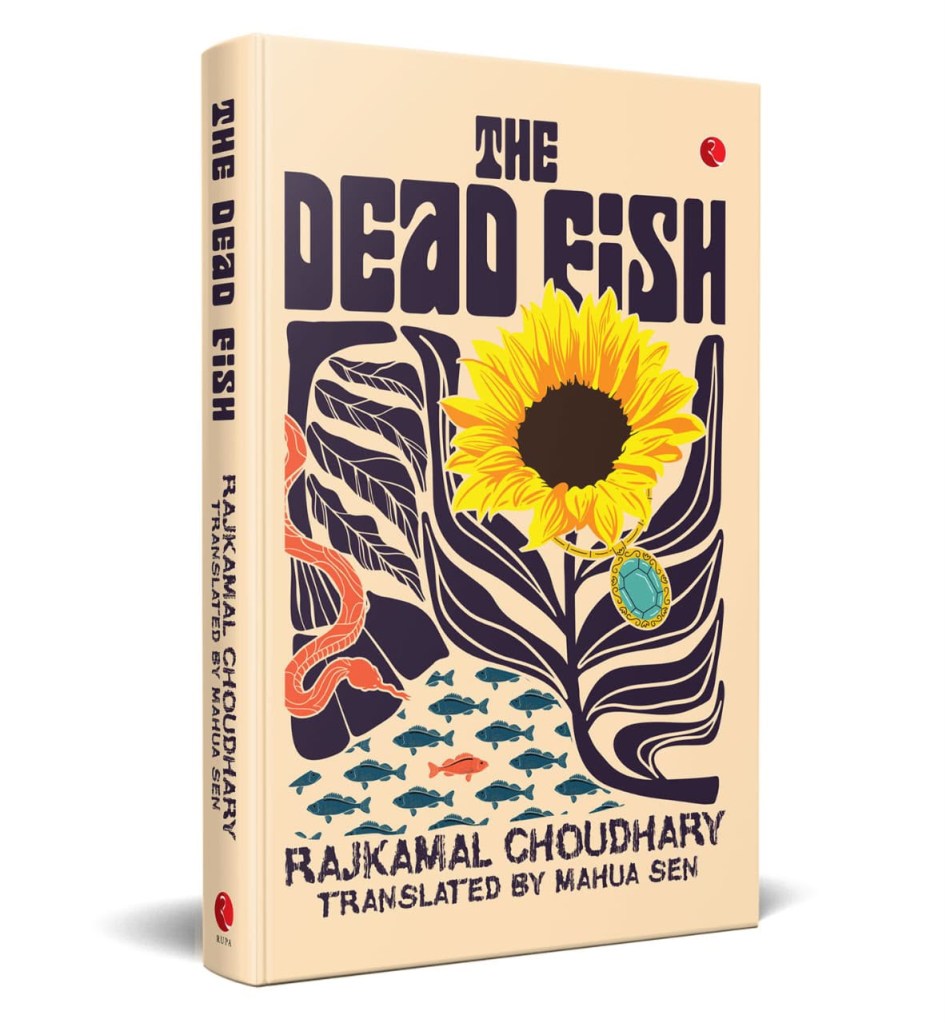
The Dead Fish
Author – Rajkamal Chaudhary
Translator- Mahua Sen
Year -2025
Publisher- Rupa Publications
The word “translation” has its etymological roots in the Latin translatio, which means to carry over. This act of carrying over carries within itself a journey, a “route,” from one language or linguistic system to another. If we probe further, the idea of this journey brings with it the idea of a change, a metamorphosis—sometimes a growth and at other times a stunting. These associated conundrums are a translator’s greatest challenges, to make the journey from one language to another, all the while having to be very careful so as not to alter the original text and preserve its nuances, mood, spirit and essence. What makes it even more problematic is the fact that the act of translation is never simply a linguistic exercise but the aim is to perfectly straddle the two cultures—that of the source text and the other of the target language.
Mahua Sen translating Rajkamal Choudhary’s The Dead Fish from the original Machchali Maru Hui faces another uphill task. What makes her task an uphill one is that the text does not always follow a linear chronology, moving to and fro across time and space. Added to this is the almost hysterical pace at which the prose progresses despite the text not being a thriller or a crime fiction. To keep up with that furious pace, the expansive setting of the story across continents and a surgeon’s eye in dissecting the social and moral fabric of the 1960’s Calcutta and the first wave of the immigrant movement in America—one must commend the translator for retaining the flavour and intention of the Hindi original. The Hindi original treats the city as a palimpsest, rich in history, of settlers and of those who quintessentially epitomise the rags to riches story. Sen’s translation is lucid, and the text offers us the chance to peel layer after layer to go to the kernel of the world of the central characters.
Choudhury however offers us a doorway into entering the novel and its world. He issues a kind of disclaimer in the Author’s Notes that “This novel is not about anything—it just hints at something.” (The Dead Fish, xix). We understand where Choudhary is coming from. Even though “cancel culture” had not entered the lexicon of critical exercise and enterprise in the 1960’s in a country that was merely two decades old, there was obviously the very distinct possibility of being castigated and ostracised for the different themes he was dealing with in this novel. The Dead Fish is about sexual politics and the desire for sexual liberation, an examination of man’s ambition and the unscrupulous measures one is willing to adopt to move forward in the quest to have sway over the world of business and the power that comes with it. It also provides a penetrating insight into the alienation and loneliness that engulfs man in the pursuit for a life one has dreamt of and more so when all that s/he has dreamt of has been achieved.
Choudhary is clever in the sense that his prose takes the readers in a kind of a cat and mouse game. The figure around which the entire narrative is constructed is Kalyani Mansion, “the towering thirty-storied building…No one could have imagined such a tall and wide skyscraper in our country.” (Chaudhury, 4) and its human embodiment Nirmal Padmavat, the owner who resides on the topmost floor, having an unrestricted view of the city, like a falcon or Zeus, depending upon how one looks at this enigmatic character. Very early, he is branded as one who “practices occult” (Chaudhury,4), possessing “knowledge of witchcraft” (Chaudhury,4) and the more damning, “Nirmal Babu is a criminal” (Chaudhury,4). All this in a space of two and a half lines. But as the narrative progresses, we see that he is just a man, carrying a terrible heartbreak, a kind of Byronic hero in the mould of Heathcliff. He is not the only one who has this sense of mystique around him. Kalyani, who plays a major role in Nirmal becoming what he does, “had a knack for spinning captivating stories about death, love and gods and goddesses.” She is the woman on the other side of the mirror, whose life is proverbially stranger than fiction—one who in her lifetime and even after her death, can be looked upon as a study of loneliness and alienation, especially as an immigrant in a foreign land.
Mahua Sen’s translation captures well the breakneck speed at which the narrative progresses. It is one thing to say what the original author is saying and quite another to do it in the manner and tonality with which s/he has done it. Sen not only through her crisp and lucid prose brings alive the characters but also does the same with the portrait of the city of Calcutta, which can be looked upon as a character itself. What strikes us is the timeless nature of the city—it seems to be locked in a time warp and the description of the city of the 1960’s can well be used to delineate the pulse in 2025-26. The narrative sweep too, of the temporal and the spatial, poses a different and significant challenge to the translator. It is a detailed and nuanced exploration of a nation coming into consciousness, where the already privileged are trying to milk greater economic and cultural capital for themselves and some trying to buy into and surrogate the American Dream.
The fact that a literary translation opens up a text to a wider audience is understood and accepted. As a reader, one can question as to why a text written in the 1960’s needs a wider readership almost half a century later, or even more pressing would be the issue of relevance of the text beyond its immediate socio-cultural and historical setting. The answer to that would be that the novel presents us portraits of female exploitation and gender roles which are perhaps more pertinent now than ever. Kalyani, who is omnipresent in the text and in the lives of the central characters, in life and even after her death, is vulnerable and gypsy like, and forced to fall back on her sexuality to survive in a foreign land. Later after her death, she seems to carry the legacy of sexual promiscuity and is a prime example of how a women’s reputation is shaped, created and navigated in a man’s world. Her daughter, Priya comes to terms with her own sexuality and sexual identity much later, but strangely when sexually assaulted, the act of violence is deemed to be a necessity to “make her a normal straight woman again.” (Chaudhury, 156). One must read this in the context of the social fabric of the 1960’s but also realise that such prejudice and ignorance about gender roles and sexuality are prevalent to this day. Add to this is the very problematic representation of female characters, sometimes as objects of desire, sometimes denying them agency and identity. Take for instance, Nirmal meeting Shirin in his mansion and Chaudhury writes, “After all, Shirin was his wife and he had a right to play with her body. He has all kinds of rights—religious rights, social rights, ethical rights. Shirin cannot refuse his advances even if she wants to.” In a society where marital rape is not criminalised because of the fear of that the institution of marriage will crumble, it is only natural that a novel written fifty years ago mirroring the same concerns should be read, discussed and disseminated, even if only to show that more things change, the more they remain the same.
The challenges while rowing through this text are many, both as a reader and as a translator. Mahua Sen’s success is in the deft handling of the temporal and spatial shifts in the narrative, the linguistic pyro technique that Chaudhury’s original Hindi text employs and almost a postmodern chuckle and play with the readerly expectation and sensibility. Sen doesn’t try to match up to the stylistics of the Hindi original, and at the same time resists from being overshadowed and overwhelmed by the canopy of the literary brilliance. That, along with the act of choosing this book in the first place, is where Sen’s credit would most lie.
Review by Sayan Aich Bhowmik

Mahua Sen is a poet, editor, translator, and a management frofessional based in Hyderabad.

Sayan Aich Bhowmik is currently Assistant Professor in the Department of English, Shirakole College, West Bengal, India.


Leave a Reply