The Forgotten History: The Nama-Herero Genocide in German Namibia (1904-08)
Vincenzo Cohen
The origins of the Jewish genocide are found in Africa and date back to the era of colonial imperialism. Too often we dwell on topics on which widespread journalistic and media coverage has been provided, but very little has been written about dark pages of history that are fundamental to our general knowledge and to the development of our critical sense. The extermination of the Herero and Nama populations in German South-Western Africa took place between 1904 and 1908 during the development of Germany’s plan of colonial rule over present-day Namibia (1884-1915). I would like to argue that this is the first genocide of the Twentieth century, characterized for the first time by the use of concentration and extermination camps. This bloody event marked one of the most painful pages in history of the West by drawing a new topographical configuration of the current ethnic groups of South-West Africa.
Racial colonialism began in early twentieth-century in Europe, when the main European powers began to divide the various territories of the African continent. During the Berlin Conference in 1884, the African territories of Togo, Cameroon, German East Africa and German South West Africa had been granted to Germany. The latter region was rich in mineral deposits of tungsten and uranium, gold, copper, tin and diamonds. The two original tribes of those territories were the Nama and the Herero. The two populations originally occupied different territories within the present-day Namibian state. The Herero were settled in central Namibia, between the city of Okahandja and the Waterberg Plateau, while the Nama occupied the south-western area from Rehoboth to the Kalahari Desert.
Arriving in Namibia, the German colonizers began usurping the Nama and Herero territories by expropriating their lands and resources. This attitude found a supposed justification in
geographer Friederich Ratzel’s theory of “Lebensraum” and in racist theories of the end of the century. Clashes and riots soon erupted into repression by German troops. The lands of the
Herero were occupied by German colonizers to develop intensive livestock farming. Initially, the area of Herero revolt was limited to the Okahandja region but soon land expropriations and abuses dragged the entire population into a full-blown war.
Command had initially been entrusted to General Leutwein who attempted to avoid war by engaging in diplomatic and negotiating tactics. However, the situation worsened when Kaiser Wilhelm II ordered the army to go and repress the local tribes by placing a bloodthirsty and violent military leader, General Lothar von Trotha, in command of the troops. He immediately met with Governor Leutwein and formally took over command. General von Trotha, for the first time in history, used the terrible verb “vernichtungs-politik” (politics of annihilation). Before long, the initial riots turned into a race war. The goal of the German authorities was not the simple repression of the revolt but the extermination of the Herero nation, which occurred through military operations and then deportation and abandonment in the Omaheke Desert. The vast mass of deportees died of thirst unable to turn back because along the 250 km border with the desert, the German army had orders to fire on sight. In the late summer of 1904, von Trotha’s army stationed itself on the Waterberg plateau. The offensive was to be completed during the same year with the extermination of Herero people. Von Trotha’s strategy consisted of pushing the local populations towards the Kalahari Desert where the Herero would have no chance of survival, condemned to die of hunger and thirst. The German intention to launch an ethnic cleansing plan based on coercive annihilation by the military authority was foreshadowed. In this event it’s possible to glimpse the seeds of thought that subsequently led to the Jewish Shoah. In fact, during this period, several people were moved to Germany to conduct eugenics experiments on them to demonstrate the supposed superiority of the white race. The context in which the original peoples of west-south Africa came to be is very similar to the current geo-political situation of Gaza, where today the Israeli government is carrying out an operation of generalized extermination of the Palestinian population by leading to the total destruction of a
civilization. This teaches us that history has a cyclical trend and that the tendencies of totalitarianism accompanied by a repressive policy devoted to the law of the strongest tend to
return sometimes in even more violent forms.
During this period, the first concentration camps were set up in Windhoek and Swakopmund (the main port of the colony) where the deportees Herero and Nama were subjected to forced labour, ill-treated and starved to death. Among the latter, many women and children were used to unload ships docked in port. Living conditions were so miserable that many died of starvation. The same fate befell the Nama people, whose population was demographically smaller than that of the Herero.
Another concentration camp had been built on Shark Island, in an isolated and inaccessible place. Thousands of people belonging to the Nama tribe were deported and killed here. Prisoners were collected from far away places and shipped by rail in wagons to remote destinations, where they were systematically exterminated. It was probably here that the idea of mass extermination was first conceived, which would later be followed by the Nazi genocide perpetrated against the Jews in the first half of the twentieth century. In the Shark Island concentration camp, the Germans began starting in 1908, the first experiments in what would later be known as “NAZI EUGENICS”. The author of these crimes against humanity was the German Physician and anthropologist Eugen Fischer who performed experiments on children and adults. Adult experiments included sterilization and inoculation of smallpox, typhoid and tuberculosis germs.
Around 2000 Herero died in Swakopmund between 1905 and 1909. The names of the dead were recorded in special registers, along with identification data and the cause of death, which was almost always due to exhaustion. Slaves were also used for the construction of public works such as the railway connecting the
port city of Luderitz to the rest of Namibia. In 1908, the Shark Island concentration camp was finally closed. 65,000 Herero, about three-quarters of the population, had died in Namibia. About half of the Nama people were exterminated. Hundreds of villages remained empty and South West Africa was finally completely subjugated to Germany.
After the end of the war, the defeat of the Herero and Nama was considered by the colonial government and settlers as a victory for civilization over barbarism. Survivors of the genocide
were banned from owning land and livestock, and all forms of political representation were barred. For this reason, the public memory of the tragic events of 1904-1908 remained that of the sacrifices and victories of the Schutztruppe (the German colonial army) while the traumatic memory of the genocide remained the oral heritage of the Herero and Nama communities. The occupation of Deutsch-Südwestafrika by South African and British troops in July 1915 marked the beginning of a change. The British were given the task of collecting testimonies on the ways in which the colony had been managed by the Germans. Survivors of the genocide offered detailed testimony, and the collected material was published in a book published in London in 1918, known as the Blue Book. In this document, the memory of the genocide is made a historical document and used in support of South African and British demands to testify the history of European colonialism in Africa and the misconduct of Germans. In 1926, however, all copies of the Blue Book were destroyed due to the request of the German government and due to the negative image the book provided regarding German colonization.
During the years of South African occupation (1915-90) two independence movements were formed. The South West African National Union (SWANU), founded in 1959, began as a majority Herero party and the South West African People’s Organization (SWAPO) was founded in 1960 as a party representing the majority of the northern Ovambo population. For these organizations, the Herero and Nama genocide became one of the pillars of anti-colonial propaganda. German colonialism and the South African occupation were seen from the perspective of a temporal continuum of oppression and illegitimate government: thus the foundations were laid for the birth of the resistance that demanded the nation’s independence. The memory of genocide therefore became a powerful tool in the anti-colonial struggle in the 1970s.
After a slow and gradual process of social emancipation and struggles between political factions On March 21, 1990, the flag of independent Namibia was finally raised, marking the end of colonial subjugation and the beginning of independence. However the Nama-Herero genocide has been considered the first genocide of the twentieth century which remained on the margins of historical memory for a long time.
Numerous monuments were created following the war of liberation. They are expressions and repositories of the historical memory of various political and social groups, often in opposition to each other. Numerous controversies and debates have in fact arisen around the erection of symbolic monuments representative of German colonial memory. The Reiterdenkmal, the equestrian statue that stood in Windhoek, is the most emblematic example of how the remembrance of the German presence continued to remain imprinted in the Namibian memoryscape after independence. The statue represents a German soldier on horseback and was erected in 1912, to celebrate the German victory against the Herero and Nama, on the very site that had hosted the Windhoek concentration camp. During the period of South African occupation, the statue remained in place, a testament to the German victory, in line with the policy of peaceful coexistence among white settlers. In 2009, a full nineteen years after independence, following numerous requests from the Namibian people, the statue was effectively removed to make way for the new Independence Memorial Museum and temporarily placed in the courtyard of the Alte Feste, the old German fort that now houses a museum. Today, on the site where it was originally built, stands a statue of SWAPO leader and the nation’s first president, Sam Nujoma, clutching a copy of Namibia’s constitution.
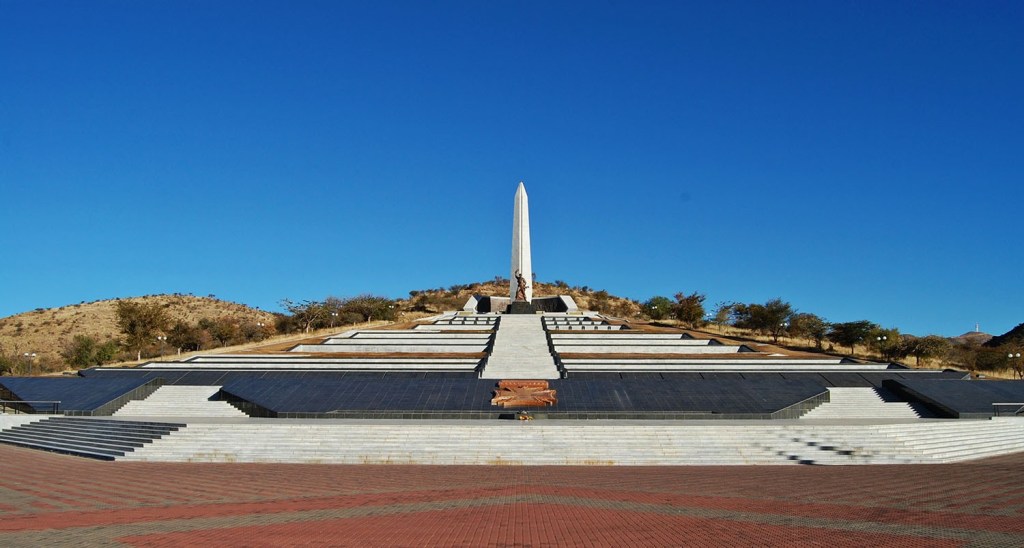
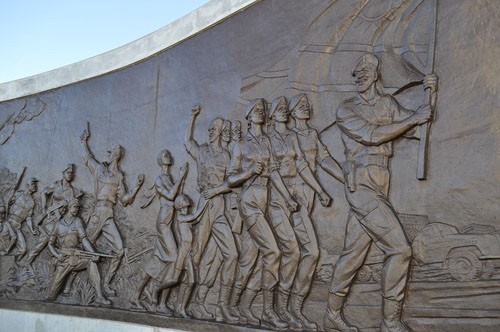
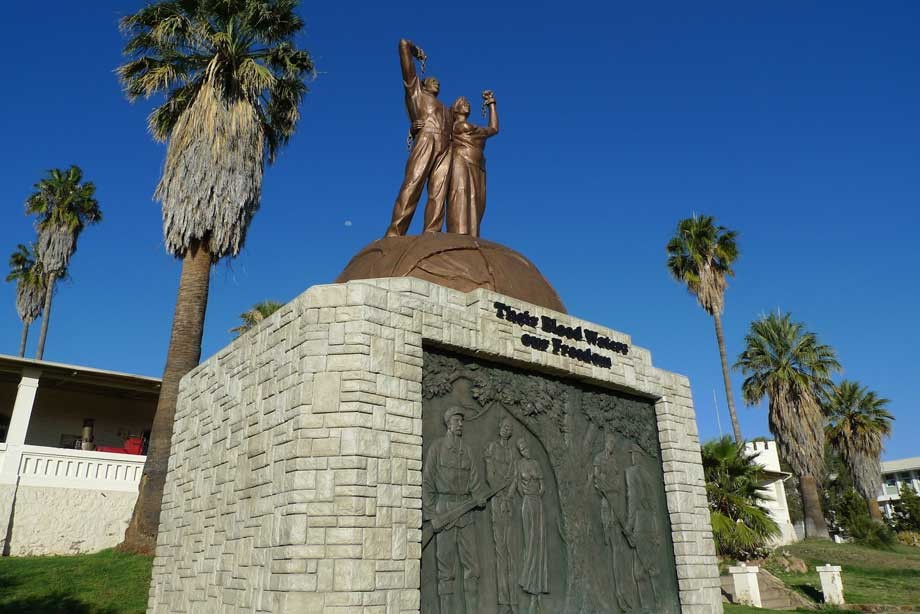
The most significant monument is the Independence Memorial Museum, inaugurated on March 21, 2014, to mark the anniversary of independence, along with the Statue of the Father of the Fatherland, Sam Nujoma, and the Genocide Memorial Statue. The latter is a monument in memory of the victims of the genocide, depicting a man and a woman raising their arms to the sky with broken chains on their wrists, and the inscription «Their blood waters our freedom», testifying, once again, that the national liberation struggle began with the Herero and Nama revolt.
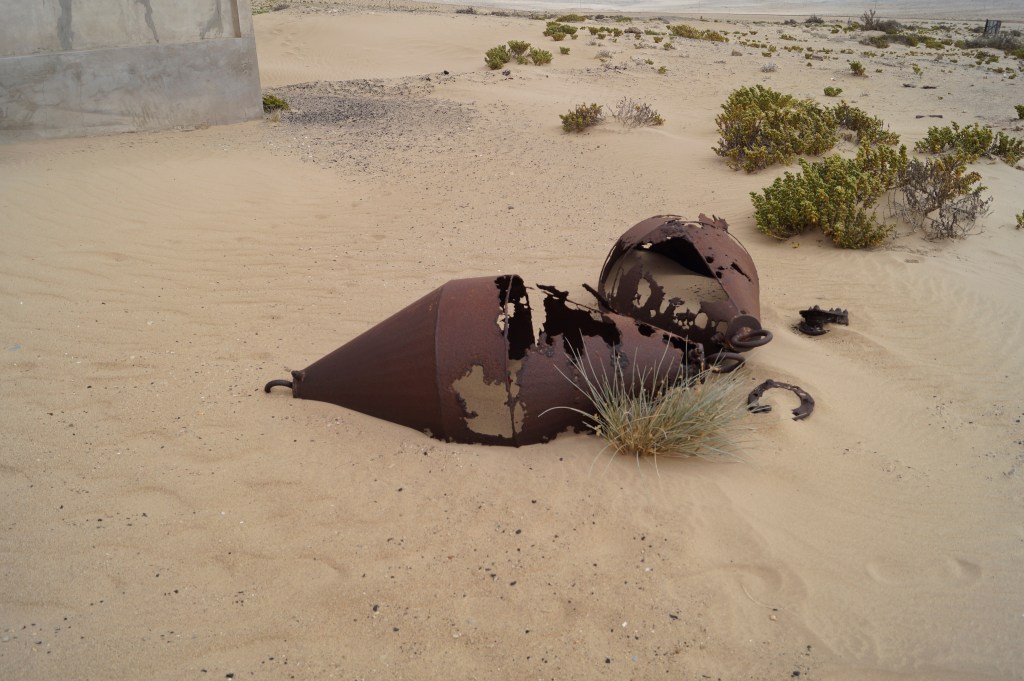
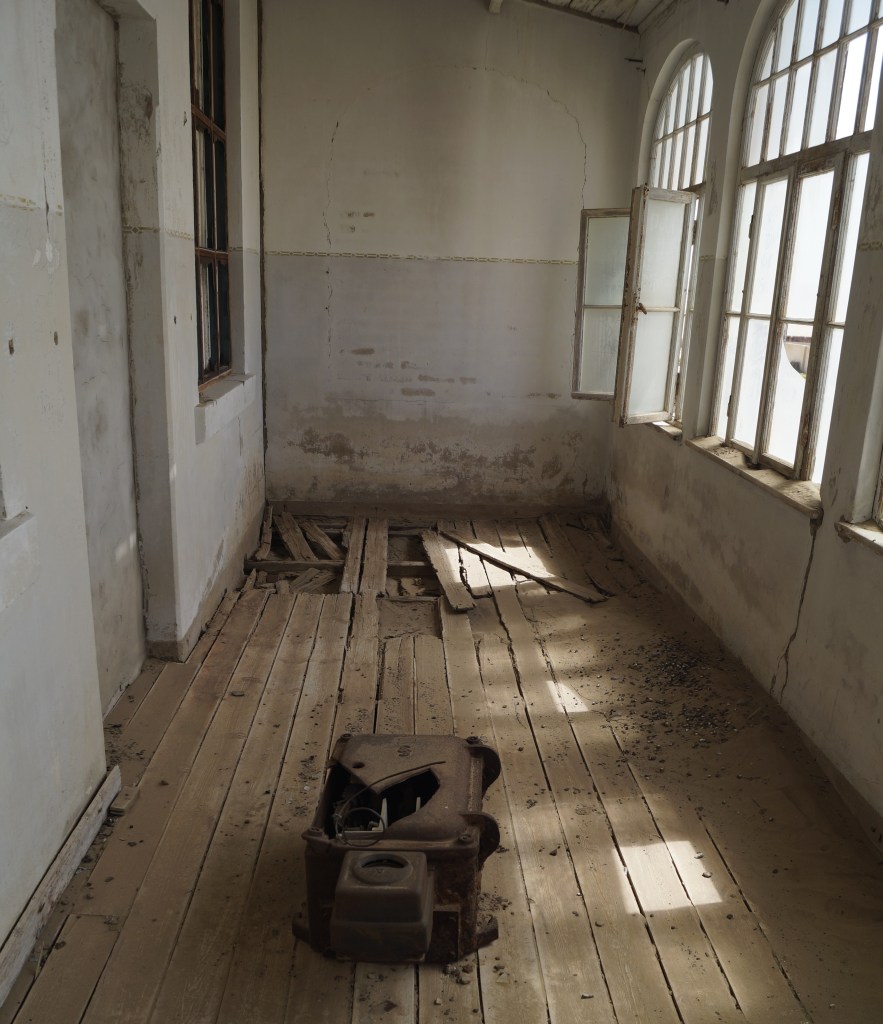
The above two images show war devices and metal scrap used by the Germans during the war against South Africans left abandoned in the ghost village of Kolmanskop, southern Namibia. The sumptuousness of Kolmanskop’s houses testifies to the ancient glory of this village, once a rich city with all the comforts used by the Germans as a base for diamond mining. The city was built in 1908 and abandoned due to drought and high costs of water supplies felling into disuse after the 1950s when diamond resources began to run out and colonizers emigrated to areas of better extraction.
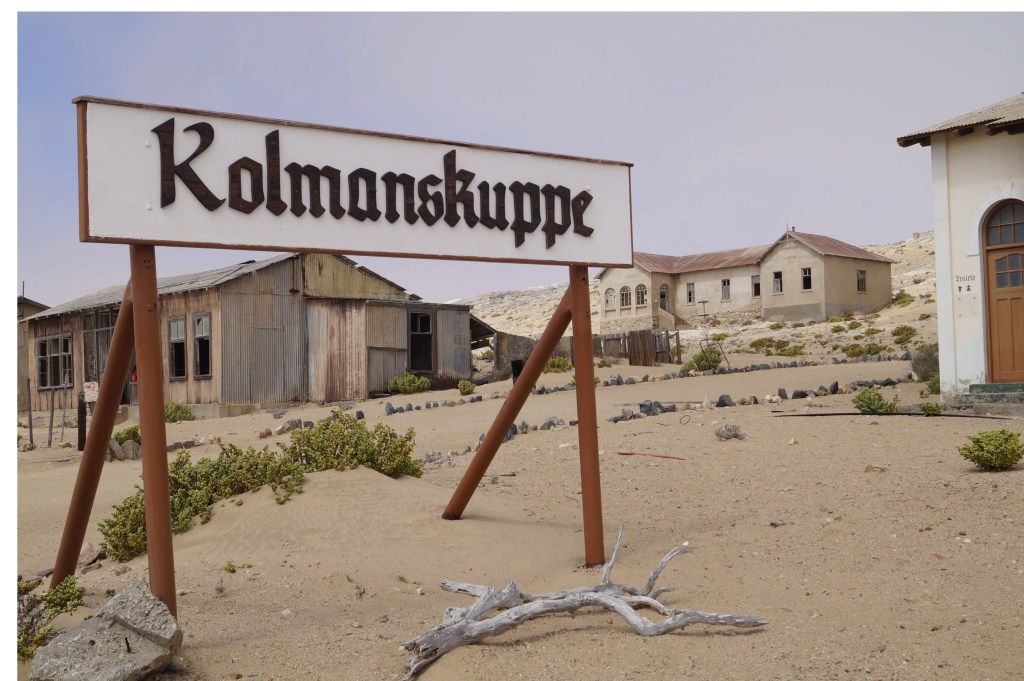
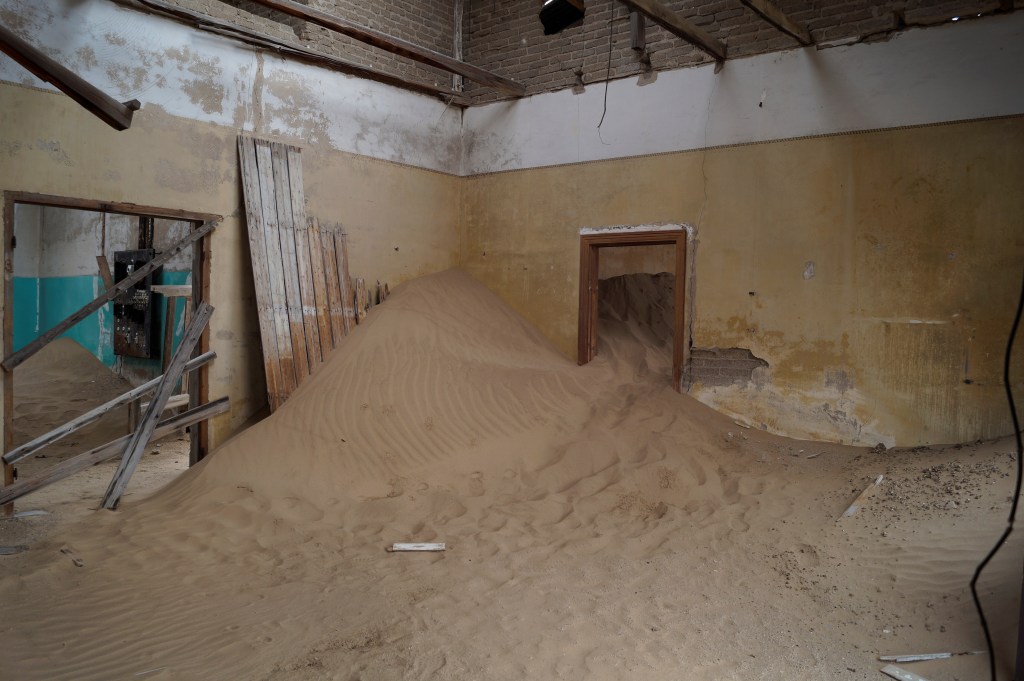
The ghost town of Kolmanskop. Today, abandoned houses have been swallowed up by sand that has invaded the rooms, creating a surreal atmosphere.
(Photographs credits from the author).
Bibliography:
Zimmerer J. 2008, Colonial Genocide: the Herero and Nama War (1904-1908) in German South-West Africa and its Significance, Stone D. (ed.) 2008, The Historiography of Genocide, Basingstoke: Palgrave Macmillan: 323-343
Kössler R. 2007, Facing a Fragmented Past: Memory, Culture and Politics in Namibia, «Journal of Southern African Studies», 33 (2): 361-382.
Silvester J., Gewald J.B. 2003, Words cannot be found. German Colonial Rule in Namibia. An Annotated Reprint of the 1918 Blue Book, Leiden-Boston: BrillGewald J.B. 2003, Herero Genocide in the Twentieth Century: Politics and Memory, Abbink J., De Brujin M., Van Walraven K. (eds.) 2003, Rethinking Resistance. Revolt and Violence in African History, Leiden-Boston: Brill, 279-304
Vincenzo Cohen is an Italian multidisciplinary social artist and content writer. He earned the MFA from Fine Arts Academy and the MD in Archaeology from “La Sapienza” University in Rome. His production ranges from visual arts to writing exploring cultural and historical content as well as issues related to social and environmental justice. An interest in history pushes him to investigate human origins through historical narratives, earthly poems and representation of archetypes and myths. Main themes addressed within his production are inclusion, human rights, social resilience, fight against the hate speech and prevarication of power, representation of unconscious content behind the human expression. His desert photography reports are focused on fragile ecosystems, climate resilience and animal survival. Over the years the artist has published art and history books and his works have been featured in international literary and art magazines.


Leave a comment