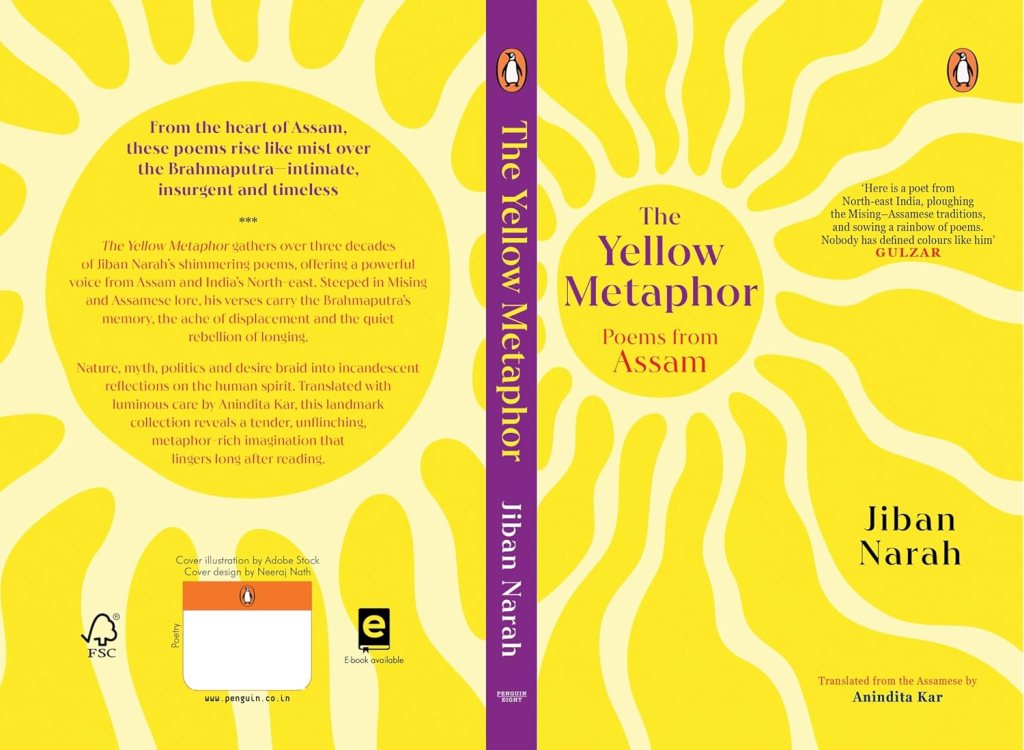
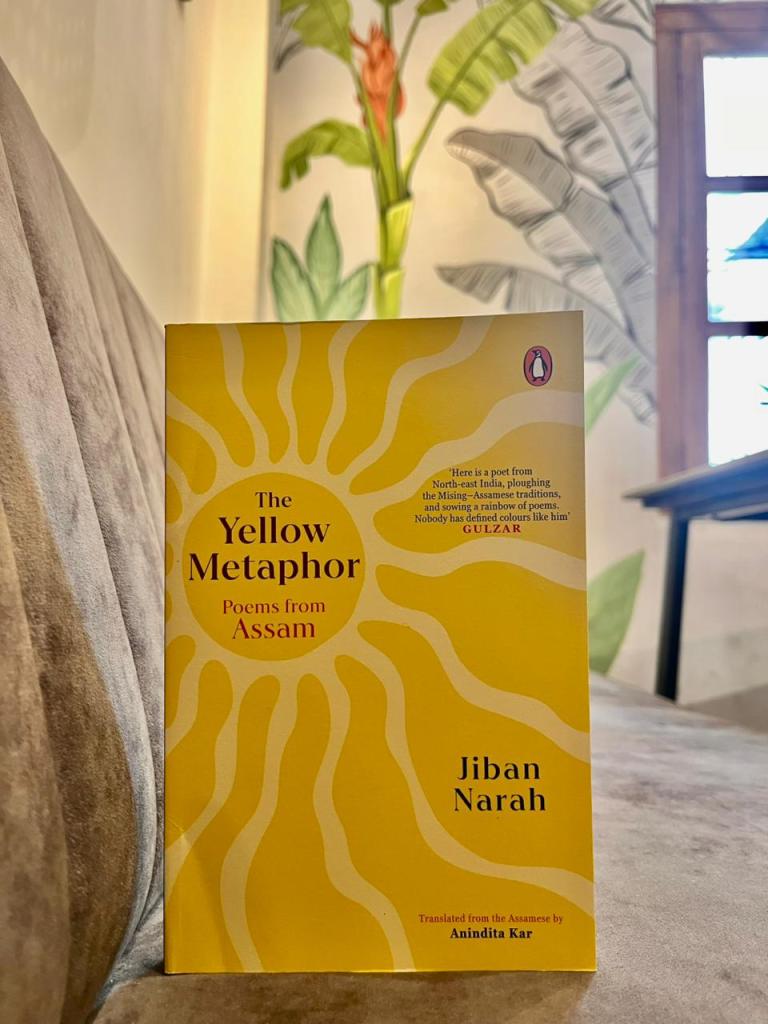
Title: The Yellow Metaphor: Poems from Assam
Poet: Jiban Narah
Translator: Anindita Kar
Publisher: Penguin Eight: An imprint of Penguin Random House
Year: 2026
Pages: 232
Price: Rs. 450
ISBN: 9780143471677
Clever boys love ignorant girls
just as history loves the voiceless
Hearing this verse the fictional characters
clap their hands and dive back into the river
and from beneath the surface, they sing:
One cannot count the underwater currents
one cannot count the bubbles in the river
And one cannot finish counting the lies of history – Subaltern
As a student studying literature in the early 2000s, we were fed on a diet of English literary giants and their works; we studied extensively those time periods, the ideas circulating in those regions from which these literatures had emerged which included the social and the political realities. In contrast, for us the Indian literature remained on the sidelines until my own interest led me to focus on the copious amounts of literatures that the country was producing. Most of it passed by us due to the barrier of untranslated works in various regional languages. Translation was happening, but only for a handful and even that was often subjected to the tastes of the one who was translating it. But as years passed, and now we enter 2026, I cannot help but feel happy at being surrounded by voices that are now being translated with more fervour. For readers like me, who want to know and read more; who have that hunger to learn and to understand people from other states of the country; their ideas, their views, their thought processes, their perception; this is a significant shift when linguistic borders are being crossed.
Or am I hallucinating?
At the beckoning of rain and woods,
at the crossroads of two disjointed thoughts,
why does the Poet falter?
Are we all solitary islands?
Or the fleeting joy of a moment . . .
Slowly, a verse from a windswept melody reaches me,
Slowly, sleep pulls me to its tender bed. – The Buddha
What stands out in this collection gathered over the years is the evolving journey of one of the defining voices of Assamese poetry, Shri Jiban Narah, and how the views do not remain stagnant. How those very images that once held a particular meaning, when revisited after a few years, add another layer of meaning to it.
Aai, you drink too much
Anxious about your fast greying hair
you drown yourself in bowls of country beer
Mourning our long absences from home
you burst frequently into loud sobs
soaking tears deep into the skin of pillows – Aai
The figure of the mother walks through the pages of this book, infusing her presence into the details that seem to ask her to stay around, to linger, and to breathe within these pages. The philosophical concerns are not lost on the reader; as the navigation of the routes that life throws up require a gentle steering like a boat moving along a river.
I am a small sailboat
that drawn by the flute
longs to touch, like a river,
the two green banks
I can’t spend this night alone,
for I am the first blossom of the simolu
– The luffa blossom
One comes across the act of turning inwards, this act of looking within in the book.
You look at your face
in your palms
Shadows of veins
blur the palm mirror – The mirror
Time within the pages of this book appear fragmented. It carries with it a feeling of how things can at times be stymied, and at times flow. The mirror that one turns to in order to make sense of oneself becomes at times an unreliable narrator and at times, the only friend one has. But what is it about mirrors that fascinates poets so persistently? Is it the gaze that refuses to stop at the surface and looks beyond, or does it become a way of inverting the image that we have created of ourselves for ourselves. The moon, too, emerges as a recurring image in this book, a soft light that illuminates the pages of this book. It is here that the role of a translator steps in. What Anindita, the translator of this lovely collection has done is bring forth a compendium of feelings, of realities, of discoveries and to render them into a form that I, as a reader who interacts first hand through a translated language can understand. At the same time, one is aware of the negotiations that a translation demands.
Actors stumble over their lines
trying to keep up with the beat.
Even festivals have a grief of their own.
Notwithstanding, we embrace each other
and return to our homes,
each in our own rhythm.
– Rhythm
To retain the voice of the original, to carry across the core of what the poet is saying, and to introduce that level of creativity and interaction that is bound to arise when poetry written in one language enters the space of another. It turns into an interaction between two languages that moves towards reshaping both.
Solitude and loneliness sit down and have a conversation across the pages of this book. The way the poet introduces these two in the book, it lingers in one’s heart long after one has finished reading the book.
Water droplets on solitary leaves
drench the sunshine
The banana leaves dance
with the whooshing wind
A grieving afternoon
paces along a twisted path
under a canopy of banana leaves
– Solitary leaves
It is very rare for me to be able to pick out one poem that stands out and becomes an immediate favourite, but I found in this book a poem that will stay with me for years to come – Mother’s conversation with Woolf from her sickbed. In this poem, the poet manages to cleave to the essence of what women across different timelines, cultures and spaces observe in terms of their lived experiences. I read this particular poem with deep fascination, savouring every line, and hoping that the poem would refuse to end.
You built yourself a ‘room of your own,’
and then took your own life.
Was it madness, feminism, modernity?
We plant lai seeds
so they call us backward, traditionalists.
You take those same leaves,
cook ’em up in all kinds of fancy ways
they call you modern.
I’ve got a room of my own too,
a husband, children,
a house full of grandchildren.
– Mother’s conversation with Woolf from her sickbed
The search for one’s identity, and the question of how one identifies; to what extent do these identifications hold water in a world such as ours, has been brought out in a very sensitive manner often through the poet’s relationships and people who are close to his heart.
Before I was born
my elder brother gifted me a colourless shirt
In its pocket, a slip of paper
the date of my death already written
One morning I woke up to find my address gone.
Who slipped it from my pocket?
Gone was my permanent address
my surname
the surname my father carried
the eyes my mother gave me
the name my aunt chose for me
and the tally of fish the mongers measured
– I died before I was born
To search for the ‘authentic’ self remains an elusive idea, and becomes magnified as the poet turns to various identifiers or markers in the form of people and spaces one occupies.
I grow restless
crafting a clay umbrella
Beneath that fragile umbrella
we undo the seams of our clothes
and then
you drape over me
a new robe, sewn with water needles
– From a distance
Colours hold specific meanings as they unfold and spread across the length and breadth of this book.
Red and blue screams
mingle in the river
Fish nudge the screams
with their tails
– Tiny boats
The book is not just a gathering of poems but a riot of colours, of musings, of sighs, of strains, of that quiet pain that one carries within, and of both the said and the unsaid versions of the self. The imageries that come alive in these pages, and I am sure for a translator to transport those into another language especially when translating poetry is not at all an easy task; but Anindita has done it beautifully.
Human flowers bloom only in dreams.
When we catch the shadow of trees,
We glance quickly into a mirror
we grow, soaked in blood,
while the trees drink deeply from the soil
darkness grows in the dark
– Human flowers bloom only in dreams
The book becomes a fusion of modernistic and post modernistic elements that find resonance within our current world; and perhaps it is time that we read this book not only to understand the world around us, but to understand our own ‘selves’; before the flux that we are living through begins to erode our sense of belonging.
another day,
another one
will return only to find
fire and ashes
and see
nowhere
is a naked boy
nowhere
is a sapling planted
Only uprooted men
all over
their roots left behind
screaming –
Uprooted men

Anindita Kar is a translator and poet. She teaches English at Jagiroad College.


Leave a Reply