- Prologue to the Issue: Bhaswati Ghosh
- Barbara Anna Gaiardoni
- Shelley Ettinger
- Jeannette Zallar
- Arthur Neong
- Linda Vigen Phillips
- Kavita Ezekiel Mendonca
- John Davis
- M. Benjamin Thorne
- Featured Artist: Shiwangi Singh
Prologue to the Issue: Bhaswati Ghosh
The unjust catastrophe of our anthropocentric world
As with most abstract and loaded ideas, the concept of justice came to life for me through the experience of its opposite in real life. I was an eight-year-old, studying in Class 4. Top-scoring students from each of our seven sections were chosen for an upcoming mathematics quiz contest. Despite scoring less than what I did in the test, one of my classmates superseded me. I naturally felt left out — unfairly at that. I was a quiet kid, yet my hurt was visible to my family. Visible enough for my grandfather to visit the school to meet with my teachers and bring to their notice my exclusion. To my fair-minded grandfather, the omission could have been an oversight after all, something an open conversation could easily resolve. Except it wasn’t an oversight, and it didn’t get resolved. I was deliberately left out as the teachers saw my shyness as an impediment to being a quiz contestant. The sting of this judgemental, obviously unjust exclusion twinged me for a long time. Interestingly enough, the word justice, which has Latin roots, came to mean “right order, equity, the rewarding to everyone of that which is his due” since the late 14th century. I now understand it was the last of those attributes — the rewarding to everyone of that which is due — I must have felt deprived of when the teachers left me out of the quiz contest squad, owing to not any mathematical lacuna but reticence that was mistaken for silence.
Curiously enough, all these years, decades later, it’s the increasing absence, or rather denial, of justice that underscores its need more urgently than ever before.
***
It’s December in Delhi, a month that used to be my favourite growing up. During my childhood, it used to be a time when balmy sunshine draped your skin like a fuzzy alpaca wool shawl. It was a month meant for peeling oranges after lunch and for shelling mungphali — roasted whole peanuts — for a late afternoon snack, for annual picnics at historical monument sites, for Christmas cheer and for getting your body wrapped in mother-knitted woollens. That Delhi is long gone, a memory wisp that only remains as fodder for nostalgia. That passage — of a certain place over a period of time — is an inevitability one learns to live with. But a transition that feels much more alarming and difficult to reconcile is losing that December, too.
I’m visiting my home city in December after a gap of fourteen years. Through this period, during which I’ve lived in North America, I’ve come back home at other times of the year — spring, summer and autumn, but rarely in winter. In merely fourteen years, I can no longer recognise Delhi. The moment I step out of the airport, a coat of smoke so thick you can almost touch its surface, licks my face and stays there, its sooty saliva impossible to wipe off. It’s reality check time for me. From an air quality index (known as AQI even to the children of Delhi) of 1 or 2 where I live in Ontario, I’ve landed straight into one of 500. Delhi’s infamous smog hits me before I can see the face of my brother and sister-in-law who have come to receive me. Over the next fortnight I would spend in the city until the time I get to writing this piece, I would nurse my mother, a cardiac patient, as she struggles with a persistent cough that keeps her up at night and troubles her throughout the day. I would fall sick myself, with a relentlessly runny nose, watery eyes and a cough that feels like a spiky fruit stuck in my throat. Hundreds of face tissues later, a face mask would finally tame the waterfall streaming down my nose and excessive ginger-tulsi infusions, my cough.
I feel cheated. This isn’t the city I remember from my childhood or even my youth. Smog isn’t new to me, but this choking, lung-decimating air is. I don’t step out unless out of necessity and feel an apocalyptic shroud enclosing me at all times. I’ve come home to spend more time with my mother, but this homecoming feels less than what it ought to be. It feels unfair. Yet, this gas chamber of a capital didn’t emerge from the vacuum.
Looking into the etymology of ‘justice’ I came across another interesting nugget. Between the 15th and 18th centuries, the word also acquired a vindictive connotation — one of infliction of punishment or vengeance. The sort of justice we humans appear to have dealt Delhi with in recent times. From a disproportionate boom in vehicular use that is choking the city’s streets to seasonal stubble burning, a farming compulsion born of economic and time pressures to dust storms that invade the city to unbridled construction and industrial emissions, there’s hardly an abuse the capital has been spared, particularly in the last decade. It’s only natural for Delhi’s air to heave and in turn to make its residents gasp. As I wrote in a poem titled ‘Counting Breath’:
Freedom fluttered atop the
air once. A thousand pigeons
rode on its wave. From the
ramparts of a fort, a blue sun
hoisted itself. The air’s laughter
archived regime changes, turbaned
pageantry, the vacuity of
promises. Its daze measured
the distance between when
freedom came to when
it became a fossil.
Once.
The air is held hostage now.
Hemmed in by a spiralling
fortress. Grey, black. It
wrestles and gasps. Dead
birds circle its grave. Little
children wear masks to school.
If the crises gripping the world — from conflicts in the Middle East and Ukraine, to the alarmingly shrinking Amazon cover, forest fires, floods, earthquakes and other extreme climate events displacing entire populations, to depleting groundwater, melting glaciers, unchecked carbon emissions and loss of biodiversity — we live in reveal anything, it is the sheer catastrophe that anthropocentrism has proven to be. In placing ourselves — humans — front and centre of everything, we’ve turned into Frankensteins condemned to self-destruct. The scales of justice haven’t merely tipped off balance; they’re on the edge, about to crumble under the unbearable weight of obese human greed.
From my mother’s living room window, I look out at the street. I can count on my fingers the number of people wearing a mask amidst the toxic air. We’re indifferent, in denial. If we continue to look the other way, our freedom, and the justice that delivers it, will actually turn into fossils — with impressions of the past, but no life breath.

Bhaswati Ghosh writes and translates fiction, non-fiction and poetry. Her first book of fiction is ‘Victory Colony, 1950′. Her first work of translation from Bengali into English is ‘My Days with Ramkinkar Baij’. Bhaswati’s writing has appeared in several literary journals, including Indian Express, Scroll, The Wire, Literary Shanghai, Cargo Literary, Pithead Chapel, Warscapes, and The Maynard. Bhaswati lives in Ontario, Canada and is an editor with The Woman Inc. She is currently working on a nonfiction book on New Delhi, India. To learn more about her publications click here .
Barbara Anna Gaiardoni
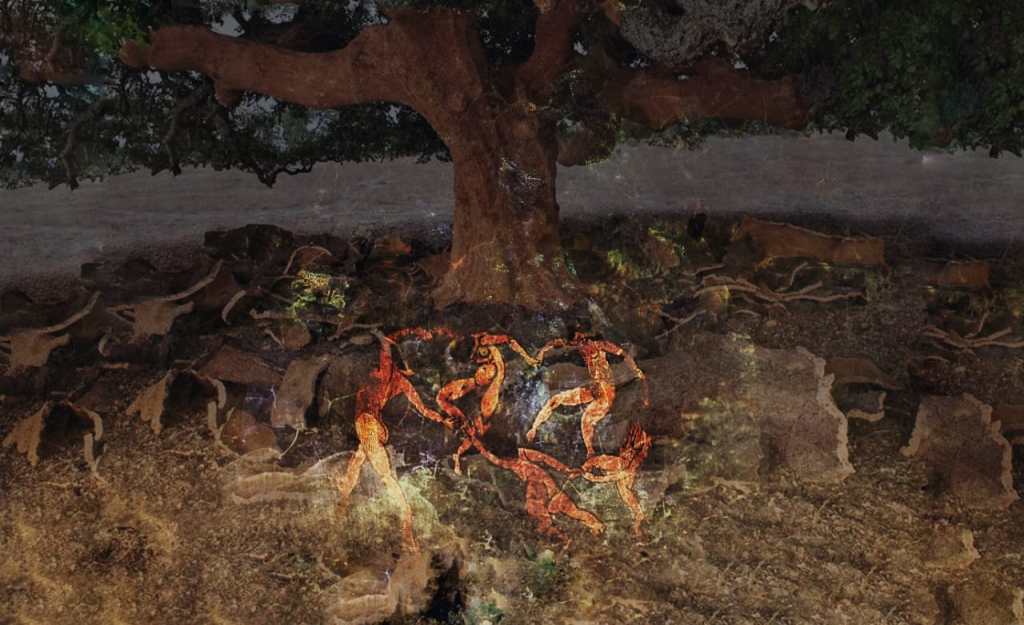
an oak scrapes
the weary sky

trunk
of truth

Barbara Anna Gaiardoni is an Italian pedagogist and author. Barbara’s Japanese-style poetry has been published in 280 magazines and translated into 12 languages. She is a winner of the 7th Basho International English Haiku Competition and a two-time Touchstone Award nominee (2023, 2024). Her work has been featured in The Mainichi’s “Best of” lists and received an Honorable Mention at the Fujisan Tanka Contest 2024. She is the author of three origami micro-chapbooks, including Eating Haiku (2024), which was exhibited at “Artfarm Pilastro.”
Drawing, swimming in the sea, and walking in nature are her passions. “I can, I must, I want” is her motto.To read her publications, see http://barbaragaiardoni.altervista.org/blog/haikuco-2/
Shelley Ettinger
When Where How When
When polio runs rampant and the Proud Boys are ascendant and there’s no one picking fruit or packing meat, when trans is back for fats but banned for teens and fracking triggers tremors forming faultlines where none were previously seen, when workers are fired for striking and students expelled for protests and librarians fill jails for saying kids should read, when cis-het white male primacy which has always reigned supreme is boosted bolstered buttressed legally, when Gaza’s fully flattened and the West Bank’s white suburban and Big Oil’s rule enshrined officially, what will we do where will we go how will when will who will what will what will what can we
Don’t look to the Dems, they created this mess, if you find that extreme at least you must see that they didn’t help, campaigning with warmongers arming genociders deporting the seekers of succor and safety, it’s always their means, if the fascists challenge they tack right they do not get that facing left is the only way to victoriously fight, good luck with that, not gonna happen as said old fuzzybrain whose hubris guaranteed doom, it’s the party of big business same as the GOP so though they differ tactically class allegiance reigns supreme and once we understand that we’ll know where to go what to do how to do it when to move it’ll all come clear maybe sooner than anyone thinks
Shelley Ettinger is the author of Vera’s Will. Her work is in Mizna, Gaza Verse, Rabble Review, Louisville Review, Radical Catalyst, The Skinny Poetry Journal, Gertrude, Nimrod, Mississippi Review, and other lit mags. She is a Lambda Literary Foundation Emerging Writers’ Retreat fellow and has been a queer anti-racist social-justice activist for over fifty years.
Jeannette Zallar
Justice
Justice is not always loud,
nor does it always shout.
Justice is not always out,
obvious and only with the devout.
Sometimes, justice is quiet.
Sometimes, it’s handing an unhoused man some change,
even if you think he’s going to rearrange
his insides, because you have faith
he might actually need it for food.
Sometimes, justice is loving.
Sometimes, it’s opening a door for someone in a red hat
because you’re kind; even if she isn’t kind to you.
Justice is sticking to what you know is true,
that not everyone will thank you.
Sometimes, justice is sharing your food,
sharing with your crew, as much as you can,
because groceries are getting more expensive,
and yeah, you have to sit at the food bank forever,
treated like a number and not human,
but if it means those you love can eat, you do it.
Sometimes, justice is speaking for others,
even when the world refuses to hear them.
Justice is when you’re able to get a point across
for someone you’ll never meet on the other side of the world
who lives by the sea, dreaming of liberty,
and things they’ve only heard about on the radio
while dodging missile strikes, while the government gripes
about the promises of ceasefire, as soon as they get their way.
Jeannette Zallar is a writer in South Texas trying to make sense of the world. Jeannette lives at home with two cats and their partner, while juggling a love of writing and a full time job.
Arthur Neong
The Case with Justice
And now
The case lies forgotten
She who was found hanging
In her room upstairs
By her dad
Could she have committed suicide?
The whole house was yellow-police taped
The other narrative seemed to have been
She was killed then hanged
On the top floor
Though saying it now, it sounds
Implausible, but not impossible
Anyway there’s no news now
The house seems alright now
Not a hint of what happened
I wonder if it’s still lived-in
I pass by it so many days
And i don’t even bother peeking
From my side window
All i see is the road in front
And other cars so they don’t come at me
And we don’t meet
I don’t want another death in the house
I think we forget because there’s no news
There’s so much unwanted news, but none on that murder case
Maybe she did commit suicide
Maybe her parents didn’t want anybody to know
Perhaps she’s a born-again Christian
Maybe something happened that’s better left forgotten
Maybe the killer pleaded for secrecy
There’s no justice for her, there never was
But now there’s no justice for us
Perhaps in a 100 years the truth will be revealed
Declassified as they say
When all the perpetrators are too old
Or too dead to be accountable
Meanwhile a thief gets 2 years in prison
A drug-peddler gets hanged
And snakes in suits and skin rule the streets
Scheme from tinted cars and walled-in mansions and skyscraper towers
Stalk even our dreams
Through its long-body machinery

Arthur Neong is a Kedahan Malaysian Chinese. Having taught for 11 years, he now delineates the maelstrom of thoughts and visuals. His works have appeared in Borderless, Eclectica, Eksentrika, Everscribe, Men Matters, Porchlit Mag, SARE, Tap Into Poetry and elsewhere.


Leave a Reply