Reviewed by : Jhilam Adhikary
While reading T.S. Eliot talking of John Donne in his now famous essay The Metaphysical Poets, I came across the part where he praises Donne’s works, which frankly, opens the door for a renewed interest in Metaphysical Poetry early in the 20th century. To put it simply, quoting the line, “A bracelet of bright hair about the bone”, as an example, Eliot explains that what made Donne so different from his contemporaries was the way he could put together “brief words” and “sudden contrasts” by force, and make them make sense beyond what is commonly associated with them. The unexpected juxtaposition of such contrasting imageries and their significations, or in Eliot’s words, “telescoping of images and multiplied associations”, creates a shock effect which denies its readers the comfort of simply enjoying the poem, forcing them to focus on what they are reading and why it’s important.
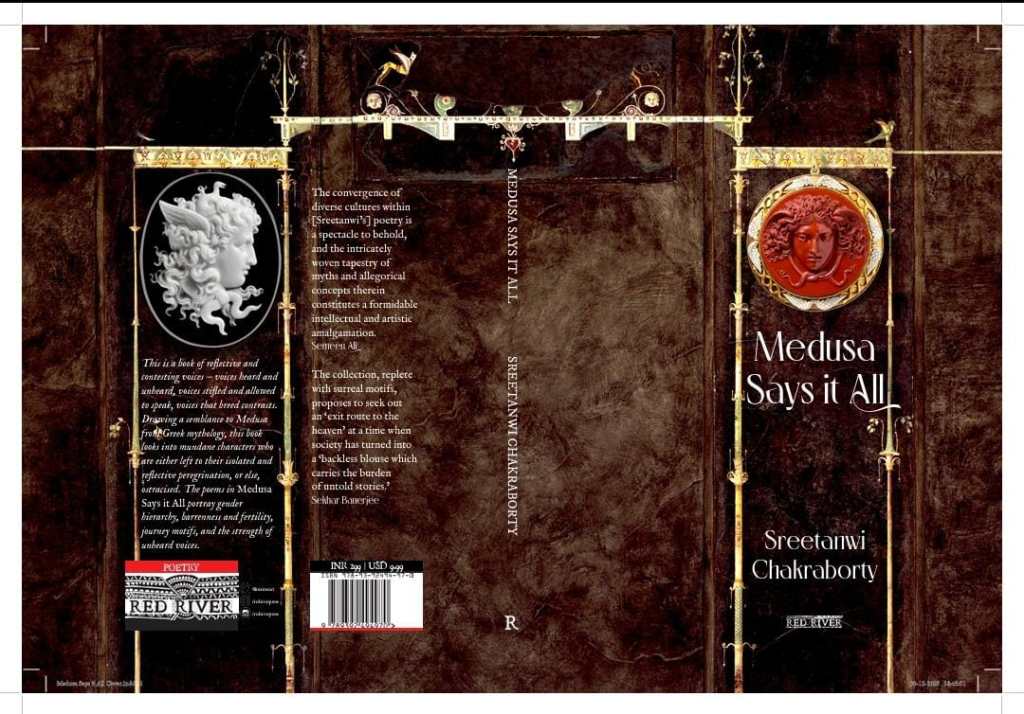
I found this peculiar quality in many of the poems of Sreetanwi Chakraborty. In her collection of poems, Medusa Says it All (published by Red River Press), Chakraborty repeatedly juxtaposes the mundane with the macabre. For instance, in her description of a mundane evening spent at a lounge in Kolkata, she writes, “…serving cupcakes with death warrant on the fondants.” Similarly, her poem Chronologic begins with the innocent and familiar image of tea being made but immediately loses its sense of warmth and comfort and transformes into the image of blood. The comforting smell of tea being a trigger for painful memories makes the readers realise how deeply traumatic the unspoken experience must have been, encouraging them to speculate and to read other poems to investigate.
Medusa Says it All is divided into two sections, namely “The Woman on the Other Side of the River” and “All My Life I Grew Up Wanting.” While the first section reads like a series of impersonal vignettes about strangers’ lives, the second shifts into more intimate, first-person narratives. Her poems record micro-narratives of contemporary India which are otherwise destined to be lost in time. Chakraborty is a traveller who goes around the world to collect stories and her references to Manali, Benaras, Puri’s Chandrabhaga beach, the tea plantations of Darjeeling, villages of Midnapur, etc., situate the poems within a distinctly Indian ecology of memory. As a working woman who is tied to her city life, the author chooses to celebrate her limited leisure-time in the presence of rivers, trees, dust-laden streets, and monsoon skies. She includes her personal experiences, gathered from such travels, to infuse her poetry with a rich sense of distinctive Indian-ness, some of which have no other records of existing, such as the “Goanese lanterns,” of Sepia Notebook. The poems blend Indian and Greek mythologies, as well as occasional mentions of Biblical characters like Lucifer and Mother Mary, to create hybrid stories and even equates those myths with present-day experiences to portray their relevance in today’s society. Even historical figures find their mention in the moments such as the classroom recollection of teaching Tughlaq in the poem The Retrograde Venus. Moreover, with untranslated vernacular phrases, mention of daily used items like spices and jewellery, common everyday experiences, titbits from Ancient Indian texts, visual, olfactory and auditory imageries, the collection can be best described as a cultural “tapestry”, as it weaves together various linguistic and material objects of culture to form lifelike recreations of different scenes from India, giving the readers a sneak peek into the private lives of strangers.
Yet, despite the poems being so intimate in nature, they carry mournful, shocking, and even violent undercurrents which frequently pop up in the form of those sudden contrasting imageries with which I began this review. The poems allude to the atrocities faced by refugees, protesters, activists, revolutionaries, and marginalized individuals. For example, her poem, The Dusty Lane and the Gulmohar, casually touch upon the sufferings of the “coolie,” the “gully child” and the “flower selling girl” on the dusty streets next to the romanticized Ganga’s shore, as if the existence of their struggles is no less natural than the “Gulmohar tree” and the “bulbuls.” Being a Bengali, the setting of West Bengal, including various tea-plantations of Darjeeling, villages of Midnapur, named and unnamed locations in Kolkata, etc., is fairly common in her poems which represent her love and nostalgia for those places, still, in How are you, Afroz? she calls her beloved land “the shellshocked city, rigorous in Naxalite pain.” “The ignored and neglected trauma of people is seamlessly woven into the everyday lives of the narrators of her poems. By not directly highlighting the tragic and violent reality of her country but rather using it as an ever-present motif, silently breathing in the background, invisible yet overtly open with its presence surrounding seemingly normal days, the readers are forced to carry its discomfort and dread by passively experiencing a few glimpses of the subtly terrifying memories of common women.
It is no secret that the experiences of women have never found their proper place in grand narratives and have been pushed aside for being “too dramatic,” “too emotional” or “too irrational”. This is why the figure of Medusa herself, who is, like most women, forever silenced, becomes the metaphorical representative of the collection. Since whoever is gazed upon by her is forced to remain petrified and unchanged for eternity, she had been forever alone, unable to narrate her experiences to any living soul. Medusa represents those forgotten, “unimportant” lives, whose stories are lost to time and the collection becomes an archive of their memories.
The strength of the poems in this collection lies in restraint. They do not not argue but rather accumulates. They do not preach, they remember. Medusa Says it All gathers moments that are at once personal and quietly historical, intimate yet faintly political. Readers attuned to contemporary Indian poetry, particularly to writing that allows myth, memory, and material surroundings to intermingle, will find in this volume a work that unsettles gently, but persistently, long after one has finished reading the collection. And that is where I feel the success of the poet lies.

Jhilam Adhikary JHILAM ADHIKARY is an Independent Researcher. Her recent publication is titled Caste, Class and Cuisine: Exploring Food Hierarchy in India and its Impact on Assamese Food Representations in Literatures and Media.


Leave a Reply