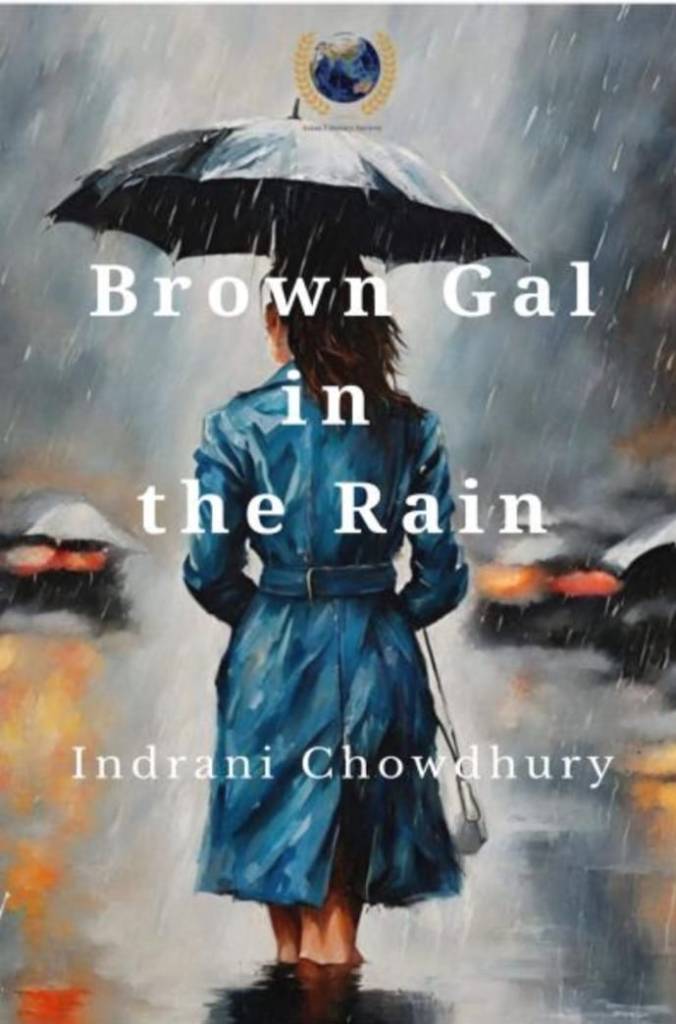
The six sections of Brown Gal in the Rain, evoke the poet, Indrani Chowdhury’s inner life, through her fascination with themes of love, longing, heartbreak, and intimate relationships. This opening segues into considerations of Hues of Life to include life’s complexities, the development of deep emotions and insights into existence. The section, Peekaboo is a more light-hearted section permitting the celebration of a childlike innocence, where Let There Be Light! turns the poets gaze to considerations of resistance, empowerment, and personal growth. The last two sections of the collection examine nature and a variety of diverse subjects. At nearly 200 pages this is more a substantive gathering of the poet’s oeuvre thus far, than a standalone book. There is both history and reflection here. Such as the poem Old School where an intimate, wistful voice laments what technology has mislaid:
I prefer to read your letters,
Which may have errors in spelling,
And it is a testimony,
Of your poor vocabulary,
Than reading your autocorrect.
The collection percolates concepts of identity; often within the greater arc of societal issues and juxtaposed from this, thestemming of one’s personal growth. Indrani Chowdhury’s writing is intensely evocative in her willingness to directly explore existence from a variety of stances with tension and urgency. She wields consonance and assonance as guides in the reader’s emotional experience, by carefully manipulating inherent qualities of sounded-language. Such thought-provoking writing has imbued Chowdhury’s work with a universal quality that invites deeper emotional resonance by inviting the reader to journey with the poet through her moving and enduring perspectives on life around us, whether casual observation or deep family tie:
Her sarees were ordinary, and her meals were simple,
I never found her having her eyes on some expensive jewel,
But I can tell you that real sadness used to engulf her otherwise happy being,
At occasions when she detected lackadaisical attitude in me or my sibling. (Maa).
There is a definite avant-garde element to Chowdhury’s writing, specifically as she examines themes of empowerment and challenging restrictive societal norms, often utilizing caesura for greater emphasis. In poems like “Prometheus Unbound” and “Let Me Be…” there is a resilient emphasis on the necessity to be individual and courage enough to find and pursue one’s own way in the world.
In the poems “My Dear Girl, You Must Know…” and “Unfulfilled Dream,” Chowdhury asks that women consider such challenges, to gain greater freedom and not give up on one’s individual dreams even in the face of societal disapproval. Interestingly, there is also a recognition of Transgender identities. Poems like Tale of a Transwoman and Diary of a ‘Different’ Girl really examines, utilizing enjambment, the hardships of Trans in modern India. Begging the question how much is too much? (of ignorance, of cruelty?) in its eponymous poem. This is a unique angle and a courageous one, with the push-back in mainstream India against the LGBTIQQ+ community, “to make her fit into their version of what is normal.” The voicing of such acceptance and compassion is both necessary for writers to do, and brave.
But she had known from her little life,
That nothing lasts forever,
Not even the scornful boos of the crowd, (Diary of a ‘Different’ Girl).
I particularly appreciated that courage, as well as Chowdhury’s truthful expose of the façade of social media, in ironic poems like Dear Facebook Girl… where she contrasts via assonance, the carefully curated persona people share online, with the reality behind that fictionalized perfection: “The fb girl in her real world is suffering from acute depression” This willingness to explore the complexities of modern identity, in lines like; “we cross the vast spiritual wasteland of our existence” (An Ode to the Sunflower) are highly relatable and powerful in their analysis of what we’re missing and losing by focusing so much on social media.
If eyes are a window to one’s soul,
Then how do illusions play at what we behold? (Eyes).
Chowdhury also makes memorable allusion of women’s bodies through poems like My Menstruation Story where her critique of Indian restrictions concerning menstruation, highlights the disparity between the genders (and this is not just a problem in India). Chowdhury completes her journey, celebrating the strength of women, for example in Greetings to All Women! with an eye to gaining true gender-equality and not pretending we have it yet, or the incredible poem, Wonder woman’s Appraisal of the Superwomen of this World:
Would you not hail that rape victim,
Who refused to remain silent and told in a packed courtroom,
The ‘shameful’ details of that harrowing incident?
Or what about that woman who suffered and survived domestic abuse, and
Still remained unbeaten?
Love is viewed as a transformative force, especially in the poems My Beautiful Dreams About You and My Heart Goes On, where the poet shares her considerations of why love can be empowering and life-altering. There is a vein of self-acceptance through such reflection, in Rewinding Life and My Life’s Learning, where Chowdhury reflects on her own hyperbole, failures, and triumphs, admitting, none of us are perfect, but effort and resilience go a long way. In this, Chowdhury candidly embraces vulnerability, openly sharing highly relatable emotions and truths we connect deeply with, through symbolism, personification and a well-turned directness:
And you could be alienated and left to rot!
Your steps may falter, and your dreams could be shattered, (My Dear Girl, You Must Know).
Throughout her writing, literary and figurative devices enhance meaning whilst evoking genuine emotion and Chowdhury speaks to her readership intimately, encouraging us grow through both the losses and gains, whilst connecting with each other through the beauty and solace of life. There are some lovely and redolent recollections of Chowdhury’s own childhood where these tender memories add to the poet’s appreciation for simple joys, lasting relationships and the formative experiences that shape all our identities.


Candice Louisa Daquin is Managing Editor, Lit Fox Books, author of The Cruelty.
 Parcham Online
Leave a comment