Analyzing Parasite through the lens
of Existentialism
Existentialists believe we are born into existence and form our identities through our choices and actions. According to them, the world is meaningless, and human beings must confront the anxiety and absurdity that come with this realization. Bong Joon-ho’s Parasite is a stark commentary on the alienation that stems from class divide and the consequences humans undergo when they search for freedom and identity. “Man is condemned to be free,” said Sartre, which means humans are inherently free, but their freedom is not a gift; rather, it is a burden and a source of responsibility. The quest for this freedom drives humans to desperation at times, obliterating their moral compass.
•Alienation and Absurdity•
In the film’s narrative, there are three families—two working-class families (the Kim family and the Moon-gwang family) and one upper-class family (the Park family). Both working-class families experience deep-seated social and emotional alienation as they are victims of capitalism and recession. Both patriarchs of the families, Ki-taek and Oh Geun-sae, used to work in the same shop and lost their jobs when the shop went bankrupt. The Kim family resides in a semi-basement, which stands as a metaphor for their social class, below the affluent. However, they possess strong desires to climb the social ladder and therefore try their best with limited resources to bridge the gap. They do not conform to class discrimination; on the other hand, the Moon-gwang family has accepted their subservient position in society, showing unwavering allegiance to their masters, i.e., the Park family. They no longer question the status quo. The struggle of both families is not just economic but also existential; they are constantly subjected to the absurdity of their condition. Bong Joon-ho, in one of his interviews while talking about Parasite, makes a very grim statement: “Essentially we all live in the same country called capitalism.” The Park family stands as a representation of capitalism in the film; their snobbery, self-absorbed nature, and ignorance alienate them from the gruesome reality of working-class people.
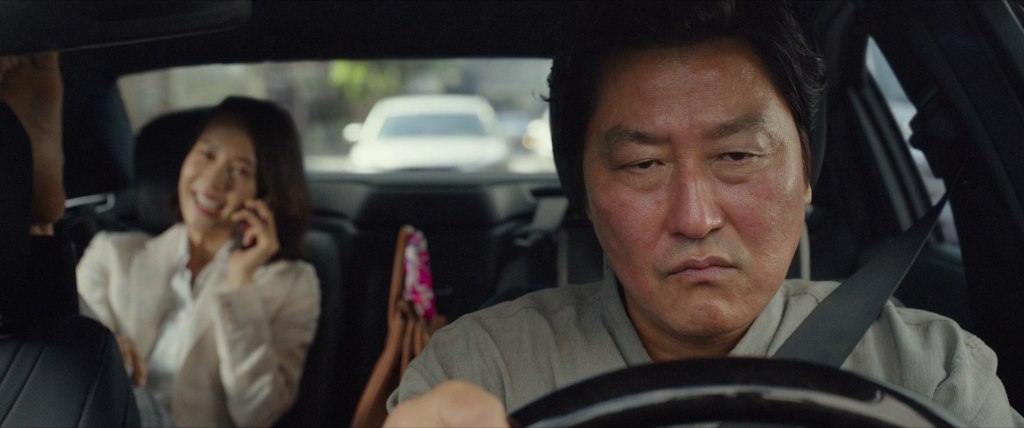
The flood sequence is an epitome of the perilous existence of the Kim family. Joon Ho in this scene captures the absurdity of human suffering in a cynical world. The gym becomes their haven for the night. At that time a brief conversation takes place in the gym between Kim Ki-taek and his son Ki-woo regarding future where Kim states that the best kind of plan is to have no plan at all. This statement reflects his existential crisis and his resignation to the meaninglessness of life. Followed by this, the next day in a car sequence when Kim Ki-taek is driving the car, Mrs Park in the backseat is seen commenting on weather being very pleasant as a result of the storm. Her untoward comment exposes how privilege blinded her thus leading to her willful ignorance of the suffering of the impoverished.

•Authenticity vs Inauthenticity•
According to existentialists, authentic existence means embracing the truth of one’s condition and taking responsibility for one’s freedom. On the contrary, living in bad faith means conforming to roles or societal expectations to escape this burden. The Kim family resorts to the latter option, which leads to their downfall.
A parasite is an organism that lives on or in another organism (the host) and benefits by deriving nutrients at the host’s expense. In accordance with the title of the film, the Park family performs the role of hosts, while both working-class families (the Kims and Moon-gwang’s family) perform the role of the parasite. Min-hyuk, an old college friend of Ki-woo, offers him a prosperous job tutoring the daughter of a wealthy family in English. Since Ki-woo is not qualified enough, his sister forges his marksheets, posing him as a student of Yonsei University and changing his name to Kevin. Ki-woo, aka Kevin, uses this opportunity to carry out further nefarious activities, teaming up with his other family members. The Kim family gradually displaces all the other workers, such as the chauffeur and housekeeper of the house. They patiently execute almost a heist to leech off the wealth of the fortunate Park family. Bong adds a lot of humour to this section, making it entertaining. In this way, the Kims infiltrate the Park home. All of them adopt false identities, which allow them temporary success, but their unbridled greed and desires become their hubris in this tragedy. They realize they have flown too high, and now nothing can save them from crashing down to Earth like Icarus.
Along with the Kim family, there’s also the Moon-gwang family—the housekeeper’s family—who fed off the Park family like leeches. Moon-gwang’s husband Oh Geun-sae took refuge in the basement of the house. Park family’s younger son, Da-Song used to draw self-portraits after seeing a pair of eyes rising from the basement one night which was the reason behind his panic attack. The revelation of Oh Geun-sae’s story therefore corroborates the fact those distorted self-portraits which Da-Song’s mother mistook to be his were actually portraits of Oh Geun-sae.
In contrast to the Kim family, the Moon-gwang family has accepted the truth of their existence. She and her husband have set up a crude living space underground. When these two parasite families confront each other, they engage in a nasty fight, and this is the moment when the Kim family reaches the peak of their dehumanization. They quickly handle the situation by locking the injured Moon-gwang and her husband in the basement. Their self-deception leads to their existential crisis and moral degradation.
•Class as Existential Condition•
Bong Joon-ho’s film intersects existentialist concerns with Marxist insights, suggesting that class structures shape the conditions of human freedom and identity. The Parks are not cruel, but they are self-involved, ignorant people who live in their bubble—which is also the reason for their naïveté. The director uses space in the film to emphasize class discrimination. The Park mansion is enormous and spacious. The family members are hardly seen together in one space whereas the Kim family lives in a cramped semi-basement, with things piled up in every corner leaving no space. However we always see them together in one space discussing or sharing ideas that in a way reflects their intimacy and bonding highlighting the absence of the same in the Park family. The stairs also play a symbolic role in demarcating class- in park mansion the stairs are a metaphor for socio-economic ascension while the stairs in Kim family are a symbol of socio- economic descension. The secret basement where Geun-sae resides stands as a metaphor of the repression of the oppressed where oppressed are deluded to an extent where their sense of emancipation and identity slowly fades and they gradually start hero worshipping their perpetrators- forbears of capitalist society.
All the families in the film are victims of status anxiety. It is frequently shown in the film that Mr. Park talks about maintaining a line between himself and his workers, often saying, “I can’t stand people who cross the line.” This is simply the rich man’s reinforcement of boundaries to maintain social hierarchy. Along with space, smell also acts as a marker of class divide. Mr. Park is earlier seen complaining of the putrid smell coming from Mr. Kim; later, his wife too smells the same odour and frowns. Smell becomes a sensory marker of class, illustrating how material conditions define not only perception but also existence. The discrimination based on smell results in fatal consequences for Mr. Park in the end.
•Freedom and Responsibility•
It has been said that with freedom comes responsibility. Existentialism places the burden of freedom on individuals. Freedom entails choices, which lead to responsibility—often resulting in despair. In a traumatic frenzy, Geun-sae, seeking revenge for his late wife, attacks Ki-woo with the viewing stone, damaging his cognitive abilities, and stabs Ki-jung. Witnessing the bloodbath, the young boy of the Park family, Da-Song, faints. While Mr. Park is concerned about his son and rushes to take him to the hospital, he turns a blind eye to Ki-jung, who is in a more serious condition. Though he is unaware that Ki-jung, aka Jessica—his son’s art therapist—is Mr. Kim’s daughter, it still doesn’t change the fact that he doesn’t offer any help to the dying girl. Instead, he plugs his nose, disgusted by Mr. Kim’s smell. This is a moment of great disbelief for Kim, who sees that there is no ounce of pity for people of his class, even during a moment of raw human terror. Ki-taek cannot be fully blamed for what he does next. Through the act of turning the knife inside Mr. Park, he momentarily achieves freedom from men of higher class like Mr. Park, who curbs their freedom. However, the cost of this freedom is his eternal entrapment in the basement, which also reflects his debasement as a human being.
Ki-woo’s dream of getting a good education, building a career, and earning enough money to buy the same house so that he can reunite with his father is also a form of existential hope. However, the final shot implies that it is likely just a dream—reinforcing the absurdity of seeking validation within oppressive systems.
The viewing stone that Ki-woo receives as a gift from his friend Min-hyuk in the beginning, who says that it will bring them material wealth someday, is just an illusion. Instead of bringing wealth, it only brings destruction.
In a recent New York Times poll of the best 100 movies of the 21st century, Parasite holds the first rank. The film is inspired by director’s personal experiences and observations when he worked as a tutor for a wealthy family. Hailing from a middle- class family he was aware of the socio-economic disparities in Korean society which he explored in Parasite. While the film is rooted in Korean society, he depicted a universal story about the unending gap between the rich and the poor.
The film not only critiques capitalist society but also sheds light on the predicament of individuals entrapped in class struggle and roles assigned by hierarchical systems—systems that are inherently unfair and force individuals to make radical choices in the face of absurdity and powerlessness. Like in Camus’s The Myth of Sisyphus, where the characters continue pushing the boulder of hope and self-deception uphill—only to see it roll back down again.

Srilekha Mitra, holds multiple certifications in film and cultural studies. She writes on pop culture and films, with works published on major platforms. She’s also a poet and essayist.

 Parcham Online
Leave a reply to archanasonti Cancel reply