
Hazardous Gas: The Biblical Flood—Shruti Sareen
It seemed as if the air was thinning down. It was becoming scarce. The air was suddenly insufficient. It was smoky. Big black gaseous clouds could be seen at a distance– approaching closer at great speed. There was a stench, a putrid smell coming from the drain nearby.
As Fasola, unwell, lay sleeping, she dreamt that she could not breathe, she was suffocated. There was some train in her dream too. She was trying to find space in some train. Something made her look up. She saw the gaseous clouds of smoke approaching. Her throat seemed scorched. She muttered, turned over, and slept again.
Later that evening, there was an announcement on the loudspeaker in their neighbourhood. In all neighbourhoods throughout the city. In many cities across the country. Rescue air planes would be coming the next day. They would be carrying people to other pastures, to other climes, to first world countries where the air was cleaner, fresher, the pollution lesser.
The only issue was that everyone couldn’t go, of course. There weren’t so many airplanes, for one. Secondly, where on earth would so many refugees be transplanted? And finally, there was the question of where the money would come from.
So the loudspeakers announced that those who could afford it should immediately book their tickets online and leave tomorrow. With the pollution outside, it was deemed best and safest to e-book the tickets. And yet, nobody seemed to spare a thought to those who couldn’t afford air tickets. Those who had no computers, internet, or even the literacy to book these air tickets. Those, who didn’t even have four walls of a house to save them from the stench and the putrid smoke.
There seemed great hurdles to be crossed. Fasola dreamt this time of a game of hopscotch. The road itself seemed to be divided into great big squares of hopscotch, each posing a different challenge.
A big yellow moon shone overhead. It almost seemed ominous. Sometimes yellow moons are friendly especially when seen amidst tree branches, but this one was almost a burnished red. Was the moon angry? Was the moon becoming the red planet Mars? Why had the moon forsaken its benign countenance to turn into this furious, terrible thing, glowering down through the black smoke and the charred trees?
Fasola lived all alone. She did have money enough to book the airplane tickets. Her other family and friends would be booking and boarding from the different locations where they were. She thought of her house-help, Medha didi. She hatched this plan of dressing her up so that she didn’t look like a maid anymore. She looked at her account balance. Ordinarily, she would not have even dreamt of buying one international air ticket. Now, at the moment of life and death, she actually managed to scrape two, for both of them. Fasola may have managed to save two lives, her own and Medha didi’s.
But would everyone after all be so privileged and so lucky? So then what of those who couldn’t afford it? They would be left to die, unfortunately. Collateral damage. The government assured everyone that they wished everyone could be accommodated, but since they couldn’t, and since some would have to be left behind anyway, it made no sense to incur a monetary loss and to create an economic disaster on top of the one they already had.
Perhaps the ultimate in absurdity was a group of teachers who went around arranging books in different ways, presenting them, distributing them among people in the midst of all this chaos. Who would look for books when they had no air to breathe, water to drink, and food to eat?
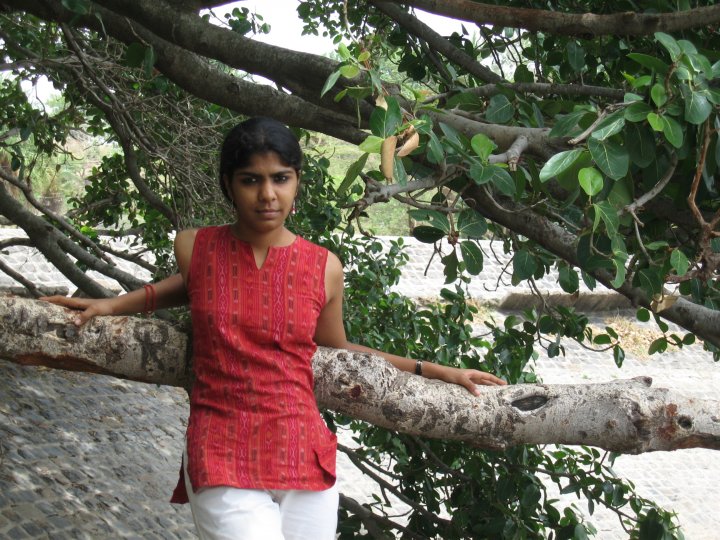
Shruti Sareen, born and brought up in Varanasi, studied at Rajghat Besant School, KFI. Graduating in English from Indraprastha College for Women, University of Delhi, she later earned a PhD from the same university, titled “Indian Feminisms in the 21st Century: Women’s Poetry in English” which is now forthcoming from Routledge (UK) as two monographs. Her debut poetry collection, A Witch Like You, was published by Girls on Key Poetry (Australia) in 2021. She is currently seeking publishers for her novel, The Yellow Wall, and is working on a manuscript, Sapphic Epistles. She was an invited poet at global poetry festival, hosted by Russia, Poeisia-21. She lives and teaches in New Delhi.


 Parcham Online
Leave a comment