
Oleander— Suvechchha Saha
ONE
Gopiballavpur
Jhargram 13.01.1971
Dearest Nilesh,
We have reached Gopiballavpur today. Yesterday we left Calcutta in the evening. My father says it is safer to travel at night these days, particularly when a young lady is accompanying him. Though I know, not only these days, but all around the year, daylight hardly proves to be sustainable for the health and soul of young ladies. But it was utterly necessary that I should come with my father. I wish I could show you the way her face has been beaming since we have entered the house. It baffled both of us how she could recognise the young woman all by herself whom she did not meet for seventeen years. Baba has yet not told her about our reason of coming lest she becomes furious and obstructive from the very beginning. But he is struggling to conceal his agitations, I can see that. Though he tried to maintain a calm demeanour, I saw him sweating the whole way of our journey. I cannot say I myself was not really nervous. There are more vicious nightmares than death and mortal wounds for a woman to dream of. However fearless you know your Rubi to be, she could not help being scared when three people entered her coach in the depth of night looking like the very embodiments of outside darkness later to be revealed as a family, or when she and her father, while looking for a vehicle to reach the village, had to roam around the bleak station that appeared more distrustful in the dubious glints of dawn. But she stayed unwaveringly in her decision of accompanying her father despite whatever may befall on the way. Nilesh, I know you will be proud of me knowing all these, won’t you? After all, you are the one who, all the time, encourages me to be fearless in sacrificing the self in the cause of others.
However, the look on my mother’s face when we set out yesterday, is troubling me persistently. Nilesh, you know my mother. No grain of her soul and mind is what can be identified as selfishness in anyway. I grew up listening to her story of getting out of home at night to help refugees from East Bengal. But when she realised that her only daughter was to travel to one of the major hives of the Naxalites, she could not gather herself to think about anyone else, certainly not the older sister of her late mother-in-law. But Baba was determined to take me, as he knew, only I could convince Barothamma to come with us in Calcutta. Those unfamiliar with us, would probably think this rather unnatural to care this much, but you know my family. I along with Baba tried to remind Ma of these values, fought with her, I wept when she did not want to understand me, and Ma, in turn, tried to persuade Baba to understand whom he should prioritize. The others- my uncles, aunts, cousins also divided themselves in support of the two parties. One more thing, Nilesh, you may not know that flame of the raging revolt has reached the unperturbed lanes of Calcutta too.
After reaching Barothamma’s place, Baba has not let me leave the house for once. He himself has spent the morning visiting nearby shops and talking to people who have known Barothamma for a long time. It is from them that he has got together scraps of information. The entire Jhargram has become a ground zero of the movement. Number of agitators is rising rapidly with more and more tribal members and young students from the town joining the peasants. Only last Sunday they burnt down the house of a shroff living in this very village and rumours are that a young gentleman from Calcutta, who has recently arrived here, has led that campaign. I could feel my blood oscillating with each of Baba’s words like the waves with each strike of a windstorm. My heart was beating faster than I could take while listening to him. But I can not say how many of those beatings were of fear and how many carried the muffled voice of unquenchable excitement. How many Bagbazar evenings did you and I spend thinking of a farmer’s shrunken rickety black face and his ailing wife and two children? How many off-periods did we spend talking about the selfless youths burning themselves for such a cause?
I have to stop now. Barothamma is calling me for dinner. You will be amazed to know that she has a massive obsession with an oleander tree on her yard. Coincidence, is not it? I will write about her in more details in my next letter. I hope you are doing well. I am sending you all the love that I am capable of holding. I cannot express in words my desire to see you right now.
Yours and only yours,
Rubi
P.S. Even on the day before we left, I asked about your whereabouts in all the possible places. I went to the University again and talked to whoever I could. I met all your friends again. Where are you, Nilesh? You are gone for too long… too long. I wish you were here with me to understand the turmoil of my heart. You say I am like a lioness, but what I really feel like is an imprisoned moth before a wildfire.
TWO
Gopiballavpur
Jhargram
21.01.1971
My most beloved
Nilesh,
Barothamma is a whole story. She really is. Nilesh, you have always been interested in the stories of people. Hers is a story aging seventy-six; in that many other stories of different people have been raised from infancy to adulthood, from adulthood to their deathbed. And these are stories that we do not usually talk about. If you were here, they would surely intrigue you both emotionally and intellectually. I last saw Barothamma when I was five years old. After independence, my own Thamma and Dadu moved here to escape the tumultuous state of Calcutta. Dadu had always been the sole escapist of our family. Ma and Baba were newly married then. I was born in this house. I do not really recall the days spent here during that time. But I have been told that Barothamma became a little child herself, after I arrived. She was less of a gentle grandmother and more of an exhilarated elder sister. She used to become sullen when she was denied to carry me, she used to talk to me all the time when I was left alone with her, not that I could understand anything. Then as I was growing up she used to teach me alphabets and rhymes. I, too, did not want to leave her side as I have been told. Then we relocated to Calcutta in 1954. Honestly, when I wanted to come here with Baba, I did not do it out of love for the woman, once the end of whose Saree always used to be inside my little fist. I just wanted to come because my learning taught me to help people in distress, whether they are related to me or not.
My Thamma had three sisters and two brothers. Being the youngest of all, she was always the most pampered. On the other hand, Barothamma had to take hold of the guardian’s role at a very early age. Having five younger siblings some of whom shared a significant age gap with her, she had to give up her carefree childhood even before turning seven or eight. Can you imagine it, Nilesh? When I was seven, I willingly denied my privilege of playing with the neighbourhood children and used to sit in my room all day to read children’s tales. Barothamma was married at the age of nine. That is when she came to this house. I heard somewhere that when people live in a house for too long, they do not remain people anymore; they turn into the house itself. Seeing the withering figure of Barothamma coming in and out of the decayed rooms of this large house, I feel that could be true.
When Barothamma came here as a newlywed wife, Jhargram was not declared a state. The whole area was under a zamindari that dates back to the late sixteenth century. Barothamma’s husband was a high ranked employee of some Raja who was the zamindar then. They had no children. Ma says there must be some physical issue with either one of them or with both. But Barothamma did not have to spend a barren life without laughter and delight. They used to live in a large joint family and all the children of the house loved her dearly. She became a mother figure to all of them. However, within the first few years of her marriage, the Swadeshi movement began to take shape throughout India. Its current electrified the villages too. Barothamma’s husband and some other men went to Calcutta to join the nucleus of the movement. He died there even before Bengal could be reunited in 1911. As per the letters he sent in those years, he got involved in direct armed protests. After his letters stopped arriving, his brothers went to Calcutta seeking for his news. What they could gather were only to be able to surmise that he was shot dead by the police.
I already knew these from Ma, Baba, and Thamma. But since I came here, I have been able to know about her life more. Every day after lunch I sit with her on the yard and Barothamma tells me stories about her, her husband, her family. She is very interested in my life too. It seems like she has not forgotten the love that she once used to shower the little girl with. But now her love has become more serene and more content. She is more of a grandmother now. Nilesh, I have told her about you. I have told her you call me Your Rubi.
The first thing that anyone would notice about Barothamma is her fixation with the oleander tree on her yard. Did I mention this in my last letter? There are some other plants too which do not look very well maintained. Naturally it is not possible to look after everything in such old age. Still, Barothamma is strong enough to remain self-dependent. But she has taken care of that oleander tree in every possible way. With all its boughs and the uptight trunk, it looks really ancient. Barothamma says its age is same to that of her years in this house. Often, she arranges to bring diverse kinds of ingredients from outside to prepare fertilizers for it. Baba was telling her that she should not be working so hard for a tree in this age. But I think she looks youngest when she takes care of that tree.
Years passed after the death of Barothamma’s husband and one by one his brothers and their families began to drift apart in other places. Many of them wanted to take Barothamma with them. But she refused to go with anyone and decided to live in this house till her last breath. This is how we knew that it would be very hard to convince her to leave this village now. Last night Baba told her the reason we have come here. He tried to make her understand the situation of Jhargram now and why it is very dangerous for an old lady to stay alone here. But Barothamma has clearly stated that no one can make her leave the house.
This afternoon she told me, “It’s not the house, Didibhai (granddaughter). It is that tree. I cannot leave her side. We cannot be apart.” I looked at the tree and kept on looking for a long time. I wondered whether this was the reason why Barothamma did not agree to go with any of her relatives to live in some other place and why she had been spending her days in this decaying house all alone. I could not understand what was in that tree to bind a person for such a long time. I thought of Rabindranath’s play- ‘Red Oleander’. But these oleanders are not red. They are white.
I hope you have returned home. I am always thinking about you and where you might be now.
Your Rubi.
P.S. Do not come running here once you get to know where I am after reaching home. I will be back soon and the first thing I want to see upon returning is you.
THREE
Gopiballavpur
Jhargram
10.04.1971
Dear Nilesh,
I don’t know where to begin or how to begin. I came here to convince Barothamma to come and live with us in Calcutta. Instead, I have convinced myself that there is no place I want to live in more than this one.
I told Baba that Barothamma’s original fixation is not with the house, but with the tree. He tried to reason with her. He got angry when she replied in “I would go with you if my oleander could go with me”, he laughed when she said “I would rather die than leave her side.” Almost a month had passed then and news about the growing sensation in Calcutta did not let Baba be in any ease. One night we were woken up by the noise of a commotion and the next morning we saw the blazing mansion of a landlord in the neighbourhood. The next day a troop of military forces could be seen here and there in the village. From the local shopkeeper with whom Baba had developed a friendly acquaintance, he got the news that three young Naxalites including the student from Calcutta were killed that very evening and part of their bodies were found underground by a local farmer. This was the limit of my father’s patience. That night he did not talk with Barothamma and the next morning he brought a man to cut the oleander tree. I was stupefied by his action. By then I had discerned at least something of the relation between the tree and Barothamma. She went completely mad by terror and shock. She threw herself on the tree and clasped it between her arms as if she would rather let it be crushed upon her breast than let anyone else bring upon a single strike on it. I have no more words to describe that horrific scene, nor do I have any more energy. Since then, the condition here has much worsened and now even we cannot get out of the village because of the curfews. But my days are passing in considerable serenity. As I have told, I do not want to go anywhere else.
I am not anymore the roaring lioness you knew me to be. I talk less now, think more, and see more than that; at least I try. When I first came here, I did not notice how green the village is. Though I am not allowed to leave the house for once, I can see trees everywhere and the woods in the horizon whenever I climb the roof. Unlike the green patchwork in Calcutta, here the canvas itself is green. Barothamma says during the first few months after her marriage, she used to sneak out of the house in the afternoon and wander through the woods. Her husband and all the other men of the family were out for work that time. Being the Barobou (eldest daughter-in-law) of the house, she did not get anyone of her age to talk to as no other brothers were married yet. But she was still too young to spend the entire afternoon chewing paan (betel leaf) with her mother-in-law or concentrating on Ramayana. Barothamma says, in the wood she would feel like finally floating up in the water after an excessively long dive. Those Naxalite boys are also hiding in the woods. Are they also there in search of fresh air?
Time passed and one by one the other brothers married and Barothamma’s days began to be filled up with the newly wed wives, their tales, their spending time together. But that too did not last for long as the rest of the wives entered a new busy stage of lives with their babies being born. Barothamma felt suffocated in the closed loop of her immobile life. Meanwhile her husband had already gone to Calcutta to join the Swadeshi movement. Barothamma’s afternoons now passed in looking after the children as their mothers needed rest after the daylong duties. She has told me, “Everyone used to think I found my own child in the oleander tree. But they were wrong. I found a friend there. A friend whom the nine years old girl would never find in this large house, certainly not when she began to grow older.”
In these three months I have seen Barothamma talking to the tree in whispers; I have seen her getting up all of a sudden from whatever she was doing and hurrying to the tree as if she heard it calling her. I too started to spend more time with her, maybe trying to understand its language or trying to find a way of asking it to teach me how to be a friend. As I started looking closely, I noticed the peeled off dried skins on its stem. Suddenly the oleander tree began to look very old to me. Sometimes, it began to look like Barothamma too.
One day I asked Barothamma about the time of independence. I asked her how she felt when she knew she had become free. “I did not feel much”, she told me, “But I knew we have become free. And my husband gave his life fighting for that and his sacrifice has not gone in vain. And there would after all be an end to the fight between me and Chhoto (the youngest daughter-in-law) over whether the country will be free or not.”
I wonder what a nine years old married girl with no one to talk to except a small oleander plant knew of the excitement of Swadeshi movement. I wonder when thousands of people were burning in the inextinguishable flame of self-sacrifice to free the country, what flame rushed through the veins of the woman, surrounded by others’ children, in her blooming youth with her husband dead. I told you I am no longer the roaring lioness. Now I am learning to feel beyond excitement. I guess I am turning into a human.
With love,
Rubi
FOUR
Gopiballavpur
Jhargram
14.04.1971
We are returning to Calcutta tomorrow. All my father’s endeavours to persuade Barothamma to come with us went unsuccessful. I told him that even if he cuts the tree to force her come to Calcutta, we will not be able to take her alive. After that he decided not to postpone our return any longer lest the curfew gets imposed again. He is worried about his own family now.
Something unexpected had happened yesterday morning. When I was strolling on the roof, a small paper tied with a small stone dropped from somewhere. I tried to see who threw it but could not find anyone. I opened the paper and there was written, “We know where your loyalty lies. If you want to join us, keep a branch of any tree with only a single leaf in it in front of the gate of your house. We will communicate further after that. Inqilab Zindabad (Long live the revolution).”
I am going home. I have to restart learning about life and I am going to do this where I started learning at the first place. Barothamma will be here, in Gopiballavpur, amidst the Naxalites, amidst the green woods of Jhargram, in this decaying house, with her only friend- the oleander tree. I hope they die together when the time comes. I really do.
From,
Karabi
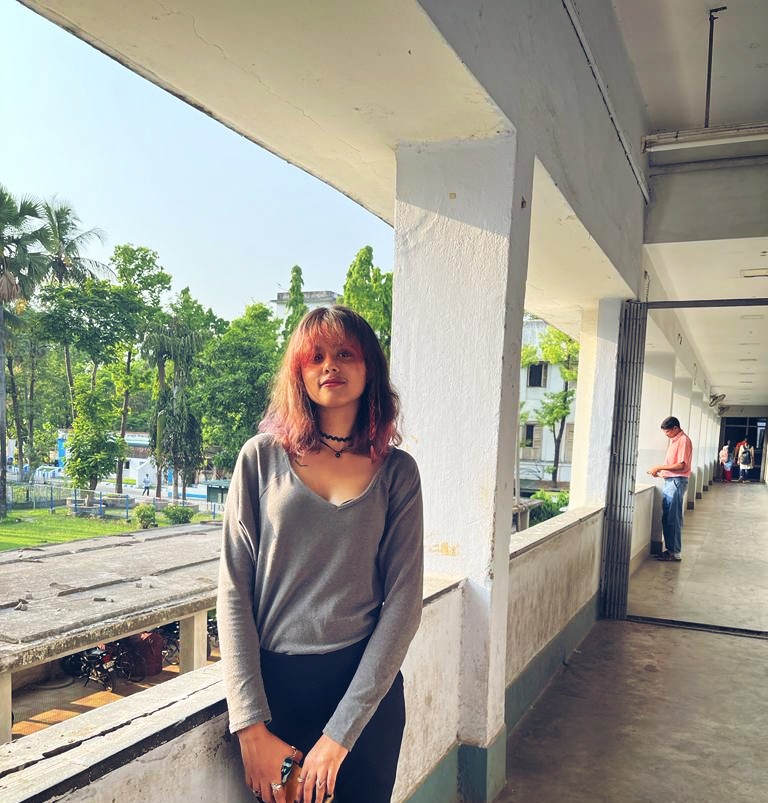
Suvechchha Saha is an aspiring writer and has recently completed Masters in English literature from Rabindra Bharati University. Her special interest lies in feminist literature and women centric fictions.


 Parcham Online
Leave a comment