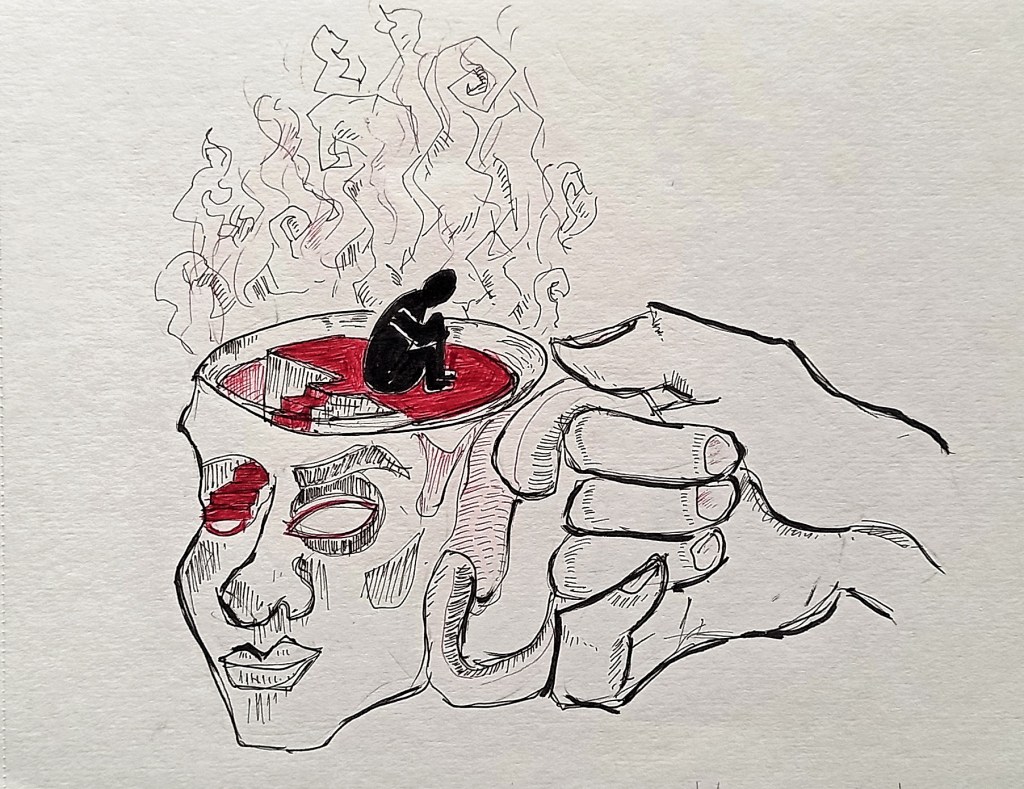
We’ve Stood Apart for So Long by William Doreski
Whiskey-colored days are spent.
Tongues dangle from the trees
in the park. Teenagers toss
a football and leer at mothers
pushing strollers that cost more
than the toddlers they contain.
We observe whatever requires
observation. Red birds rattle
through vapors we shouldn’t breathe.
The old spring choir disbanded,
but some of its members still
alto around the neighborhood,
splaying notes that stick nowhere.
We’ve enjoyed this village, but now
our tempers retail our souls,
if we have them, and we spark
as if receding into childhood.
Time’s Arrow, we laugh, a crisp
little novel we’d forgotten
we read aloud decades ago
while the whiskey colors danced.
Can we salvage ourselves in the park
while the vulgar play continues
as infants tan and grandparents
enumerate defining moments?
We’ve stood apart for so long
that our crumpled parts no longer
define or refine our personhood.
Let’s go home and cobble moments
of peace amid the weeds. Ransom
of tick-bites, terrible disease,
and umbrage of melodies lost
in a lack of musicianship
don’t have to embarrass us
if we pose at the proper angle,
sweating like sundials at work.

William Doreski lives in Peterborough, New Hampshire. He has taught at several colleges and universities. His most recent book of poetry is Dogs Don’t Care (2022). His essays, poetry, fiction, and reviews have appeared in various journals.
The Selfie by Nina Carroll
compose one
stop short
on sidewalk
so self-absorbed
another’s tripped
mid-step
the shooter
now overwrought
shot caught on cell
smartphone or webcam handheld or on a stick
edit self-portrait
construct or make-up
camouflage sadness
erase blemishes
boast happiness
fake beauty marks
post stills live videos
in grace/disgrace
face made up/ not
body nude/ dressed
hair brushed/ mussed
jpegs pinned in cyberspace
on social apps
dating site du jour
a media made pic
dropped into place
Instagram or Snapchat
TikTok or whatnot
set up a false dichotomy
vet images
love your own
nix others
see self first
like mine
take down theirs
put up yours
look at me not you
steal satisfaction
buy self-esteem
praise me
like me too
marks with hearts
clicks to share
outnumber
the likes of you
later change your name
so no one links you
to your ancient posts
fake aloof
truth or spoof
now vanished
you lie in disguise
reinvent a new persona
with polish and poise
and yes
the emperor has new clothes.

Nina Carroll, MD., self-identifies as poet, traveler, sailor, gardener, gynecologist. She composes poetic fragments like tesserae for word mosaics now become poems old and new which have been published in the anthology Irises of the University of Canberra, a book How Swimmers Dream, and in Open Door Magazine.
Graffiti by Rachel Loughlin
My friend studies graffiti
From Roman ruins
I once heard her speak on the things
We learn from words arrested by time
When ash rained down and paused life
Before it could be curated into
Narrative sanitized to serve power
And I look at the statue
In the center of the road
That runs directly into my house
And I wonder what historians
Would make of it
Were we to be unearthed after burial
By a rain of sudden ash today
Exaltation of wars lost
Cries of pain and liberation
Coexisting on that marble
What will history say
Of the part I played
When it came in teargas plumes
Up the road to my door
Did I answer, or peer between the blinds
Afraid. Till time moved on
When they dissect our memory
Hold this crossroads where
History meets the urgency
Of tonight and live-streamed sudden storms
How will they interpret
Urgent scribblings of righteous anger
Expletives and prayers
History denied a people
Too long, too late
Till at last
Fire falls
Rachel Loughlin graduated from Virginia Commonwealth University where she received the Undergraduate Poetry Award. She is a graphic designer, eternally optimistic gardener, runner, muralist, and writer living in Richmond, Virginia. Rachel explores the intersections of nature, sensuality, and deconstructed spirituality through her poetry. Her work appears in Pure Slush Books, Green Ink Poetry, Tiny Seed Literary Journal, Paddler Press, Flora Fiction Literary Magazine, Musing Publications, Moss Piglet, Plum Tree Tavern, and Kind of a Hurricane Press.
Before Everything Else by Oindri Sengupta
What petrifies me the most
is the sound of a doorbell.
Once you learn
how to fling the dichotomy of time
out of the courtyard,
the wait on the other side of the door
turns into a song being played on loop.
We are all looking into someone else’s mirror
to see the faces waiting for us
through the mist of centuries.
The colours are dying from overuse.
Also that overarching excuse
to yield before monumental desires
haunts like a cloud set on fire.
Because the sun erupts
with the same motion each day,
to plant its seeds in the ashes of the night.
As sometimes it is only about
how to stand and wait
and wanting only to be loved again.

Oindri Sengupta teaches English at a Govt. School in Kolkata, West Bengal, India.She had been published in national and international anthologies and journals like The Lake (UK), Muse India, Chiron Review (USA), Outlook India, Plato’s Caves Online, Abridged (Northern Ireland),Poetica Review, Dhaka Tribune etc.
‘After the Fall of a Cloud’ (Hawakal Publishers, New Delhi, February 2022) is her debut collection of poetry.
College Street By Somrita Urni Ganguly
when I was younger
when I stayed with my parents in Calcutta
when I frequented College Street to meet an ex-lover
when I prepared for my classes reading physical books lying flat
on my stomach
on the terrace
under the melting winter whiskey warm sun
I used to buy books every month
I love
the smell of new books
the jaundiced texture of moth-eaten dying second hand books
back then
when some books were rather rare
back then
when I hardly had money from my monthly allowance to spare
I used to buy old books every new month
this old book was a Thomas Hardy
Far from the Madding Crowd
and on its last page was a love sonnet
written by a previous owner
in that old book that I had bought that new month
following the sonnet were the following words
I write this for you Bathsheba of my heart
and send it out into the world
so it can travel to your heart
and if it does
write back to me for you know I shall be waiting
my soul bound to the spine of this old book month after every new month
I did not know who the words were for
I was afraid to presume they could be for me
I returned the book to the book vendor
with the hope that the letter
would find an answer
someday
how I wish I could recall that sonnet today
as I sit here ordering another book on my Kindle
waiting for that WhatsApp message that might never come
how long are people willing to wait?
Dr. Somrita Urni Ganguly is a professor, and award-winning poet and literary translator. She was a Fulbright Doctoral Research Fellow at Brown University, and is an alumna of the University of East Anglia’s International Literary Translation and Creative Writing Summer School. Somrita served as a judge for the PEN America Translation Prize, and the Kamala Das Poetry Awards, and an Expert Reader for the English PEN Translation Grant, the National Endowment for the Arts Translation Grant offered by the US federal government, and the National Translation Award (US). She is currently Head of the Department of English, Maharaja Manindra Chandra College, University of Calcutta, and has worked on literary translation projects with Room to Read, USA, and the National Centre for Writing, UK. Her work has been showcased at the London Book Fair, and she has read in cities like Bloomington, Bombay, Boston, Calcutta, Cove, Delhi, Hyderabad, London, Miami, Providence, and Singapore. Somrita edited the first anthology of food poems, Quesadilla and Other Adventures (2019), and translated 3 Stories: Sarat Chandra Chattopadhyay (2021), Firesongs (2019), Shakuni (2019), and The Midnight Sun: Love Lyrics and Farewell Songs (2018), among other works.
 Parcham Online
Leave a comment