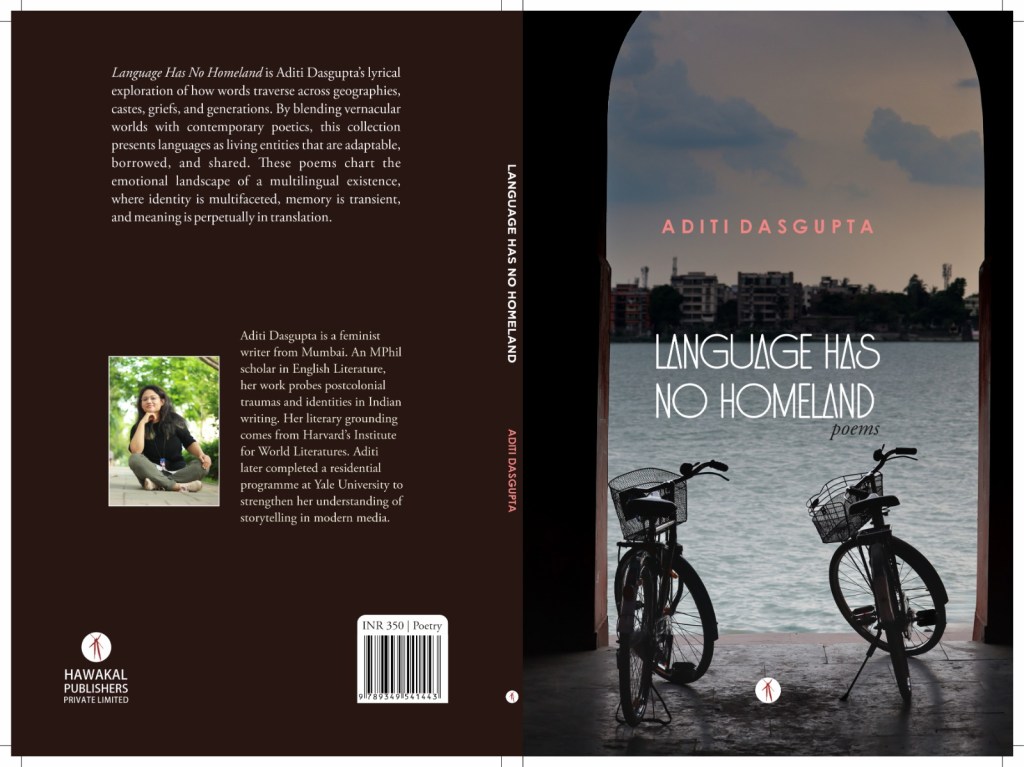
Language Has No Homeland
Poet: Aditi Dasgupta
Reviewed by: Malini Bhattacharya
Aditi Dasgupta’s Language Has No Homeland is a slim book, albeit an inventive and cadenced one. This is a collection of poems that builds bridges across languages and the unique emotional semantics that each represents. We meet Bengali, Tamil, Urdu, Hindi, Marathi, Assamese, Bodo, Kashmiri and more, and Dasgupta successfully establishes how identity is essentially plural, and that language itself is an inveterate shape-shifter. In fact, the book is dedicated to “the people we once were and the languages we never outgrow.”
Dasgupta has split her book into two sections—Innocence and Experience—a clever codification suggesting an evolution in the way language is experienced and wielded. “Over time, languages reshape their own edges, and in that very distortion lies their resistance,” she writes in the Preface.
A first read immediately draws attention to the nearly familial intimacy of these poems, a sense of ease with the surroundings explored—kitchens, courtyards, train compartments, temple premises, balconies, and hospital wards. Domesticity expands to accommodate a teeming lexicon straddling multiple tongues. In poems such as “Mishti Doi” and “Kaku’s Ombol,” humour grows from memory, allowing food and colloquy to ensure cultural continuity without resorting to peddling nostalgia. The poet’s linguistic shifts are skillfully done and quite seamless; one perceives that they arise from her lived experience rather than from attempts to merely be ornamental. This is especially noticeable in “Vairagya”.
“But we all begin rehearsing long before the final act.
Because—
I have unlearnt wanting over the years, one life at a time.”
Quietly brilliant are the poems in the latter part of the book. “Nine Yards of Zidd” is a telling study of a woman’s relationship with inheritance and autonomy, through the drape of a sari. In “Nidar” and “Thanimai,” the body acquires a duality, as both battleground and witness to its struggles for survival. Dasgupta’s diction fans out to take in words that resist translation, because they carry whole mysterious lives with them.
Dasgupta’s craft is best showcased in the fine balance she achieves between lyricism and narrative clarity. Her images are startling and sensuous, but comforting, and possible to fit into the borders of our ordinary lives: tanpura strings stretched taut, rice measured out by the grain, ink moving like a splinter beneath skin, bubbles breaking the space between air and water.
“And for five full minutes,
the world is just this —
a child,
in his balcony
with his budbuds.”
Ultimately, Language Has No Homeland is a deeply performative work. Dasgupta unravels and re-weaves the threads that make up the idea of belonging—borrowings, miscegenation, and the ineffable limits of translation. Her poems invite readers not to grapple with the confusions of a heterogenous linguistic landscape, but to turn inward and pay tribute to the hyphenations of language and identity within their own lives.
Publisher: Hawakal
Price: 350 Rs
PP: 90 pages

Malini writes fiction, creative nonfiction and (very rarely) poetry and translates the work of contemporary women writers to and from English and Bengali, working in thronging cafes that afford the anonymity she likes. Her work has appeared in Palette Poetry, Coldnoon Travel Poetics, Litro, Tehelka, Cerebration, The News Minute, The Better India, Agony Opera, Aparjan among others, and an anthology of mental health writing – “Side Effects of Living”. She published her first book of short stories – “Irregular Love”- in 2022, and her second – “Despite All That” – in 2026.
 Parcham Online
Leave a comment