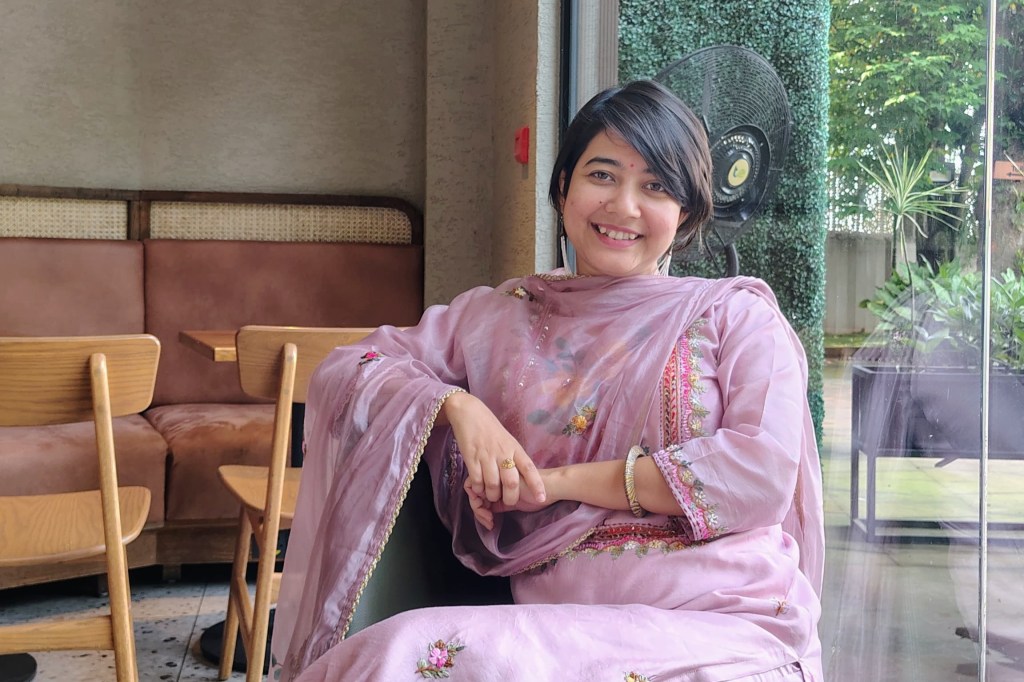
Candice Louisa Daquin in conversation with artist, poet and activist, Dr. Jharna Choudhury
“The mouth of a needle” is the embroidery activist Dr. Jharna Choudhury’s first collection of short poems in English. Choudhury has been writing since 2011; and she split her poetry manuscript into two books. The first, “the mouth of a needle,” was published on the dark day of the legendary artist Zubeen Garg’s cremation. The collection is still a manuscript, looking for a home, titled “this is your mother speaking.”
I got to know Choudhury through The Kali Project and some other subsequent projects I was co-editor of. I found every time I began working on a project, I wanted to reach out to Choudhury and have her embroidery activism and poetry in the project. She’s a prodigy in her abilities, and has an insight that few possess and an intensely creative way of expressing herself politically, socially and as a woman. I sat down with Jharna Choudhury to ask her some questions about her writing-process during the month of her publication:
CDL: Jharna. It is an honor to interview you for Parcham Magazine. We’ve featured your work before and so admire the direction of your activism. How do you have the energy for your activism? How do you fit into your schedule, a family, responsibilities, plus full-time working in academia, and still have time to make such powerful embroidery activism pieces and write so well as a poet?
JC: I am extremely honoured to have this conversation with you and Parcham Magazine. Regarding my embroidery activism and work, definitely, as a woman, it is very challenging to balance everything. I have a 9-to-5 job as an Assistant Professor in a college in Assam, then I have a family to take care of. As we all know, rigorous research work and creative creations, poetry and a slow art like hand embroidery, take different spaces of my mind. At times, I need to choose my direction. I divide my time throughout the year; there are months when I work on my academic writing, and the other months I focus on threading and poetry. I draw my energy from my belief in the universe. Art is my god, and I worship nature. This keeps me going.
CDL: When you began working on the initial manuscript that was split in two, what was your thought process? Why did you want to do it? And where in the process did you decide it should be divided?
JC: I have written a lot since I was a teenager. In 2011, I completed my first novel, still unpublished, and I have no plans of publishing, as I have since outgrown it. But this completion gave me the courage to believe that a book can be finished if I write with my focus intact. I began writing poetry around that same time, 2011. I had started with regular online writing challenges, college magazines, and began compiling my unpublished poetry. Over the years, I ended up with quite a number. In 2023, I published my Assamese poetry collection Kaya, which roughly translates into “the body”. The poems are sensual and eco-poetic. In 2025, the current year, I looked through my compiled poetry in English, and decided to divide some poems into two chapbooks. The decision was not spontaneous; “the mouth of a needle” has more poems on my reflection as an embroiderer, and the second book “This is your mother speaking,” still unpublished, reflects on women, hardships, the female body, same-sex relationships, and maternal health.
CDL: What do you think when people connect with your writing? Do you have a dislocation where you can’t really relate to positive feedback or does it help you continue writing?
JC: As a writer, the release of emotions is a wild project, and I have a target audience, but this structure is not concrete. People often connect with some of my works; sometimes they do not. There is no compulsion. I don’t believe in the viral world of social media. The viral is a virus, I will say again. If a writer is writing to be viral and famous overnight, then I see a problem there. I want my poems to talk to people in their most vulnerable moments. Only then, I believe my poems get positive feedback. My poems should be a moment of halt, like you know, sometimes we forget that we are breathing, and then we reflect on it, and suddenly feel the breath: I am talking about that moment.
CDL: Do you see yourself as a social activist? If so; what activisms do you most relate to?
JC: Yes, I see myself as a social activist, in the sense that I talk about experiences that are still taboo, I write about tokenism, debilitating rituals, menstruation, aspects of maternal depression, melancholia, and sexual identities. I don’t write romantically; I think as Indian women, we are still not there. It is a big loop of expectations, household load, compromised dreams, and from “what to wear” to “what to eat,” everything is controlled. That is a sad fact! That is why I want to write as sharp as a knife. I am still working on the technique.
CDL: How important is it to speak up against injustice? Does it work? If you think it works, how do you think it works from activism to change?
JC: Speaking up against injustice is extremely important. Silence sustains all sorts of discrimination. Change doesn’t always begin with a loud revolution. It is small at times, as small as a stitch, a word. I have this ongoing social project, A Hundred Stitches, where I have taught a handful of government and charity school students the basics of hand embroidery. I consider this a tangible form of change, where a student from a family of financial hardship feels empowered when they can repair their uniforms and bags. This is a reminder that self-reliance starts at a very young age. Activism and change are correlated; it is not always about protesting. I feel skill training and equipping others can carefully bring about a change as well.
CDL: Why did you decide to write this book in English? I speak English as a third-language so I can relate to the Universalism of speaking English in order to get jobs, or have a wider reading audience. But do you also feel there is something lost by speaking and writing in English? Something that we should hold onto so we don’t lose our cultural roots?
JC: We all have a journey with language and languages. English is always a bridge, and it allows a global conversation, but there is an obvious risk of diluting the cultural experiences and local expressions that belong to one’s mother tongue. I also say that languages co-exist, they enrich each other. I try to negotiate this gap with my textile translations, weaving local sensibilities, memories of silences.
CDL: How does being a South Asian Indian poet and embroiderer influence how you see the world, versus the way the Western world views things? What do you bring to the table that is lost in the over-influence and dominance of the West, that fortunately is beginning to change as we become more globally minded?
JC: I am definitely surrounded culturally, environmentally, and sensorially by a very local Assamese community. I live and work in the Dimoria region of Assam, known for the local flavour, the ethnic and linguistic diversity (Karbi, Tiwa, Bodo, Rabha, Deuri, Garo), biodiversity, handloom variety, and this influences me all the time, when I place myself in front of a Western worldview. As a reader and writer of literature, I do not have a center. I may write from a small corner of Assam, but I want global listeners who will understand the rhythm of my words. Where I deviate from the West, as a South Asian Indian poet-embroiderer, is the idea of “speed”. Like I have already said, “viral is a virus”. I love slow art; it has infinite possibilities. Poetry too, should see seasonal changes, moods, decay, rebirth.
CDL: A lot of your work is intensely feminist. I love that about it. You are unafraid of showing the viscera of a woman’s life. Why is this important to you? And in general?
JC: I am so unapologetically feminist. I won’t stop being one. I have seen and heard and felt mental and physical cages; I do not want to submit. Patriarchy is so systemic in society at large that we come across regular challenges. Right from the birth of a woman, to her puberty, her safety issues as a child, then as an adult, everything is policed, and there are layers of violence. For me, embroidery is a language, a radical art form, or a so-called “feminine craft”. My embroidery documents the labour of a woman’s life, added by society. I have worked on motifs of dowry and bride-burning, post-partum depression, and body scars. I have a work called “Women Meat”, which displays a rape and the treatment of women as a product of consumption, correlating it her to sister species of an animal. As a woman, I feel the urge to be vocal with my art, to resist with threads.
CDL: Have you received a lot of support as an artist and writer? I have found in my own experience I had to do everything myself, I received very little support, and at times that was very challenging to self-generate that faith and keep going. I’ve noticed you galvanize a lot of people who really believe in what you are doing; does this help push you forward? Who has been there for you who has surprised you?
JC: As a beginner, there is always less support. Also, I feel embroiderers support embroiderers, and people who work with paint or digital art support people in their own field. But being in the centre, where threads can paint and project, I am sometimes lost. I definitely have a handful of friends who understand my point. People approach me for commercial orders, and when I say ‘no’ they really don’t understand why I am doing it. It is like writing and being unpublished. Yes, I do have people who appreciate my perspective- my mother and husband stand by me, in my artistic projects, always inquisitive. My husband, Arupjyoti Baruah is an artist himself, and we have made our home an art space, constantly creating for the love of it. His musical compositions are such a therapy, when I am threading or writing, he comes like a surprise in my life. Also, I have people like you, Candice, who have been a supporter of my art on social media. Some friends, yes, gave me the courage to make more.
CDL: Like yourself, I’m an advocate of the slow-down-movement, wherein as women particularly, we’re not defined (or defining ourselves) by how much we ‘achieve.’ This is an inherited mantle from patriarchy that doesn’t feel organic in a feminine experience. When I moved to America I noticed particularly how ‘fast’ everyone was, how your ‘worth’ was tied inextricably to your output, or weight, or income. I feel this sets feminism at its core, back. We try to do ‘everything’ to prove ourselves but we only end up losing more. What do you think?
JC: I agree with you deeply here! I love the rhythm of slowness; it has nothing to do with being unproductive. The constant pressure to achieve is so overwhelming at times. It appears that the concept of achievement or output was never designed with women in mind. Rest is so important for us, and the only worthy feeling is being rested. We carry the baggage of exhausted mothers and grandmothers, who are hailed as achievers in society, because they drained themselves out and never said a word. Today, more than the “performance” of a woman, I choose the act of being peaceful and handling the surroundings with kindness. I feel this is a feminist gesture as well.
CDL: What would you like people to know about your debut collection in English? Especially a Western audience that might not be as nuanced as your readership in India?
JC: I do not believe in smoothing the edges of local flavor in my writing style to fit into the readership of a Western audience. I have admired poets like Toru Dutt, Kamala Das, Eunice de Souza, Nirmal Prabha Bordoloi,who caught readers off guard, allowing them to pause at an intimately Indian expression.
CDL: Do you think the West is woefully ignorant of the multiplexity and sophistication of thinking in other parts of the world? Whereby they relegate intellectualism and knowledge to their own tired troupes, disregarding the value and enormity of other cultures?
JC: I do think the West overlooks the complexity and intellectuality of the “other” part of the world. It simply homogenizes, draws a philosophical lineage that charts world history, keeping the West as the centre, erasing other epistemologies. The oral tradition of India and the Global South is rich and still unexplored to a large extent. Western academia cannot draft a template on its own, for the entire world. That is where expressions from diverse cultures matter.
CDL: Exactly. I feel the West thinks it’s dominant but really is just shallow in its underappreciation or total ignorance of other cultures and ways of living. If we consider the average American for example, hasn’t even gone abroad, it gives us an indication of the lack of knowledge of the breadth and depth other cultures offer the world. In some ways I also think of this being tied to womanhood. It’s a form of stereotyping other cultures, just like society at-large stereotypes what a woman ‘should’ be. I like that your art and writing reject that norm, just as other artists and creatives have. What do you think it is about art that seems to be at the heart of resistance and overthrowing ignorance? Do you get fed-up of being stereotyped? What do you do to break out of those limiting labels?
JC: The refusal to see value in other cultures is sad. Such ways of flattening and oversimplifying a culture or womanhood go together. Yes, I face stereotypes, as an Indian, then being from Northeast India, a woman of color, and as a woman who takes an interest in textiles. I do not want to be inside tidy boxes or become someone whose register is domesticated. Art helps here, in this refusal. It makes others uncomfortable, with questions. Art is never “behaved”, and as a woman, it is a way of being unapologetic for having individual thoughts.
CDL: Your introduction states: “The Mouth of a Needle threads twenty-one poems that pierce, mend, and resist. From the hands of an embroidery artist, these poems unravel maternity, trauma, desire; silences that turn into storms; scars that open into rivers; and women’s fiercest emotions. Each line pricks like a stitch: small, sharp, and impossible to ignore.” Do you believe activism, especially in women, is attached to their physicality? Meaning, it is impossible to divorce ourselves physically as women and what we endure, from activism?
JC: Yes, yes, yes! Activism is inseparable from the physical body. In India, on a daily basis, the female body is far beyond the abstract ideals of “devi” worship, or you can use other synonyms here! The female body faces danger and shame. All women are hyper-alert, why? Women are trained to endure, and our bodies are trained to adapt in threatening situations. That is the truth! I correlate my experiences, writing and threading with my body. Before I exhaust, I want to write. Each poem is an act of survival.
CLD: I found it really interesting that you said your writing ‘mended’ things; as that’s a novel and really positive way of perceiving the art of writing. I relate it to when you can mend something through sewing. How do you see your ability as a writer and activist, in being able to repair and mend things? And what things?
JC: Mending is about care. I believe embroidery and writing heal. At the same time, it resists invisibility. Tell me, how long will you be invisible, or inherit silence? Definitely, there is no permanent fix! But it helps mend temporary fractures that we carry in our heads, until we down ourselves. Tiny and steady stitches, or words, simply mean we are moving ahead; it keeps us from falling. That’s all we want!
 Parcham Online
Leave a comment