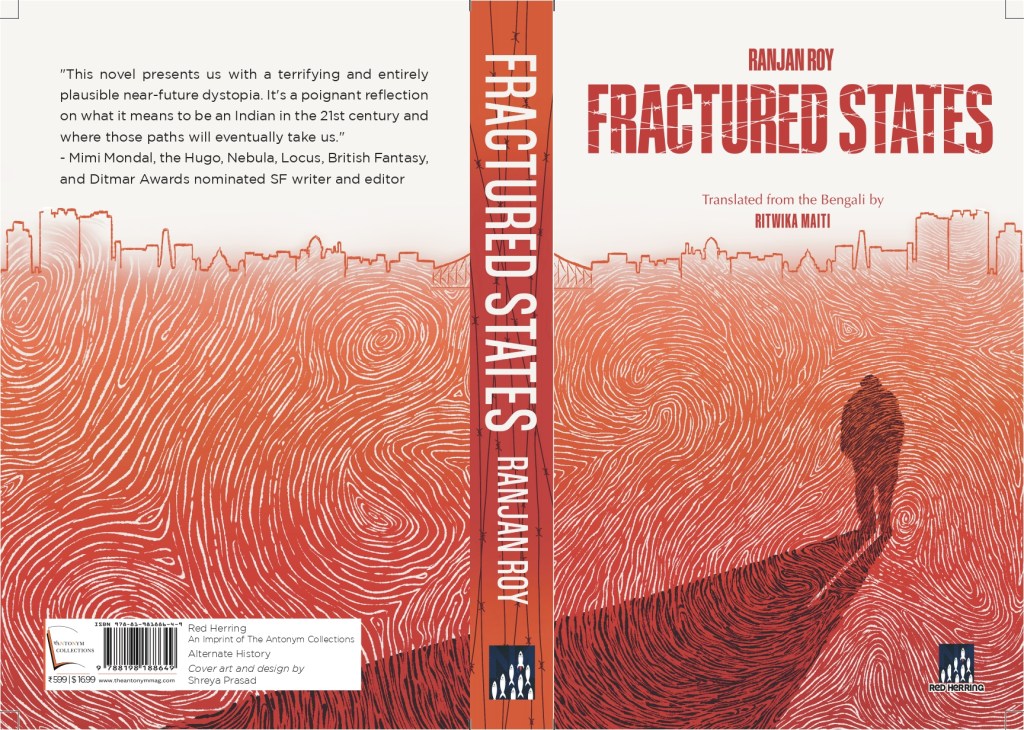
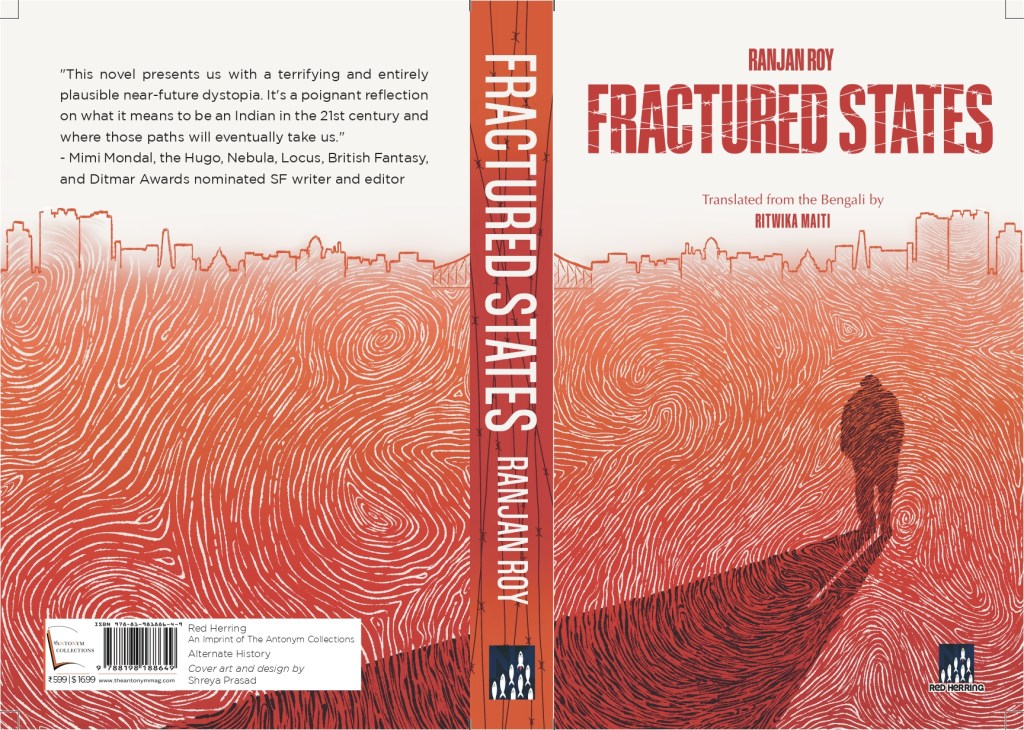
Book: Fractured States
Author: Ranjan Roy
Translated from the Bengali by Ritwika Maiti
In a near-future India, the nation has shed the last remnants of its democratic past. The Constitution has been quietly rewritten, surveillance technologies monitor every citizen, and belonging is no longer a right—it must be proven through documentation. The government, through its National Citizenship Register (NCR), now determines the worthiness of every individual using biometric profiling, ancestral records, and digital scoring. In this stark new order, a single clerical inconsistency can turn a lifelong citizen into an illegal entity.
Tarini Kumar Dutta, a 79-year-old retired schoolteacher in Kolkata, is one such casualty. Soft-spoken and principled, he awakens one morning to find himself flagged as a “D” — a Doubtful Citizen. He has no birth certificate, no legacy documents, no verifiable lineage linking him to the new official timeline of the Republic. Without warning or trial, he is detained and transported to a facility built inside his former school, now repurposed into a state-run detention center for the undocumented.
Inside, Tarini encounters a tragic tapestry of others like him: teachers, students, civil servants, and artists—all rendered stateless by missing papers, political vendettas, or inherited ambiguities. They are subjected to endless interrogations, indoctrination programs, and psychological erasure. The system is faceless, run by AI algorithms and legal automation, immune to reason or empathy. Meanwhile, outside the facility, Tarini’s wife Sabita embarks on a heartbreaking search to locate any shred of documentation that might restore his status. She traverses record offices, libraries, and family archives only to discover that the paper trail of their lives has either decayed or been erased.
As Tarini’s memories unfold—of a childhood in pre-Partition Bengal, of teaching generations of students, of his quiet resistance during a more hopeful time—the story becomes a meditation on the meaning of home, history, and the fragility of truth in a state where memory holds no legal value. The more Sabita tries to validate her husband’s existence through government channels, the more Kafkaesque the struggle becomes. The couple’s joint bank account is frozen, their home flagged, and even their daughter—an officially verified citizen—is powerless to intervene.
Yet in the heart of despair, Fractured States find quiet acts of resistance. Tarini plants a jasmine sapling in the detention yard, naming it after his daughter. He helps fellow detainees preserve their stories. He refuses to break beneath the weight of a regime that deems him unworthy. His struggle becomes not just about documentation, but about asserting the legitimacy of memory, dignity, and love in a country that no longer recognizes him.
Fractured States is a haunting, politically charged novel that blends dystopia with intimate realism. Drawing from real-world citizenship battles and the lasting trauma of Partition, it exposes the terrifying ease with which the state can erase its people—not with violence, but with silence, forms, and forgotten files. A work of speculative fiction with urgent relevance, it is both a warning and a tribute to those who refuse to disappear.
 Parcham Online
Leave a comment