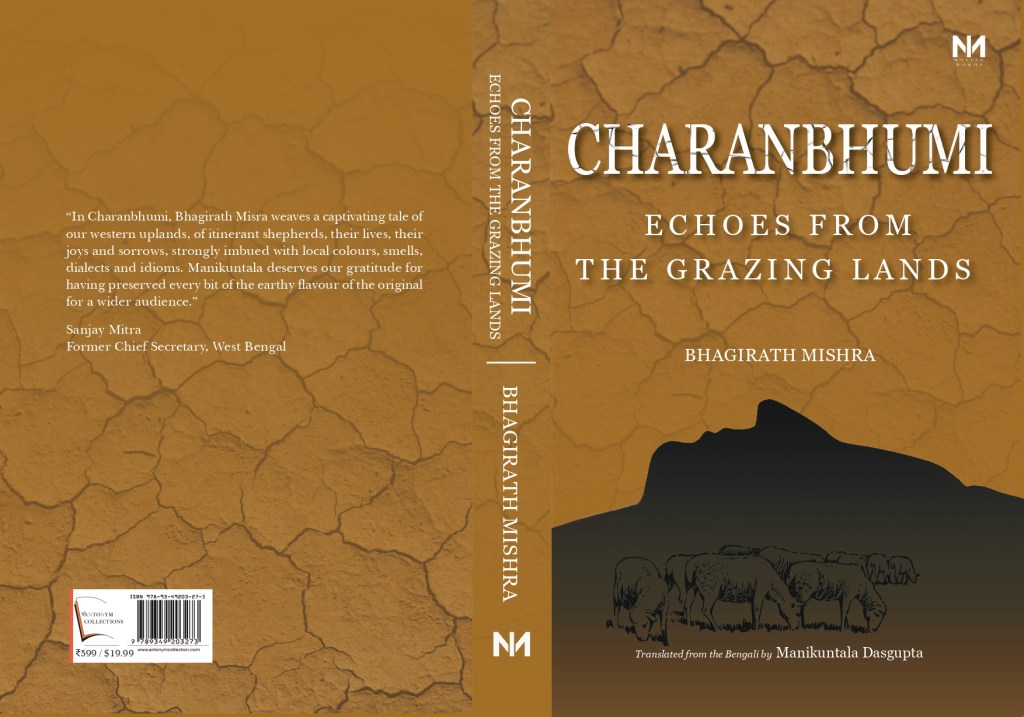
Author: Bhagirath Mishra
Translated from the Bengali by Manikuntala Dasgupta
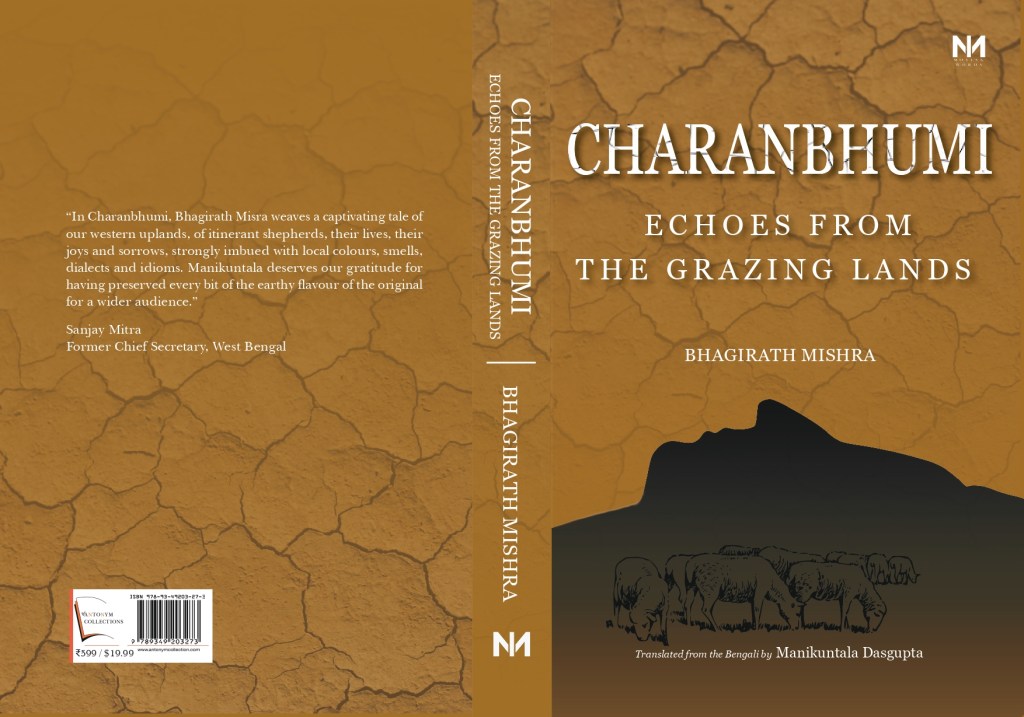
Bhagirath Mishra’s Charanbhumi, translated by Manikuntala Dasgupta, as Charanbhumi: The Grazing Land, traces the life of the shepherding bheriyar community in the rural Gangetic hinterlands of Jharkhand, Bihar and West Bengal. Set during the heydays of the Communist Government in Bengal during the 1970s, it follows the protagonist Munshi as he tries to navigate through a series of personal and political travails. The novel is packed with different characters—each lively and carefully drawn with their own set of eccentricities and problems—moving through interconnected subplots that narrate the everyday lives of the shepherds as they move from one pasture to another with their flocks of sheep. Besides its innovative content, what sets the novel apart is its inclusion of ancholik or regional dialects, songs, myths and stories specific among the migrating shepherds, and Dasgupta’s translation retains the sensibility and cadence of the original Bangla text.
At the centre of the novel’s action is Munshi’s love for Rukminia, the revolutionary Ruplal’s proud and equally fierce younger sister, and how that clashes with the bourgeois political forces led by the oppressive zamindar Prabhudayal Singh, and the personal pressures of surviving and sustaining his family as a poor shepherd. This is complicated by Parvati, Munshi’s sister’s marriage and subsequent molestation at the hands of Prabhudayal’s men who also murder Ruplal, and threaten Rukminia; by Lotan–Daho–Bakelal subplot which introduces the danger of the urban-city encroaching upon the lives and ways of the Bhakat shepherds; the herd leader Srikrishna Bhakat’s machinations to force Munshi into marrying his daughter, Durga; Munshi’s injury at the hands of the dacoits; etc. In all these encounters though, it is the absolute humanity of the shepherds that is reflected, particularly that of Munshi, in intimate moments such as when he speaks with Shingri, the ewe-matriarch of the flocks of sheep, or when the shepherds collectively celebrate their various festivals, and sing and dance around the fire under extreme weather conditions. Their will to endure the extreme hardships, stand-by the bleating lambs and sheep, care for and support their fellow shepherds no matter what, suggest an alternative model of humanity—and this is one of the gifts of the text, besides its more direct imagination of concrete political action at the end. The portraits of Handu and Hathat, Khedareng’s obsession with the caged bird, Bhishmi’s predictions, Ramana’s overdependence on Daho, etc., verging on the comical complement the text’s representation of a wide range of fascinating and variegated human characters.
It is towards the end, as Munshi discovers Rukminia’s alliance with the ultra left-wing leaders to avenge her brother’s murder that adds a different dimension to the text. Caught in severe monsoon, a hungry Munshi loses his way in the forest in search of food and is apprehended by the leftists who bring him to their hideout where he is reunited with Rukminia. They debate over the meaning of life providing profound commentaries on human fate, free will and political action. The two conflicting visions—of moving in a straight line towards a linear determinable progressive future and that of moving in circles like the shepherds attuned to the rhythms of nature—come into a dialogue here, embodied by Rukminia and Munshi respectively. Both the ways however, preclude any possibility of settling down that Munshi, tired of running around throughout his life, aspires for. The words of his grandfather seem to come true, that human beings are born with wheels under their feet, forever condemned to eternal movement throughout their lives. The text ends without any explicit mention of what befalls Munshi, Rukminia or the shepherds, as it culminates into the lovers running away, from the police and the zamindars chasing them, into an unknown future …
Beyond the conventional concerns of translation regarding source and target languages, Dasgupta’s work achieves a unique balance incorporating into English the dialect variations of the Bhakats, and specific details of the geography, microhistory and myths that define their lives, drawing the readers into Mishra’s fascinating world—while simultaneously making the text accessible to English readers. The ways she handles the proverbs, songs and poems deserve a special mention that enriches this translation exercise and makes The Grazing Land an unputdownable read.

Bhagirath Mishra is a celebrated Bengali author recognized for his extensive literary contributions. His notable works include the multi-volume novel Mrigaya, the award-winning Aarkathi, Jadugar, Charanbhumi, and the story collection Lebaran Badyigar. He has received numerous prestigious awards, including the Bankim Puraskar, Tarashankar Award, Samaresh Basu Smriti Award, and a Lifetime Achievement Award from the Kolkata Publishers and Booksellers Guild. His works have been adapted into plays, telefilms, and radio dramas and translated into multiple languages. Mishra’s novels and stories often explore themes of magic, folklore, and socio-political realities, earning him a global readership and recognition, including a discussion series at Heidelberg University, Germany.

Manikuntala Dasgupta has a background in literature and a keen interest in creative pursuits. She has also been involved in teaching, sharing her love for language and learning. This work marks her debut in the field of translation, reflecting her deep engagement with literature and storytelling.
Additional Information:
Title: Charanbhumi – Echoes from the Grazing Lands
Author: Bhagirath Mishra
Publisher: Moving Words (an imprint of The Antonym Collections)
Publication Date: July 2025
Format: Paperback
Buying Links:
1. https://antonymcollection.com/product/charanbhumi-echoes-from-the-grazing-lands/
 Parcham Online
Leave a comment