FROM “MINI PEOPLE IN THE JUNGLE”
BY DAWID PLANETA

“One must learn an inner solitude, wherever one may be.”
– Meister Eckhart
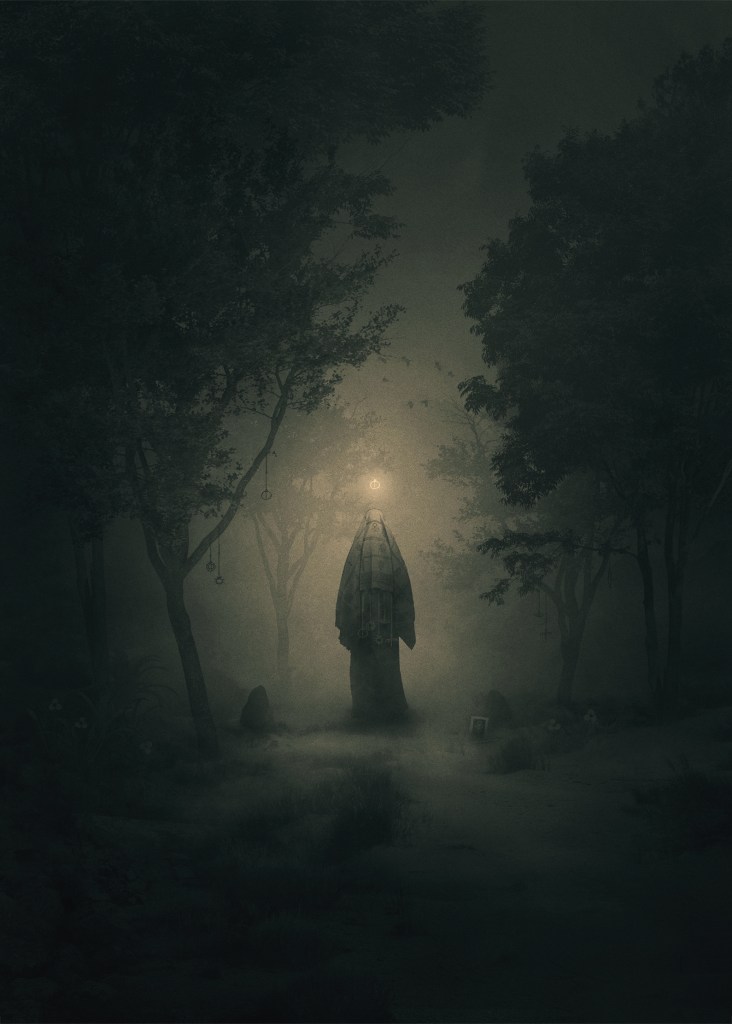
“The Hermit”, 2023,
©Dawid Tobias Planeta
The young man approached the hermit. He was standing still, looking into the light.
“Are you beginning to tell a story again?” the hermit asked, his eyes following the unseen paths. “Not everything needs to be a story; sometimes just being is enough.”
“But how can I share my experience with others if not through a story?” questioned the young man.
The hermit paused for a moment, considering the query. “Take them to a place where stories are born. Let their own stories be awakened to show them what your stories never will.”
“How can I take them there?”
“By creating a door,” he explained. “You don’t have to create stories or places. It’s enough to create a door, a space that connects the ordinary with the extraordinary. Connect others with that which cannot be put into words, which cannot be enclosed in images or stories.”
“Isn’t our conversation a story being created?”
“Perhaps, a story that’s also a door. It allows you to be in two places at once. Don’t try to describe everything. Let it be ambiguous; each person will understand it their way, the way they need the most. Let the door lead them to their own mystery.”

“I smile,
For the universe speaks to me in its own ways”
Sandesh Hukpachongbang
“The Message”, 2023.
©Dawid Planeta
“How do I know if it’s a coincidence or a message?” the young man asked.
“If you still think you can have one without the other, then I can’t help,” the old man replied, his eyes fixed on the flames.
“So you say there is always a message?” the young man pressed.
“I say that the thing that happens is a reflection of what you perceive as ‘a message’. Without it, there’d be no reflection,” the old man explained.
“But why is it so difficult to understand sometimes?” the young man pondered.
“Life speaks its own language, and you’re still learning to decipher it. Besides, some things need time to be fully articulated. It’s a language based on faith, patience and experience.,” the old man responded.
The jungle whispered its ancient truths as the young man absorbed the wisdom of his elder.
“Shouldn’t it have some reason as well?” the young man questioned, seeking assurance.
“The reason is a very reflection of it” the old man concluded, his words echoing through the night.

“I tell you this
to break your heart,
by which I mean only
that it break open and never close again
to the rest of the world.”
– Mary Oliver
Break Open”, 2024.
©Dawid Tobias Planeta
“What am I doing here?” he asked.
“You are here because you follow a voice you believe is real, though you haven’t fully embraced its reality yet. You haven’t given it the priority it deserves. Instead, you still view it as a curiosity, an intriguing thing to explore in your free time, something that could potentially grow into more someday, but nothing beyond that.”
„What is this voice, then?”, asked a man.
“That voice is life – if you don’t take it seriously, you’re not taking life seriously, and that always has consequences. You end up giving priority to trivial matters, while neglecting what truly matters. Even now, you try to hide, to shield a portion of your mind behind the wall, fortifying it with logic and the illusion of objective reasoning – ‚But what if it’s not real?’, ‘What if these thoughts are just manifestations of my complexes?’, ‘What if I’m merely imagining all of this?’ It’s easier to question and doubt than to trust and follow.
But these are all shallow questions, born from shallow thoughts. They reflect a deeper issue that runs through your entire culture – the belief that the conscious mind is all-powerful, that it can do whatever it pleases. That it has control. But if that were true, could you simply change how you feel? If so, why are you still unhappy? Out of your own free will?”
The man stayed quiet, while the voice went on.
“You are unhappy because you hear a voice urging you to act in ways that clash with your conscious plans and self-image, so you choose to ignore it, pretending it’s not there. The more intense the inner conflict, the stronger ideology you build on the outside to convince yourself that the voice you hear has no real meaning, treating it as an optional suggestion rather than a guiding force. You convince yourself that the decision is entirely in your hands, that ‚you’ are the one in control.”
“Who’s in control, then?” he asked.
“Over time, you’ll see that your inner world is much larger than you ever realized.”
“Now comes the mystery.”
– Henry Ward Beecher
“The Mystery” , 2024.
©Dawid Tobias Planeta.
“I’m still trying to understand how to find it,” the man said.
“If you can understand it, it’s not what you’re searching for,” she replied. “The mystery lies beyond reason, beyond imagination. It exists in a place the mind cannot reach—and would never want to. But that’s what your soul is calling for.”
“Is there a way to make it easier?” he asked.
“Where your soul thrives, the mind will suffer. But if you know where you’re going, that suffering transforms into a fire, burning away everything you no longer need. It burns away the pain, burns away the suffering, burns away your past. It sets you free.”
“How do I start that fire?” he asked.
“You already have,” she said. “It’s what brought you here—and it will guide you forward. You just have to listen.”

“My soul is from elsewhere, I’m sure of that, and I intend to end up there.”
— Rumi
“The Soul”, 2024.
©Dawid Tobias Planeta
Let it guide you to the place of mystery—
A place where the mind cannot follow,
Where you don’t have to think to understand,
Where truth reveals itself from within.
If you listen closely, you can hear its voice,
Hidden behind the everyday chatter of the mind—
A gentle whisper that feels different,
Like the voice of a loved one in a foreign crowd.
Don’t wait too long.
Don’t hesitate.
Each step toward the soul
Is a step toward the light you have always been.

If it is your calling, it will keep calling you.”
– Anonymous
“The Voice”, 2024.
©Dawid Planeta.
He slowly approached the fire, the flames casting their light into the darkness. The old man was sitting by it, just as the last time, his eyes fixed on the flames. The place looked the same but different at the same time.
They sat in silence for a moment.
“I think I’m lost,” the young man finally said, breaking the quiet.
“Well, you’re not. You are here,” the old man replied calmly, still looking at the fire.
“What if I can’t hear the voice anymore?”
„Well, I know you can,” said the old man
“How can you be so sure?”
“Because you are here. The only way to find this place is to follow the voice. You are here because you heard the calling.”
The young man hesitated. “But I didn’t hear anything. How do I know if I’m following it or not?”
The old man turned to him. ”Your mind will never know. Where you are going, the mind cannot follow. You must learn to listen to the silence, to see the silent path in the world of noise. That silence is the voice you’re looking for.”
The young man fell quiet. He closed his eyes and listened. At first all he could here were the whispers of the jungle and the crackling fire. But then he noticed something else, something he had never perceived before: the silent space around each sound, a silent wisdom that envelops every thought, animating it, making it alive.The void where all things are born and return, a presence that seemed to hum beneath all things.
“Don’t try to understand,” said the old man. “Trust it. Let it take you where you need to be.”
The young man opened his eyes and looked at the fire again, but now it seemed different. The flames danced around, as if they, too, were part of the silent song he had just begun to hear.
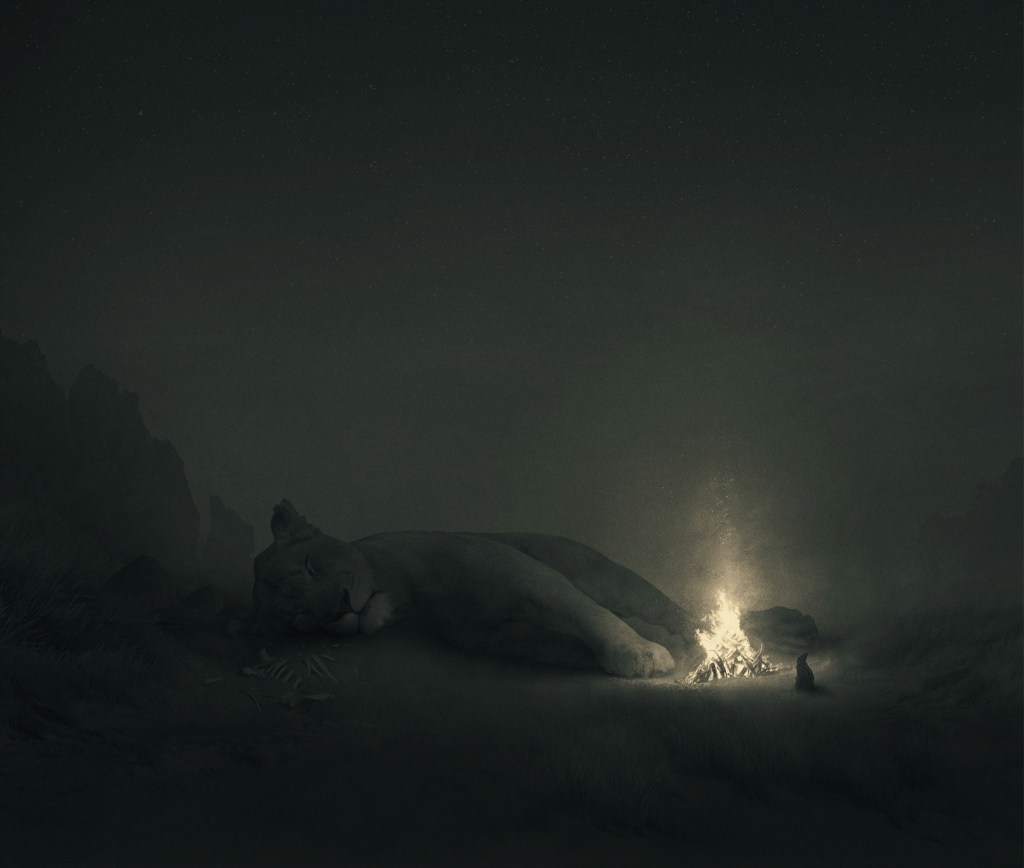
“No one ever told me that grief felt so like fear.”
– C.S. Lewis
“Grief ”, 2025.
©Dawid Planeta
“Every man has his secret sorrows which the world knows not; and often times we call a man cold when he is only sad.”
– Henry W. Longfellow
He approached the fire, looking for the old man, but the place was empty.
“Didn’t you tell me you’re always here? Didn’t you tell me this is a place outside of time?” he said, his voice tinged with anger.
The jungle responded with silence.
He sat down, staring into the flames, listening to the sounds of the night, the breath of the jungle, the heartbeat of the world.
“Just because you can’t see me doesn’t mean I’m not here,” said the voice, soft but clear.
“You see what you want to see, just as you ignore the things you don’t want to see. But that doesn’t make them disappear. They’re still there.”
“But I want to see you!” said the young man.
“That’s why you can’t. You’re afraid. Needs rooted in fear always distort your vision. You can’t see the real world now. You’re trapped by the memories of the past.”
“How do I find the way?”
“This is the way: to go back to the dark places of the past and realize they are still here. They call for your attention—for your sorrow, your anger, your tears. You must feel through the things you’ve repressed, things you’ve forgotten.”
“Then I will see the world for what it is?”
“Yes. And for what it’s not.”

“Fear not the darkness of the caves, for therein lies the path to enlightenment.”
– Anonymous
“Fear Not”, 2025.
©Dawid Planeta
“Why does it always feel like this?
Why do I keep ending up in the same dead-end?” the young man asked, frustrated.
“What am I doing wrong?”
The old man looked at him.
The fire crackled quietly between them.
The forest moved slightly in the wind.
“If you’ve taught yourself to be afraid of the night,” he said,
“you will suffer each time the evening comes.”
He paused.
“And the place where fear takes you…
it lies outside of time.
It’s always the same place, over and over again.”
The young man looked down.
“So what can I do?”
“Just let him find what he’s looking for,” the old man said.
His voice was calm, almost kind.
“What is it?”
“The courage not to let him take over,” he said.
“And the strength,” he added after a moment, “to become his friend.”

Born and raised in Poland, Dawid Planeta was always surrounded by art – his father is a photographer and his mother an art teacher. He studied industrial design at Cracow’s Academy of Fine Arts, but found it less than inspirational. His passions lay instead with art and photography, but also psychology, mythology, symbolism and the mysterious world of the subconscious.
Dawid Planeta deploys digital techniques to create moody, introspective works that are simultaneously strangely familiar and disturbingly fascinating. “Art is about going to the edge of consciousness”, he says, “where the basic layer of reality starts fading away to reveal an entirely different world beneath. It’s a place of memories that are yet to happen, where the future and the past are one. My art is a window that can help you to reconnect with deep parts of your mind, parts you often ignore.”
Planeta’s best-known works come from the series of greyscale images entitled Mini People. They explore the artist’s personal experience with depression, visualizing the mental journey through dark times. “It’s the story of a man descending into darkness and chaos to face the parts of his mind he’s been neglecting for so long,” Planeta explains.
A small figure features repeatedly in this poignant series, perhaps representing Planeta himself. He is pictured wandering through a fog-filled labyrinth, bravely facing the ominous jungle animals with fiercely glowing eyes shining through the darkness. They seem to be guiding him through the deep jungle, “to find his inner strength, to find the light and come back with it.”
 Parcham Online
Leave a comment