Semeen Ali in conversation with Dibyajyoti Sarma
I spoke to Dibyajyoti to reflect not just on poetry or publishing, but on how language and a city can shape, un-shape, and reshape a person. This exchange is less an interview and more a quiet tracing of that delicate line between rootedness and drift. Dibya, as his close ones call him, moves through geographies and tongues with a gentle defiance, never quite claiming a place, yet never entirely outside of it either. In this brief conversation, I have tried to hold that tension – that freedom – in the folds of his words. It is in these in-between spaces that many of us begin to find ourselves. I hope you, too, find something of yourself here.
– Semeen Ali.
Semeen: You have spoken about learning to speak and write in English during your Master’s at Pune University, eventually going on to teach the language at various colleges. To what extent do you feel that a language like English can stifle or complicate how one feels? It is not just a language one is learning, but also a set of subtle shifts that come with expressing oneself in it. How do you see this process, both personally and more broadly?
Dibyajyoti : Can I first complicate the question further by asking: which English? I am aware of my lack of a convent education or a foreign university degree. And my years of experience have taught me that it’s pointless to sound like someone else. So, borrowing from Kamala Das, I claim my English to be a version of Indian English, which is malleable and constantly evolving.
To contextualise this, when my first collection of poems, Glimpses of a Personal History, came out from Writers Workshop came out in 2004, Hoshang Merchant wrote to ask why I must write in English. Not only my sensibility, (Assamese), even my English is broken. I often confuse prepositions. He was right, of course. I was still learning my English (I still am). But in those days, living in a Marathi-speaking state, I found that writing in Assamese was limiting. I wanted to reach more readers. So, I doubled down on my English; it’s not how a native speaker will use the language, but my goal was never to communicate with the native speaker. My goal was to speak to my peers, and my English worked just fine. The same goes for my speech. I speak with a strong Assamese accent. When I was young, I tried to get rid of the accent, then I just gave up. I am fine as long as I am understood.
Coming from the North-East of India, I grew up amidst the cacophony of languages and accents. And it did not matter, as long as we were understood. For me, language is a medium and not a thing unto itself.
The question you ask is pertinent, especially because Assamese, my mother tongue, and English are two very different languages. Assamese is emotional. English is clinical. In the early days, I would translate constantly from one to another, but slowly English became my chosen tongue (the language in which I think), with the sprinkling of other language I know — Assamese, Bengali, Hindi, Marathi.
Unlike a lot of Indian writers, I was never keen on experimenting with the language itself, because I knew I couldn’t. I use language as a means to an end — to say what I need to say.
The key is to be aware, and to live in the chaos of it. And learn. And keep learning. It reminds me of the Robert Graves poem, ‘In Broken Images’: ‘He is quick, thinking in clear images;/ I am slow, thinking in broken images.// He becomes dull, trusting to his clear images;/ I become sharp, mistrusting my broken images.’
I am always mistrusting. I am always questioning.
S.A: Your last sentence really captures something a lot of us struggle with. That question of how much the language we are using to express ourselves is actually ours. And it gets even trickier when you have written a book and want to put it out into the world. There is still a strange kind of taboo around self-publishing; as if choosing that route automatically means the work isn’t good enough. But this snobbery overlooks something fundamental. In the Indian poetry scene, so many major voices turned to self-publishing simply because there was no other way to be heard. Writers Workshop, Calcutta was one of the few spaces that offered us a genuine launching pad, without gatekeepers. Your first book of poems was published from there in 2004. Today, the landscape has become glossier – literary agents, PR machinery, and endless talk of ‘visibility’. And yet, I have seen exceptional writers/poets struggle to break through, just because they don’t have the right ‘connects’ or representation. As a poet and translator – someone who has navigated this terrain, how do you view this hierarchy? I am not asking as a publisher (not yet), but as someone who has known what it means to start from the margins.
D.S: See, as writers and readers, we tend to forget that publishing is a business, and like any business, it must make money. The Indian publishing ecosystem is complicated and confusing. There are so many publishers and everyone is doing things their own way. So, I can’t tell you what makes a publisher say yes to one manuscript and no to another. But the end goal remains the same — the book must sell. Sometimes back, I did an informal calculation how much it costs to publish a standard trade paperback. Here is the breakdown — advance: Rs 1 lakh + editing/designing: Rs 1 lakh + printing/warehousing/marketing: Rs 1 lakh. So, for a standard book to make profit, the publisher needs to earn more than Rs 3 lakh. Let’s say the book is priced at Rs 400. You will have to share 40-45% of the profit with the bookseller. On Amazon, the number is even higher. So, to make, Rs 4 lakh from a book, you will have to sell more than 2,000 copies of the book. So, obviously, if you are publisher, more than the quality of the book, you will to consider the saleability of the product. That’s why we see so many celebrity books and self-help books in the market.
So, for a mainstream press, the decision to publish a book has less to do with quality and more with the saleability, and those are two very different things. It may be unfair, but it’s the truth.
Before I came into publishing, I was a vocal critic of the mainstream presses and the kind of work they do or don’t. But now I know better.
The publishing scenario has changed drastically over the last forty years. Earlier, there were fewer writers and more readers. So, a publisher could focus on promoting their authors. Now, there are more writers and fewer readers. And these readers are fragmented. To reach out to these reader groups, publishers put out different kinds of books, and they have no time to promote individual books. So, the onus is on the writer to promote their own book. Thus, the urban myth: it’s not the quality of your book, but the number of your followers on Instagram that will decide whether a publisher will pick up your project. Thus, visibility helps. Connections help.
According to unreliable sources, a bestselling title in India sells 3,000 copies. The number sounds paltry considering the population of the country, but trust me, it is not easy to sell 3,000 copies of a book (of course, there are also authors in India who sell more than a lakh copies of books).
In this context, self-publishing is a way out. As you mentioned, there is a stigma attached to self-publishing, but I believe it’s no longer a taboo. See, how we changed the nomenclature. Earlier, it was called vanity publishing. Now, it’s self-publishing — now, it’s an act of reclaiming the space bypassing the so-called gatekeepers, not just an act of vanity. Self-publishing has opened up the playing field. It has given writers more freedom to choose how they want to share their work with the public. It also gives an author more freedom to own their works. You mentioned Writers Workshop. I have tremendous respect for what it has done and continues to do. Clearly, Red River was inspired by Writers Workshop to a great extent.
S.A: Being a publisher, especially one focused on poetry is no easy feat, particularly in such a competitive landscape. You made a conscious choice to publish poetry despite knowing the challenges: minimal returns, limited recognition, and an often-niche audience. Why did you make that decision? What drove you to take that leap when so many would hesitate? Over time, Red River has expanded to include prose, but initially, that wasn’t part of the plan. You ventured in headlong as a poetry publisher. What motivated that early focus?
D.S: As I mentioned elsewhere, there was no grand plan. It just happened. In 2012, my second collection of poems was ready, and I was looking for a publisher. Of course, I couldn’t find a traditional publisher (see above; I couldn’t sell), so self-publishing was the only option. Self-publishing was still in its infancy those days; there were not many options other than Writers Workshop. And I already had a book with them. So, I took the DIY approach — start everything from the scratch. I established a publishing house — iwriteimprint — got IBSNs and began researching on how to be a publisher. It took two years. The book came out in 2014. I printed 500 copies and distributed them free among friends. I was then approached by my poet friends — Abhimanyu Kumar, Uttaran Dasgupta, Ishan Marvel, Nabina Das — asking me if I could publish their books as well. I said let’s try, and here we are.
It was all an adventure, a youthful experiment. I did not expect it to last this long. I had a day job, and I still do. I did not treat publishing as a business, and I still don’t. We published ten books under iwriteimprint. As I continued to receive more manuscripts, I had to make a choice. Do I continue this? If yes, how?
I decided to take the plunge, and Red River came into being in 2017. I had two ground rules — I am not thinking of making money, and I am not trying to create bestsellers. I had no investment and I did not want get involved with money. So, I couldn’t afford to hire people. A publishing house has several departments – commissioning, editing, designing, production, sales and marketing, and so on. I do everything myself. So, from the very beginning the focus was to remain small.
The focus was simple: work with the author and bring out the best version of the manuscript possible. We spend a lot of time editing, which I believe is the key to making a good book — editing, revising, editing. We bring the book out and release it into the world. Beyond that I cannot do much and I have learned to live with it.
This is all in the hindsight. In 2017, there was no plan. I love poetry. I love books. And I got an opportunity to work on books. So, I just jumped into the deep end. I learned on the job. I did not want to look beyond the current project I was working on. Every book we publish, we consider it to be our last book. So, I try to give it my all.
S.A: There is a whole fan base, dedicated to the covers of your books. I have yet to come across anyone who doesn’t admire or love them. The cover is such an integral part of the publishing process, and the distinctiveness of Red River’s designs stands out. What drives your deep involvement in this aspect of the book? It is clear that each step of the process matters to you. Whenever I hold a Red River book, there is an undeniable presence to it, something that sets it apart from other books published by different houses. What makes you place such emphasis on this visual identity?
D.S: I really don’t know how to give an intellectual answer to this question. I love books. I am obsessed with books. The University of Pune has a great library and I would spend hours there during my student days. I must have opened every single one of those books. So, when I got an opportunity to design books, I tried to bring in everything that I liked about books and design. Books from former Soviet Union, especially the children’s books they produced, were an early influence. I was also influenced by the abundance of creativity in the books produced by Kolkata-based Seagull Books.
The thought process was simple. How do we stand out? The function of every book is the same. I could only play with the form. I spent a long time, years really, figuring out the right size for our books. At first we published a couple of titles in the traditional pocketbook size. I was fascinated by pocket books, those popular Penguin titles with yellowed pages you find in second-hand bookstores. Then I realised that size was limiting for poetry. Poetry needs space to breath on the page. So, we came up with our current format, a custom size little bigger than the mass market paperback.
Next, I wanted our books to do something extra. Hence, the design elements. I don’t have any formal training in design. I am not an artist. I just know basic photoshop. But I experimented. I am especially grateful to our early writers who allowed me to carry on with the experiments.
S.A: I want to shift the conversation a little and ask you this – where, in the truest sense, is home for you? Is it Pune, where you embarked on your higher education, taught, and began your journalistic journey? Or does home lie in Delhi, where you not only honed your craft but also founded Red River, marking a new chapter in your journey? Or is it Assam, where your story began, where the roots of who you are still pulse beneath the surface? Each of these places has shaped you, but which one carries the most weight when you think of home, that quiet, unspoken sense of belonging?
D.S: I am grateful to Delhi for helping me start Red River. The poetry community I found in Delhi in the years between 2012 and 2020 played important roles in making Red River what it is today. I will be always be grateful to our early poets for their trust and comradery. I am not naming names; it’s a long list.
But in the truest sense, I consider Pune to be my home, especially the University of Pune campus. That place made me who I am today. Pune was the city where I found the love of my life. Pune was the place where I lost the love of my life. Pune was the place where I found true friendship. Man, I miss the place, especially Pune of 1990s and 2000s, a small-town grappling with metropolitan ambition.
S.A: As we have talked about the different places that have shaped you – Pune, Delhi, and Assam I want to ask you: how does one navigate the spaces they find themselves in? Does it blur the sense of who you are, or does it help you rethink and refine your beliefs? At what point does the noise around us begin to take over, and how do you stay grounded in who you really are when everything is constantly changing?
D.S: As I mentioned Pune was my home, but I could never be a Punekar. For my local friends, I was always the boy from Assam. In Delhi, it was easier; here no one asked, where are you from, despite my looks and accent. I could remain anonymous in Delhi and I enjoyed that. In Assam, again, I am an outsider because of my English, in a cultural landscape where Assamese dominates.
But this doesn’t bother me anymore. I don’t think I belong anywhere. There is a kind of freedom in not belonging. It opens up more avenues. Every new city I visit, the first thing I do is to visit the local marketplace. I take in the sights and feel of the place, talk to the locals, not as an outsider but as a local, and suddenly, I belong to the place, whether its Udaipur or Bangalore or Mumbai or Chennai. India comes alive on its streets, and beyond the cosmetic differences, all Indian cities are the same.
Semeen– Thank you so much, Dibyajyoti, for taking the time to share your thoughts. My warmest wishes and may you continue to drift beyond borders, rooted in freedom, belonging everywhere and nowhere at once.
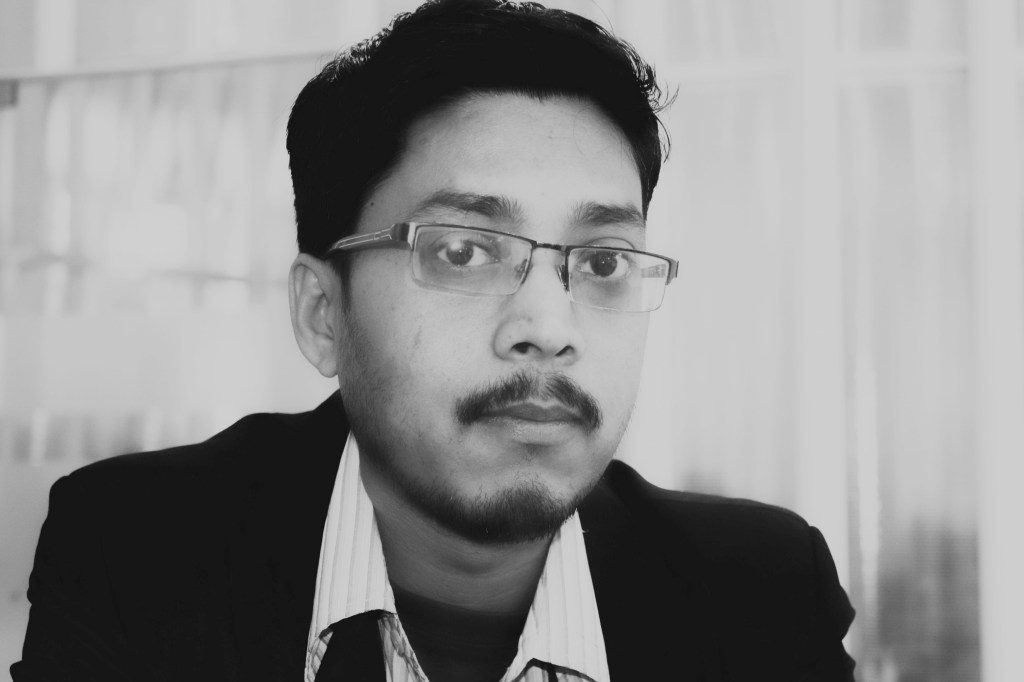
Writer and editor Dibyajyoti Sarma has published three volumes of poetry (the last being Book of Prayers for the Nonbeliever, 2018), four books of translations (the last being I’m Your Poet: Selected Poems of Nilim Kumar, 2022), and two academic books, in addition to numerous short stories and articles in journals. His translation of Indira Goswami from Assamese (Five Novellas About Women) was shortlisted for the Sahitya Akademi
Translations Award (English) in 2023 and 2024. He also runs the boutique publishing venture
Red River.
 Parcham Online
Leave a comment