Semeen Ali In Conversation with Priyanka Sarkar
A Note from Semeen Ali:
Continuing my conversations with writers, poets, and translators, I now present my exchange with the wonderful Priyanka Sarkar. Through this conversation, I have sought to unveil the journey of a person – the path one takes, or must take, to arrive at where they are or are striving to be. Conversations with writers often centre on the writing process and the interplay between external and internal influences that shape one’s work. While these aspects are essential, my own interest extends beyond this. Through my discussions, I want to meet the person behind the words. To understand, even if briefly, who they are. Though time and space are limited, I have tried to capture a glimpse of their inner world through this series of conversations.
In my conversation with Priyanka, I have sought to explore the idea of identity, tracing how individuals connect with their origins and to what extent these roots and routes are shaped by societal expectations. We talk about the tensions between tradition and self-determination, questioning how much agency one has in defining their own path. And we have tried to look at the resilience required to carve out a space for oneself, especially in environments where cultural and social norms impose limitations. This series, at its core, is an attempt to capture those fleeting moments of insight – the quiet revelations that offer a glimpse not just into the writing but into the writer as well.
SA: Hi Priyanka, thank you for taking the time to have this conversation with me. Let me begin by asking – Did you experience a contrast or a sense of dichotomy between studying in Delhi and the space you once occupied in Udaipur? I recall a conversation we had about the ‘breathing space’ that a city like Delhi offered to students like us who came from elsewhere.
PS: Oh Semeen, I wouldn’t put Delhi and breathing in the same line! Definitely. Udaipur will always be ‘home,’ a place full of bittersweet memories. Bittersweet because I grew up there, surrounded with my grandparents and mother’s love, their friends who are now like family and schoolfriends but Udaipur is also still a certain kind of place that can be quite maddening and frustrating. It is like any small town but it has the added bonus of being in Rajasthan. Even if you don’t see the discrimination against women in your own house, you certainly get a good dose of it in that of others. And it isn’t just discrimination, there are so many layers to it that I wouldn’t know where to begin.
Delhi was where I had my first taste of freedom. People in Delhi also keep an eye on you but because I didn’t have family living here (there’s an uncle in Gurgaon though), I knew that whatever I was up to would not get reported to my family right away. Not that I ever got into trouble but being on your own, being responsible for and answerable only to yourself, was very liberating. There are no expectations, well except that of your landlords that you’d keep it quiet.
SA: How did that experience influence your decision to enter publishing and transition into translation? We inevitably internalise our surroundings, and they shape how we navigate life. Do you see this reflected in your journey and the choices you made?
PS: Well, only to the extent that the decision to get into translation/ publishing was only mine. Nobody was consulted or anything. First came translation, publishing happened after.
I have mostly lived my life by a few tenets. And they have mostly worked for me. One is to live and let live (though some harmless gossip is fine). Your choices shape your life. Every choice has a cost or price attached to it, you have to see which cost you are willing to pay. At the end of the day, there will be no prizes or pats on the back for the life you led because nobody will know everything. It is important that you are aware and make peace with your actions. Friends (and I include romantic relationships in this too) are the family/ support system you choose. It is vital that you choose them with care and put in the work into that relationship so that it grows and both of you grow with it. But then, if something doesn’t work, there’s no point flogging that horse. Best to move on. You’ll be sad for a while but it’ll be better in the long run.
I think these tenets have helped me professionally too. I see the industry as an ecosystem where you have your ‘friends’, those who support you. I try my best to be there for them too. Where it doesn’t work, it simply doesn’t work. I grumble a bit, but move on. No hard feelings. I also never hold grudges – it’s just not me – though I sulk a bit.
SA: I can definitely relate to the sulking bit. I suppose, in the end, one just makes peace with how things are. Moving on – when did your interest in translation first take root? Could you walk us through that journey – what sparked it and how it evolved over time?
PS: I first translated and then got into publishing and both happened quite by chance. I was doing my Masters from South Campus, DU and my mother suddenly pulled the plug on my pocket money, saying she couldn’t at that time. I asked my professors about jobs/ gigs and Professor Ira Raja gave me a Premchand story, ‘Nadan Dost’ to translate. She also gave me Rs 2000 as a personal advance after I sent the first draft against the contributor’s fee that would come only after publication. I had no clue who the translation was for, who was taking it, what was to be done unto it. At that time, I was only looking at the 2000 bucks that I was making. It turned out to be for OUP’s Illustrated Premchand, edited by David Rubin. My first book and I shared space with David Rubin and Khushwant Singh!
When I was about to finish my course, I started looking for jobs. Again, IR told me that an indie publisher was looking for an editor and took me for the interview. There was no test for that one. She had to stop on the way back to meet Nitasha Devasar, the then Editorial Director of OUP. IR told ND that the translator of ‘Nadan Dost’ was with her because she had an interview with an indie. It seems ND exclaimed, ‘Why *that indie*, why not OUP?!’ OUP was looking for trainees. I was summoned to ND’s office. We had a short chat, she called me for a test, two-three days later, the day after my final exams. And that’s how it all started.
And Semeen, these accidental loves have become true loves. Now, I can’t imagine doing anything else.
My mother once caught me smiling toothily while I was writing something. She found it quite amusing. There’s not a lot of money in the work but it sparks great joy.
SA: It is wonderful how these accidental loves have become something so integral to you. And that moment your mother caught you smiling while writing, it really speaks to the joy this work brings. But as a translator and editor, particularly as a woman in these roles, do you feel there is a difference in how your work was and is perceived? Is the scrutiny more intense, or does the focus tend to be more critical compared to your male counterparts?
PS: Well, only in that women’s writing is still seen as a tag, or as a card that you play to get published when I think the opposite is truer. I see more publishers interested in the ‘bigger narratives’ – history, business and politics, than stories about say, relationships. But yeah, no hard feelings.
SA: As you say, women’s writing is often treated as a tag rather than taken on its own terms, and certain stories still struggle for space. Now as an editor currently working on an anthology, there is often a fine line between what can be included and where boundaries must be drawn. How do you navigate these decisions? Do they stem from years of reading, or is it more a matter of experience?
PS: I think it is a bit of both and they are inter-linked. The experience has also come from years of reading, and the experience has given a certain perspective into the reading. One big difference I see is that I am a little confident when voicing my opinion. There was a lot of hesitation and doubt earlier. Maybe I know now that there is never a right answer and we are all just winging it. Everything is perspective.
SA: You are closely involved with the Rama Mehta Writing Grant, which supports writers who identify as women. Could you share what it is been like working in this space and how it encourages new writing?
PS: Oh, working for the Grant has been an experience unlike anything else. It is meant for women with a Rajasthan connection and those who have not had a book published. Writers write in English, Hindi, Rajasthani and Urdu. There have been writers calling in who don’t have their email id or phone numbers and the interactions are mediated either through a husband or a brother.
Some of the pieces truly read like they have put a piece of their heart, a slice from their life in front of us. Often the writing is so poignant that the literary merit seems like a secondary consideration and I am always grateful that there is a jury assessing that. The shortlisted writers are called for 4-day residential workshop in Udaipur and that has again brought so many different experiences. There have been writers who have had to fight with their families to be able to attend the workshop or stay at the premises. One was very resourceful and found a distant family member in Udaipur and stayed with them, so that she could come. Then, there was a writer whose husband had escorted her to the premises and stayed put in the common area, waiting for her to get done, so that he could take her back. I told him that she was safe (it was all girls, we weren’t going anywhere else, etc, etc) and going to be with us till 5 but he wouldn’t budge. After much cajoling and me sharing our numbers, he finally left. So many women who talk about how it is impossible for them to maintain the discipline of writing that many writers will tell you to have – certain number of hours every day. How there’s always something going and then when they are free, how taking that time out to write is seen as an indulgence and they are guilted about it. It is a roller-coaster ride every year.
SA: It is incredible how the Grant has created a space for so many women who otherwise face significant barriers to writing, from family restrictions to the struggle of carving out time without guilt. Let me conclude by asking – as a short story writer yourself, do you think women today have a space where they can freely express themselves through their writing, or does that freedom remain dependent on market forces and the need to shape one’s narrative according to prevailing literary norms?
PS: I think the pressure to adhere to certain norms is there on everyone. It then depends on the writer what they want to do – tell a story a certain way because it needs to be told or change it to fit in. In some ways, it is like being in school. You have to choose, who you want to be, the popular one or the weird one.
S.A: Thank you so much Priyanka for this insightful conversation. I wish we had more time and space to continue exploring your journey and the many layers that shape your work, but for now, let this serve as a meaningful glimpse into it. Thank you once again.
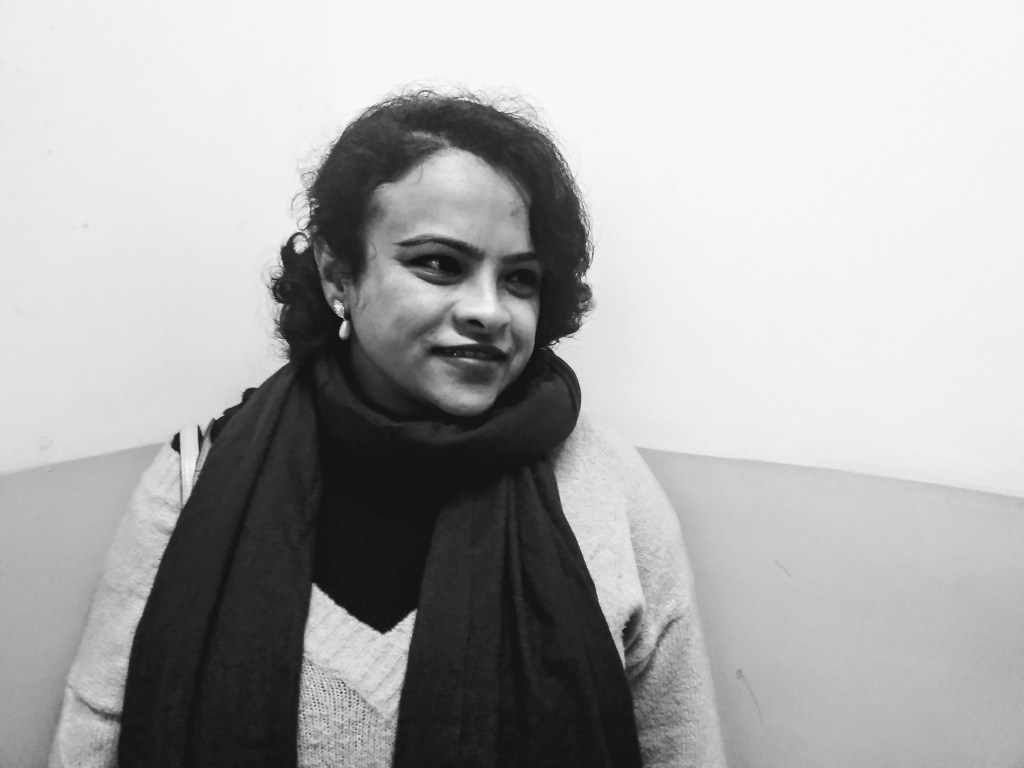
Priyanka Sarkar is an editor, translator and writer. She has translated Mrinal Pande’s Sahel Re (HarperCollins 2023), Shivani’s Bhairavi (Yoda Press and Simon & Schuster 2020) and Chitra Mudgal’s Giligadu (Niyogi Books 2019). Sarkar’s translations of short stories from Hindi to English have appeared in anthologies published by Yoda Press, OUP India, Women Unlimited, South Asian Review and Macmillan. Her translations have also featured on Scroll.in and Audible. A short story written by her has appeared in Sahitya Akademi’s Indian Literature.
As an editor, she has worked with OUP (Assistant Editor) and Random House India (Managing Editor). She was also the head of Editorial at Konark Publishers Pvt Ltd.
She currently freelances and is associated with the Rama Mehta Writing Grant, which aims to encourage creativity in English, Hindi, Urdu and Rajasthani among unpublished Rajasthani women writers. She is also associated with the Bangalore-based writer’s residency, Sangam House. She is the Translations Editor (Prose) at The Bombay Literary Magazine and was on the Literature Live! 2024 Literary Awards Jury for Fiction Book of the Year and Fiction First Book.
 Parcham Online
Leave a comment