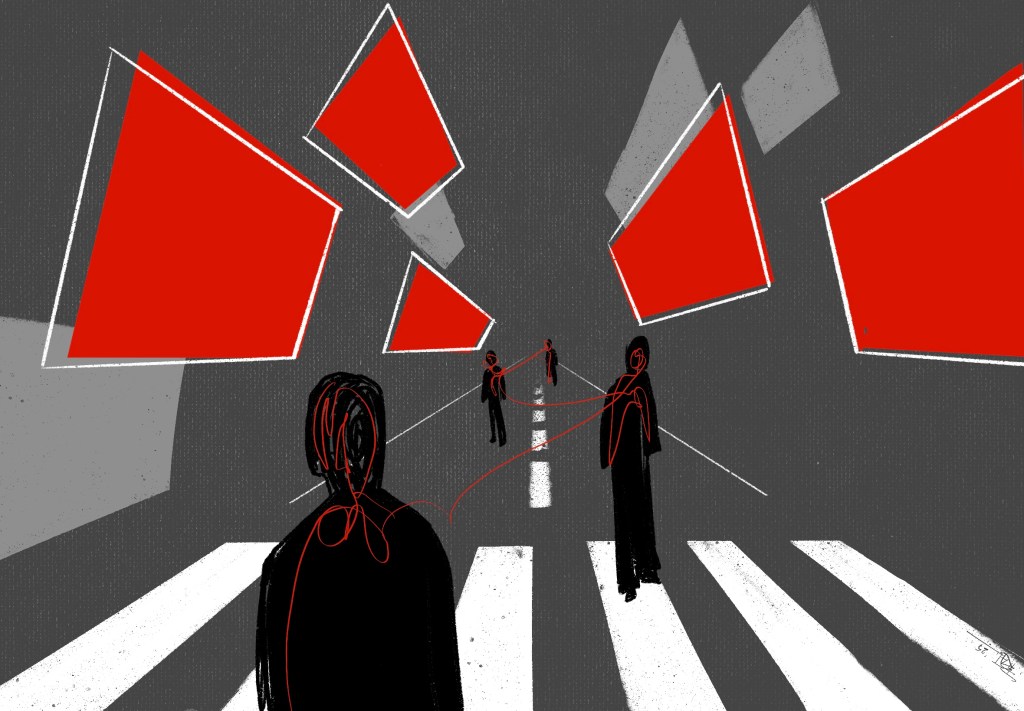
- Editorial: Suranjana Choudhury
- Two Wheels to Four by Thomas McDade
- The Baseball Coach by C.J. Anderson-Wu
- Destined for a Different Path by Chitra Gopalakrishnan
- Yesterday’s Tomorrow by Sarah Price
- Funky Road by Abdulrahman M. Abu-Yaman
- Roses on the Roadside by Jarin Tasneem Shoilee
- From Trivandrum Cntl. to Bhopal Jn. by Anu Susan Abraham
- Travels With Henry by Martha Ellen
- What the Witch of Lambs Lane Taught Me by Cesca Waterfield
- How I Experience the Uzan Bazar Area, Guwahati. by Shruti Sareen
- When the Bullets Fell by Nnedimma Okoli
- Rearview by Smita Das Jain
- Chain of Events by Gary Beck
Editorial: Suranjana Choudhury
Is it the beginning or the end of a road that we pursue? Like complex algebraic equations, roads – the real and the imagined, oftentimes confuse us. In our ways, we try to gather meanings from the many roads we tread. In the long run, whatever we have gathered makes up our archives, individual and collective. As one can see, the history and geography of a road can tell us so much about a people, their past and present. It can hold so much and yet can release so remarkably. In a different context, Ben Okri in The Famished Road notes how “the river became a road and the road branched out to the whole world.” The whole world is no small place. That any road administers life’s valuable lessons is no lie, its pedagogy forever defeating the limits of any established syllabus.
Very often in my dreams, I’m able to hear the silence and sounds of roads I have never trodden before. These roads without any specific addresses bear the potency of irrepressible truths. Whatever motion and rest a road conceives, in the course, it gives memorable things to us as Santa does – joy, wonder, excitement, love, and at times troubles, hurdles, and difficulties. A road weighed down by a milling crowd, an empty lane, or a spooky path makes us aware of our itinerant selves, our compulsive devotion to the idea of floating free. Life leads us to many unexplored journeys which prompt us to revise our understanding of fixed routes. Because of how roads are positioned, they are always outside of any promise of permanence. This note of impermanence renders its proximity to life itself.
We were curious to find out what this issue would finally look like. All the pieces that make it to this edition expand our perception of how we look at a road and how it can lead us to a destination which as Gloria Steiner notes, is “both surprising and inevitable – like the road itself.”
Thank you for being with us.

Two Wheels to Four by Thomas McDade
What would become of the barn some called a commune? I didn’t want to be found there and held responsible for rent or utility bills, probably an exaggeration since I’d signed nothing. I packed my meager belongings that fit into my seabag and overnight sack I’d found on top of a trash barrel in front of a lawyer’s office. I hid them in the woods where I sadly recalled walking with Vivian. I found a couple of her small footprints in some mud. I swear I did. Then I rode my bike to a telephone booth. I called my former landlord. A cellar room was unoccupied. I phoned Buffalo Cab and rushed back. A big Chrysler Imperial arrived soon after I’d moved my luggage to the side of the road. Each front door wore a faded range roamer image. Ernie was a talker. “I did farm work one summer in Longmont; the barn was just like this one.”
“I bet its walls couldn’t tell the tales this one could.”
“They’d recite a novel or two, kid.”
I liked him.
He’d been on the swimming team at the Colorado School of Mines. He lettered his sophomore and junior years doing the individual medley.
“No, the pool wasn’t underground, ha, but that was my life’s gold, kid. Scrap iron since.”
My bike just fit in the back seat. He opened the trunk and I heaved in my luggage. I didn’t regret backing out of the van ride to a new “Utopia” in Idaho.
Three months later I’d earned enough working for a landscaper named Sam to buy a car. My room rent was paid for the month and I lost just two days worth. The landlord had a waiting list and wished me luck. Ernie’s Chrysler cab arrived in ten minutes. He finessed my bike into the trunk to drop off at The Salvation Army Thrift Store. He handled my seabag and overnighter this time, put them in the backseat. “Is that your name?” he asked, seeing the stencil.
“That’s me, Seaman Tom Petit.”
“I was in the Navy,” he said as he slowly inched into the driver’s seat and adjusted the cushion behind his back, “a radioman on the USS Intrepid. I must have said a million times I should have stayed in for 20. You still have time kid.”
“Reenlistment’s the plan B through Z.”
He got a kick out of that.
He’d purchased a reliable De Soto at Just-In-Case Motors. He knew a guy who bought a lemon VW and tried to burn the place down.
The woman at Sally’s asked if I wanted a receipt for tax time. I laughed.
“Does priceless fit in the box?” I asked.
“I might just make those wheels my own off that clue,” she said, winking
Ernie pulled up at Justin’s office, got out, removed my bags, and stood propped next to them. I paid the fare but he wouldn’t take my tip. I returned his salute.
“Easy sailing, Tom; do everything I would have done.”
The salesman wore a Brooklyn Dodgers cap and smoked a cigarillo. He sounded like he was from Texas. The best he could do for my Traveler’s Checks was a 1958 Plymouth, 6 cylinders. He got on the phone and registered it on the spot.
I aimed my chancy grey Belvedere toward the Lincoln Highway trying to recall the mph to knots per hour conversion, trying to forget about Vivian’s overdose.
The Baseball Coach by C.J. Anderson–Wu
Chu Hwa-Hsiu was devastated upon learning about the gambling scandal and how baseball league players threw games in order to be paid by gangsters who controlled the gambling. Some of the involved players had been trained by him, and he wondered what he had missed during their training. “Should I have added ethical lessons for these young men? But honesty is the fundamental discipline of an athlete. Why did they not follow?”
Chu Hwa-Hsiu was a nation-certified umpire, and baseball was his lifelong love. When he was in grammar school, his hyperactivity made him impatient to sit in the classroom. He was punished by teachers all the time, until he was recruited by the school’s newly formed baseball team, and team members didn’t have to attend classes as frequently. In fact, playing baseball helped Chu Hwa-Hsiu concentrate, and his academic performance improved significantly. In high school, he was selected for the county team to compete in the island-wide competition, which was the highest level of games in Taiwan at that time.
But some incidents changed the course of his life as a professional baseball player. In 1959, when Chu Hwa-Hsiu turned twenty and was eligible to vote for the first time, he was excited to vote his mentor Su Dong-Chi for county councilor. However, Chu Hwa-Hsiu was shocked to see Su’s obvious victory manipulated by the Nationalist government into a loss. The voting venues would suddenly experience power outages, and entire boxes of ballots would disappear in the darkness, conveniently altering the election outcome.
The incident drove Chu Hwa-Hsiu to join Su Dong-Chi’s anti-government activism, which was strictly banned at that time. They exchanged information about the progress of their preparation for an armed insurgency under the guise of playing baseball on the empty site by the river. The information they exchanged included how and where to produce weapons, where to connect with like-minded individuals, and where to gather the resources needed for their revolution. Unfortunately, not long after their secret opposition to the Nationalist Party began, their actions were discovered, perhaps due to the government’s ubiquitous surveillance and agents everywhere. Additionally, some people close to them had been bought off by the authorities and became informants. Su Dong-Chi was arrested on charges of “Treason by campaigning for the independence of Taiwan,” and Chu Hwa-Hsiu was arrested several days later on charges of “Advocating separatism and disruption of social order.”
After days in the sweatbox, Chu Hwa-Hsiu was tried without due process and sentenced to eight years of imprisonment. Later, he learned that forty-seven people had been arrested, and Su Dong-Chi, the chief conspirator, was sentenced to death.
Chu Hwa-Hsiu was not even twenty-two years old. He had no idea that his involvement could bring such serious consequences, and whenever he thought of his mentor who was to be killed, he was filled with agony.
In Alapawan prison, most of his cellmates were “separatists” advocating for the independence of Taiwan. They were able to leave their cells to do odd jobs, like cleaning restrooms, laundering clothes sent to the prison, or growing vegetables on the empty field next to the prison. They could interact with one another, and despite the brainwashing “correctional programs” or “patriotic enhancement,” their contempt for the regime never waned.
Not long after Chu Hwa-Hsiu’s release, a prison uprising occurred. Five of his cellmates were executed. Chu Hwa-Hsiu often thought that if he still had been imprisoned during the uprising, regardless of whether he had participated in their plan or not, he would have been held as one of their accomplices and either imprisoned for much longer or executed.
But would I join them? He asked himself. Would I choose to die for my beliefs or idealism?
After his release, Chu Hwa-Hsiu had problems finding any job. No business dared to hire a national traitor, even though he had been punished and “corrected”. The only job he finally got was to organize herbal medicine for a herbal therapist in the backyard of his store, where nobody saw him.
Herbal healing isn’t a formally recognized practice, herbalists do not go to medical schools, instead, their training comes from knowledge passed down from generation to generation. And because herb picking relies on the environment where the practice is conducted, it is usually community-based. Herbalists sometimes push their herbs in a trolley to markets to promote their profession, but it is a declining business. Also, without official certification, people trust it less and less. People who try herbal healing often do so out of curiosity, so they take herbs only for minor health problems, like colds, digestive issues, or skin conditions that are commonly understood as the temporary disruptions of Qi flows.
For two years, Chu Hwa-Hsiu’s job of trimming herbs barely supported him to make ends meet. Every day, he absent-mindedly cleaned and packed aloe, peppermint, boat lily, and creeping saxifrage, among other herbs, until he was given an opportunity to coach the newly formed baseball team at an elementary school.
Did the school administration know my past record? Chu Hwa-Hsiu knew he had to clarify this. He had been hired and de-hired after employers learned he was a former political prisoner.
I told the principal, and he said it was okay as long as you don’t talk about politics openly. His friend who recommended Chu Hwa-Hsiu told him. Chu Hwa-Hsiu knew this meant the principal’s political stance was closer to theirs, or at least, he was a sympathizer.
It was the best time of Chu Hwa-Hsiu’s career; he had almost forgotten how good it felt to be on the baseball field. Chu Hwa-Hsiu found joy in coaching an enthusiastic group of elementary school kids. His mission was not just to teach them the game but to instill values that would serve them well beyond the baseball field.
Being part of a team means being responsible, he told them. You must respect your teammates, listen to your coach, and always give your best effort.
In the first month of coaching, Chu Hwa-Hsiu gathered the kids in a circle. With their eager faces looking up at him, he began explaining the basic rules of baseball. He demonstrated how to hold a bat, swing, and throw a ball. The kids tried to mimic his movements, laughing and cheering each other on. He introduced drills to build their skills, like throwing and catching the ball with partners, and running between bases to learn the importance of speed and accuracy.
In the next month, Chu Hwa-Hsiu introduced more advanced training. He taught the kids how to field ground balls and catch fly balls, reminding them to keep their eyes on the ball and use both hands. The children took turns hitting the ball off a tee, with Chu Hwa-Hsiu showing them the proper stance and swing.
Understanding strategy was key to playing well, so in the third month, Chu Hwa-Hsiu organized a mock game. He explained the different positions on the field and their roles. The pitcher throws the ball to the catcher, aiming to get the batter out, while the catcher receives the pitches and watches for runners trying to steal bases. Infielders and outfielders cover the bases and outfield, ready to catch or field the ball. He taught them simple strategies, such as identifying the pitcher’s tricks in throwing balls with different speeds, heights, and directions. He also explained when it would be a good opportunity to steal a base and how to shift positions based on the batter.
Every day they practiced until sunset, and with second-hand gears donated to them. A semester passed, Chu Hwa-Hsiu was surprised how much progress these young players have made, and how good they became after proper instructions.
That was when Chu Hwa-Hsiu met Ren-Kang and Ching-Hua, whose father/husband Jiang Bin-Hsin was one of the five chief conspirators of the Alapawan prison insurrection. Ren-Kang was very quiet; he wasn’t particularly good at baseball, but he wasn’t unfit either. Later, after they formed a new family, Chu Hwa-Hsiu realized that Ren-Kang performed mediocrely to avoid drawing too much attention. This was also true of his academic performance. That was why Chu Hwa-Hsiu was very surprised when, at seventeen, Ren-Kang joined a gang. How had his father’s rebellion and subsequent execution affected him as a child? And as his stepfather through his teenage years, what had Chu Hwa-Hsiu missed?
Were there similarities, psychiatrically, between the baseball players who cheated in the games and Ren-Kang’s choice of being a gang member? Ren-Kang continued playing baseball in middle school and was with him when their team represented Taiwan in the US. It was the last year of Ren-Kang’s participation in baseball games before he aged out of the world series. Was that why Ren-Kang joined a gang? On the contrary, for those professional players who threw games, their actions not only ended their own careers but also seriously damaged the entire industry.
Chu Hwa-Hsiu missed the most glorious time for Taiwan’s baseball. In the 1970s, baseball regained popularity in Taiwan, even though the Nationalist government did not encourage the sport due to its association with Japanese colonialism. Chu Hwa-Hsiu’s elementary school team entered many games and often won; even if it wasn’t a campaign, they were no worse than second or third place. In 1977, Ren-Kang’s school won the island-wide championship and advanced to the Senior League Baseball World Series overseas. At that time, Japan and South Korea were not members of the League, so once Taiwan’s team defeated the teams from the Philippines and Guam, they earned the right to represent the Pacific Rim in the games taking place in the US every summer. Chu Hwa-Hsiu was invited by Ren-Kang’s school coach to join the overseas coaching team, and he happily accepted the offer. He was excited about preparing these excellent teenage athletes for international games and spending precious time with his stepson.
Before taking off for the US trip, an “agent” from the “Second Office of Personnel” approached Chu Hwa-Hsiu, telling him because he had a criminal record, the authorities demanded a statement from him to guarantee he would never commit any misconduct during his tasks as a coach of the national team.
I never ever participated in any activity for Taiwan’s independence since my release, I even never talked about it. Why should I be asked to present a statement? Chu Hwa-Hsiu responded, repressing his irritation. The government was still absurd as it always has been.
No worry, the “agent” smiled, while presenting a paper already well-typed. Just sign your name at the bottom, and you are all good.
Official Statement by Coach Chu Hwa-Hsiu
In light of my upcoming travels overseas to coach Taiwan’s baseball team in international games in the United State, I, Chu Hwa-Hsiu, hereby declare that I will not engage in any actions or activities that advocate for the independence of Taiwan. My sole focus and commitment during this period will be on the athletic performance and sportsmanship of our team.
I fully recognize the importance of maintaining a neutral stance on political matters while representing the Republic of China in the international sports arena. As such, I will adhere strictly to the guidelines and regulations set forth by the relevant authorities and governing bodies.
I appreciate the trust and support of the Taiwanese people and assure you that my actions will reflect the highest standards of professionalism and dedication to the sport of baseball.
To save trouble and time arguing, Chu Hwa-Hsiu signed. The Republic of China would eventually be etched by its own absurdity, he thought to himself.
In the US, their team crushed Canada with 10:0 in the first round, then defeated the California team that represented the Northern American West with 7:0 in the semi-final. In the final, they dominated the Florida team that represented the Northern American South with 6:1.
During the final game, millions of people in Taiwan stayed up in the early morning to watch the live broadcast. Right after they won, they received a congratulatory telegram from Taiwan’s prime minister. The prime minister at that time, Chiang Ching-Kuo, was the son of Chiang Kai-Shek, who had imprisoned Chu Hwa-Hsiu for separatism and killed Ren-Kang’s father for his insurgent actions advocating for Taiwan’s independence from the Republic of China.
Ironically, 1977 was the last year that Taiwan’s athletes could represent the Republic of China. Since Taiwan’s seat in the United Nations had been replaced by the People’s Republic of China, an international trend of the One China policy was brewing, until Taiwan became having no choice but to be called as Chinese Taipei—a name so confusing and contradictory to the society’s self-identity.

C.J. ANDERSON-WU
(吳介禎) is a Taiwanese writer who has published two fiction collections about Taiwan’s military dictatorship (1949–1987), known as White Terror: Impossible to Swallow (2017) and The Surveillance (2021). Her third book Endangered Youth—Taiwan, Hong Kong, Ukraine will be launched in May 2025.
Her works have been shortlisted for a number of international literary awards, including the International Human Rights Art Festival and the 2024 Flying Island Poetry Manuscript Competition. S
he also won the Strands Lit International Flash Fiction Competition, the Invisible City Blurred Genre Literature Competition, and the Wordweavers Literature Contest
Destined for a Different Path by Chitra Gopalakrishnan
New Delhi’s Mehrauli-Gurgaon road stretches on, winding its way through tall, forbidding, dark blue, soda-lime glass buildings that screen secrets of the corporate world with clinical dispassion. Through multitudes of furniture stores that tumble with designs of simplicity, of flare, some rustic, others contemporary, all exorbitant. Through wedding venues that promise idyllic backdrops, fulfilling experiences and everlasting bliss. Through mofussil shops that sell vegetables, groceries, mobiles, medicines, undergarments, beauty services and liquor in unruly gaiety as if in one their shelves lies a piece of the customer’s life’s puzzle. And, through a tangle of grimy, swirling sewers that run alongside these buildings and shops slick with a sludge of substances, food lumps, excreta, plastic bags, dead pigs, shadows of which flicker and glisten like the scales of a serpent, vapours of which waft as stench in slow-spaced waves to catch the throats of unwary wayfarers before a swarm of flies attack them as they beat blindly about the air.
In the midday of June, in the blistering, buzzing heat, trucks, vans, cars, motorcycles, cycles, auto rickshaws, pedestrians, and hungry cows and dogs whiz and jostle past each other, past potholes, in a frenzied hurry. This is on both sides of this exceedingly narrow road despite being an arterial one. They are all equally uncaring of road etiquette and rules, each vehicle claiming the right of way and scattering their smells and hostilities in the way of hapless pedestrians.
Their clamour, strident and blatant, which stems from their torment in the heat, stirs up a whirlwind dust storm, just as mad, loud, unpredictable and intractable as them. It grows roots on this road mixing chaff of the present with occurrences and catastrophes of the past, deeply associated as this region is in its history and this tapered thoroughfare transforms into a complex, impetuous force that pushes ahead with a new amalgamation.
At least, this is how it appears to Dr Vinod Sharma, a professor of medieval history in a local college in the area, who understands the pulse of this place, past and present. On this dusty, rampageous road, one he is visiting after nine months of being away, he feels this past-present contiguity bear down on upon him as he walks nervously on the extreme left of this road in the absence of a sidewalk.
At fifty-eight, his gait is slow, his hearing uncertain, his vision impaired, his head balding, his skin patchy and his health fragile. Despite his middle aged inadequacies and his unassuming dressing that reduces effect and intensity, there is a certain gentleness to him, a calm restraint within his round genial face and broad frame that give him an air of quiet determination.
His twenty-four-year-old, tall, dark and wiry, nephew, Vishal Varma, who works in the hospitality sector and has been summoned to meet him, displays none of his uncle’s middle-aged slowness or steadiness. In striking contrast, dressed in natty beige, well-creased trousers and a white shirt and smelling of a classy cologne, his strides are long, swift and impatient.
Realising he has overtaken his uncle, he retraces his steps, tosses his mop of curly black hair and stands before him. His arms folded, his eyes darting and his frown lines deep, he gets going with a volley of questions without the mandatory courtesy of a namaste.
“Mama, my mother is frantic with worry. Why have you been on the run in the last nine months? Why are you dressed so differently? Why you have grown an unbecoming beard? Don’t you realise if you walk on the roads like some modern-day Don Quixote you could get hit and lie unheeded for days. And why have you called me in secrecy? Why trap me in your circumstances?”
Dr Vinod Sharma is silent. He stands motionless.
Under Vishal’s scowl, furrowed forehead, narrowed eyes, brusque tone and barrage of scolding questions, he finds himself twisted like steel under a tap wrench. The collar button of his pale green kurta pinches his throat and he feels a squeeze at the back of his neck.
Taking a few moments to recover, for he has not been spoken to with discourtesy in a while, yet knowing these words come from a place of concern, Dr Sharma says to Vishal, in a soft, gentle undertone, “I thought the time is right to set free the current mysteries of my life to my only family, your mother and you, by coming full circle, by coming back to the same area where everything began.”
Vishal, surprisingly, hears him over the melee of the traffic and raises his eyebrows. It is a gesture of disapproval, one that says whatever his story is it won’t gather sympathy from him.
“There are many things to be said but I will say it with modified restraints to get out my story quickly and with minimal drama. I don’t want both of you to either be in the dark or burdened to help me,” Dr Sharma says, his voice now robust, its timbre sturdy. It says he has accepted the unacceptable and has agreed to bear the unbearable.
Pointing to a thick iron railing that runs across the corner for a part of the road, Dr Sharma motions that they both sit on it. A lone amaltas tree affords some respite from the heat. He rests his heavy, black, backpack on the ground.
The railing is not as hot as they fear. They sit beside each other and to balance themselves they stretch their feet outward. They face the shops, not each other, their backs against the sun and the road, a ploy Dr Sharma uses to speak freely without the deprecating stare of Vishal’s eyes. Unglancing, shoppers’ mill around.
“I have chosen a life on the run, a life on the roads as it were, beta, as I have no choice. I have been expelled from my job for opening up a discussion on Din-i-Illahi, the syncretic faith created by Emperor Akbar in 1582,” begins Dr Sharma, his face darkening gloomily. “This faith contained the best elements of Hinduism, Islam, Christianity, Jainism and Zoroastrianism that people accepted voluntarily and readily with no state coercion.”
“This is absurd. Why did they expel you for this? It has been a part of our history syllabus for ages. I remember its details even years after being out of college,” asks a mystified Vishal, his aggressive attitude on a fade.
“An undergrad student of mine, who chose not to get the nuance of dialogue and debate versus indoctrination, complained. Our college principal advised restraint and mildly reprimanded me for not clearing this distinction emphatically to the student. The matter would have ended there had it not been for a local politician who took the issue up as a crusade, seemingly to protect the integrity of religions, particularly his. Intimidated by his threats, our principal issued an order expelling me with immediate effect, a week after the incident,” Dr Sharma explains.
“You are on the run because you have been expelled? I know it is hard to lose a job and be on the bad side of a politician but your reaction is extreme and illogical,” Vishal says, incredulity in his voice.
“I am on the run because this incident made a spectacle of my life, stripping me of my dignity and standing. Don’t forget, my profession has been my life, one started, built and nurtured in this college for twenty-eight-years and as an unmarried person I have few other anchors. Now I have been denied my staff quarters, my home, and I have had to dispose of most of my belongings and leave my books and papers with friends,” says Dr Sharma, tears gathering at the corners of his eyes.
Vishal is troubled by his uncle’s loss of composure, the humiliation he has faced alone. He has never seen him like this, so unguarded, so defenceless. He considers putting his arms around him but fears embarrassing him. He clears his throat instead, and to deflect tension, he asks, “I am puzzled. How on earth did the politician get involved?”
Dr Sharma regains his self-control and makes certain of collectedness in his frame and voice, yet again, to say, “This disgruntled student, whose fame fizzled in five minutes, must have thought it fit to prolong the drama by involving this politician with polemical views. He probably added untruths to our classroom discussions for there was nothing untoward in our dialogues, no harsh observations or even mild arguments. At the end of the class, we even mulled over as a group why the faith ended with the Emperor’s death.”
Clearing his throat, he takes a sip of water from the plastic bottle he retrieves from his backpack and continues, “Do you know in Emperor Akbar’s time, this order was called Tawid-i-Illahi or Divine Monotheism and the focus was on tolerance and humanity? As he was severely dyslexic and unable to read or write, the Emperor invited learned men of all faiths to his Ibadat Khana, House of Worship, at his courts in Delhi, Agra and Fatehpur Sikri, to explore commonalities underlying all faiths and assimilate them into a humanistic order.”
“Why did you not explain this in writing as you are doing now, mama? I am bothered by how ridiculous this is,” says Vishal.
“Beta, how do you assume I did not write to them? As a professor, this is the first thing I did, instinctively, immediately. You know I am prone to lengthy prose and long explanations,” Dr Sharma says with a rare smile.
“While my college principal sympathised in private, he is silent in his official capacity fearing the outcomes for the college and him. The politician, however, neither sympathises nor is silent. He has used words like ‘sedition’, ‘libel’ and ‘bringing disaffection among communities’ in his public speech and attached these horrifying labels to my name, phrases I associate in my mind with dreaded terrorists, with outlaws.” He shudders as he recalls the details.
With a calm that seems perfect, yet is imperfect as Vishal knows it is the calm of a disheartened man making an effort to not show how he feels, Dr Sharma continues, “For momentary attention, this man has issued threats to slap police and court cases that invoke harsh penal codes and my arrest.”
Vishal’s face reflects compassion. “The right to freedom of expression and the freedom to dissent is the essence of our democracy. Mama, while your discussion was meant to excite and expand student minds, not force opinions, like all teaching is meant to do, it is sad to see it misconstrued. Contemporary community standards have not been violated even remotely.”
Extending his hand to hold Dr Sharma’s, Vishal says, his voice choked by emotion, “Mama, please don’t give up the fight. You cannot be seen as someone who ran away from the situation. Let me find you a good lawyer. Let’s lean on social media for support. I know you have set course curriculum, assisted in research and worked hard to get your college into the mainstream. You have seven years of service left and it cannot be allowed to go to waste. Let this fight be your swan song!”
Dr Sharma smiles a wan smile. “Don’t you think this song by lyricist Prakash Mehra fits my situation?” he asks, “Manzilon pe aake loothee hain dilon ke caravan, kashitayan sahil pe aaksar doobti hain pyaar ke, manzilen apne jagah, raaste apni jagah. Jab qadam hi saath na de toh musaafir kya karen?”
Vishal nods. “Why won’t you fight back? You could find reprieve if you try but not trying would make your life on the roads intolerable,” he pleads. His hand gestures are exaggerated and agitated. “Why are you giving in to a life of senseless emptiness?”
Dr Sharma turns to look straight into his eyes to make him understand his point. “Are you not aware that many in the academia have faced similar situations or worse and the legal system has not served them well or justice, or if it has it has given them a fair trial it been so delayed that it is not justice at all. Many have been in prison for years without a hearing, without bail, without medical attention and without visitors. Sometimes, even a straw to drink water from a glass is denied. Being in such a situation would undo me and I have settled for a life on the roads. This is my form of resistance. I want to be with people who value compassion, justice, love and truth, though they have different opinions on issues.”
Vishal shakes his head, frustration and disbelief evident on his face. “Are you saying you have lost faith in our institutions? If you as an educator give up, what does it say of you as a role model for the young? Please, I beg you, quit these quixotic travels and come live with us in Mathura. Let’s change the direction of your road towards Uttar Pradesh and fight this fight together,” he says.
Dr Sharma is unyielding though he sees how tense and disturbed Vishal is. He stiffens his back, clears his throat and says, “Vishal, I have not hurt anyone’s feelings or alarmed or scandalised anyone yet my situation goes on and on with no official revoke. My institution and students should have stood by me but they have not. Maybe I have failed as a teacher or maybe my college’s education system is not capable of withstanding rightful and lawful resistance. I choose, hence, to let them believe what they want. I will not decipher the frightful riddles of my life for anybody. I have shaken off the shackles of who I believed I was to forge a new identity. I can’t rid myself of this decision as much as I try. There is something within me which won’t allow it. Call me foolish, call me stubborn and call me defiant!”
After a deliberate pause, to let Vishal gather the full import of what he is saying, he adds, “I don’t want to wait for justice in my college or court or jails. I seek resolution differently. Beta, while I deeply and humbly appreciate your decision to help me, I think you should go now. I have called you in secrecy to tell you to not knock on doors that won’t open and to say we need to put distance between us for a while so jeopardy does not follow you.” His face is flushed with the effort he has put into his explanations.
Vishal once again turns fully towards him. Dr Sharma sees many fleeting emotions flood his face: exasperation at his words not being heeded, sorrow at being dismissed and anger that he is unable to persuade him to accompany him home.
In a tender tone, almost a maternal one, Dr Sharma says, “I know you find my stance ludicrous and you think I have lost my idealism, my zest for teaching and life. And, I know I am somebody you no longer recognise. Let me assure you this is not true. No matter how shattered I feel inside, I will keep moving, unrelenting, unapologetic, but not in the way you and many others want me to.”
Leaning forward and in the same patient and tranquil voice, he says, “My experience still causes pain when I think back, but, in the last six months, I have been piecing myself together to find peace and validation from the inside. My inner journey is a work in progress. Validation from others is of lesser value to me now or in plain words, it no longer matters. I no longer require comforting narratives of being redeemed in others’ eyes. Being reinstated seems a minor and even an irrelevant win. On the contrary, it now appears as a dangerous trap, one to keep me away from seeking something broader, deeper, than narrow personal gain. Also, at the end, there may be no court cases or arrest warrants. These may have just been false threats but that’s no longer an issue, something so terrifying is no longer so.”
Finding Vishal as yet dissatisfied with his answers and unwilling to leave, he attempts to explain his position better. “Vishal, I see this experience, that has forced a harsh survival upon me, as my karma. It has been a way to force me to follow a new road, one less travelled. It is not an escape route and you should not view it like that. I certainly do not. Nor do I see myself as lost. As J R R Tolkien said, not all who wander are lost. And, I am not giving up my powers thinking I don’t have any. Instead, I am looking to this as my chance to use my abilities differently, in ways that are appreciated, by me, by ordinary people,” he says.
Vishal is quiet.
“Vishal, can you understand?” Dr Sharma asks, after a while. Vishal face is still a shut gate while he scrutinises his uncle’s.
Giving him some time to handle his pique, Dr Sharma urges him, “Please, hear me out. I recognise and even appreciate your petulance. I know you care immensely. But know that I now prefer being fastened to life by the roots of everyday things, of everyday people who I meet on my wanderings. Don’t think I have severed ties with society, institutions or turned into a misanthrope.”
Dr Sharma stops the flow of his words abruptly. His expression is changed. He seems to be looking at something within his thoughts. Then slowly, he says, “I am not sure I should be telling you this but I will to rest your fears. Vishal, I am being helped by a loose, informal affiliation of people who foster human connections, aid people like me in need without recompense.”
He gets the expected response from Vishal who listens to him intently. “I got introduced to this group, who request anonymity, by a dear friend whose uncle spearheads it. These people don’t flaunt their credentials, wealth or education or call themselves human rights activists or tag themselves in any other way. Yet they have seen me through in these last months. They have extended modest shelters, food, transport to help me ferry the suitcases that I live out of and medical help as I have fallen ill several times in my crisscrossed journeys across parts of the city, unaccustomed as I am to this unrooted life. But more importantly, they have encircled me with love and compassion when I was at my most vulnerable and have encouraged me, and still do, to find solutions at my pace, in my way. They make me feel welcome, seen and valued. It has made me understand that the power of the people is stronger than the power in people.”
Vishal looks at him, looks away and looks again. He looks several times, surprised that such people exist in the capital. It is beyond his wildest imagination.
“Beta,” says Dr Sharma, “I am daring to explore this people’s power of love that overrules the love of power. I know losing these people would mean losing a piece of myself. They have taught me to love deeply and authentically by building abiding relationships and maybe the lessons they have taught me will lead me to something more, to an affirmative movement with people’s power at its centre.”
Vishal still looks worried but not as crestfallen as earlier.
“Vishal beta, try and see me from now on as a flaneur rather than a runner. This life on the road, I must admit, undid me at first. But I know my chosen surrender to the roads will take me to the unknown, to beyond what I know. Getting lost in this manner is getting to be fun and could lead to the one way meant for me and to the parts within me that are hidden, subtle and mysterious,” says Dr Sharma, his eyes alight with a certain quality. Hope?
“I don’t intend to craft a social movement or indulge in social re-engineering,” he continues, “I am far too simple-minded and un-technical but maybe I could set up a people’s collective by assembling people of different expertise to help each other, to reaffirm each other’s faith and potential; a start-up that addresses an un-addressed need.”
Vishal is at this moment reminded of Margaret Mead’s observation. She observed the first sign of civilisation was a healed femur, the bone that connects the hip to the knee, an indication the wounded person must have received help from others. Maybe, his uncle had his head and heart in the right place.
Patting down Vishal’s curly hair in a comforting manner, something he would do when Vishal was a child, Dr Sharma says, “Beta, go now. Don’t keep your taxi waiting. I will call you off and on and regularly when I am certain I am not a threat to anyone. Don’t worry about my finances, I have withdrawn most of my money and can tide it over as I have barely spent my earnings. Be well, beta, and give my love to Abha behen.”
And as an afterthought, he adds, “One more thing, I promise to wear better clothes and shave off my beard.” The laughter in his voice reaches his upper cheekbones and crinkles his eyes.
To Vishal, he looks like his old self, handsome and distinguished. He braces himself to say goodbye. His anger and anxiety are dissipated but sorrow chokes him as he is not sure if he will see his mama soon. He is left with a sense that there is something more to hear, something more to say. He hugs his mama and walks away, looking backward time and again.
His uncle’s gait appears spritely from afar as if his unburdening has helped him relieve himself of the memories of the absent, from conformity.
Dr Sharma walks on. Through his spectacle lenses, the horizon is endless at three pm, the road more welcoming, less derelict. Even his dusty frames do not dim its prospects. The soft murmur of voices nearby is comforting to him as is the sharp caw-caws of crows looking out for each other and though the sun is still sharp he has the sense that everything is just as it should be.
He walks a little more, re-living Mehrauli’s history and its continuum in his mind. He thinks back to Lal Kot built by the Tomar chief Anangpal in 731 AD and its expansion by Prithviraj Chauhan, the ruler who overtook the Tomar reign. He then lets his mind wander to Qutub Minar, the tall victory tower, whose construction was started by Qutub-ud-din Aibak of the Malmulk dynasty and completed by his successor Illtumish and then refurbished by Feroz Shah Tughlak of the Khilji dynasty. His thoughts then rest on the Jain temple of Yogmaya constructed in the 12th century and believed to have been built by the Pandavas.
“Time to rediscover all of my city anew, its past, present and future, not just its geography as a cartographer or its history as historiographer or its future as a futurologist, but more as an anthropologist who seeks to understand what it is to be human, to be a person, today, yesterday, long ago, always, and more so as a humanist who has concern for human welfare, values, freedom and dignity,” he says to himself.
He recites Majroo Sultanpuri’s verse under his breath, “Main akela hi chala tha jaanib-e-manzil, magar log saath aate gaye aur karavvan banta gaya” before he flags an auto rickshaw to take him to his far away destination.
Footnotes**
Manzilon pe aake lootate hain dilon ke caravan,
The caravans of hearts often get looted upon arriving at their destinations
Kashtiyaan sahil pe aksar doobtin hain pyaar ki
Boats of love often sink when they reach the shore
Manzilen apni jagah, raaste apni jagah
Destinations remain in their place as the roads do
Jab qadam hi saath na de toh musaafir kya karen?
But when the feet do not offer support what can a traveller do?
****
Main akela hi chala tha jaanib-e-manzil magar
I set off alone towards my goal but
Log saath aate gaye
People came along
Aur kaarvaan banta gaya.
And the procession gathered numbers

Chitra Gopalakrishnan, a writer based in New Delhi, uses her writing to break firewalls between nonfiction and fiction, narratology and psychoanalysis, marginalia and manuscript and tree-ism and capitalism. Author website: www.chitragopalakrishnan.com
 Parcham Online
Leave a comment