CD: Dear Suzette. It is an honor to interview you on behalf of Parcham Literary Magazine. I was impressed with the caliber and consistent quality of your writing, and it came as no surprise that you taught. Do you find teaching helps you be a more prolific writer or do you think the reverse is true?
SB: Thank you so much, Candice. I’m very honored to be interviewed for Parcham Literary Magazine! I was lucky to be able to teach creative writing, poetry, fiction, and nonfiction, along with composition and literature courses over my teaching career. I also helped to start and develop a creative writing minor and feel very privileged to watch that grow. It was wonderful to witness my students’ creativity, characters, metaphors, images, and world-building, giving them a challenge and seeing what they could come up with. It was very fulfilling to see students go on to win or place in the Texas Association of Creative Writers’ state-wide contests for undergraduates in all three genres, earn fellowships and awards from the Writers’ League of Texas, and continue to write, edit, and publish.
I’ve noticed since retiring I don’t feel over-saturated from a heavy grading load, and I’m able to focus better on writing poems. I could do that while teaching or during breaks, too, but more often, I was jotting in a journal in short spurts of time or doing exercises with my students in class. It was fun, kept me writing, using that muscle, getting me to try something new, but sustained concentration to shape and revise seems easier, now, along with the pacing needed for ME/CFS, which I have. Since there are no FDA-approved medications for ME/CFS, pacing and rest are the primary methods of maintaining some limited energy and function. Unfortunately, reading, including reading student work, can exacerbate symptoms as well.
Happily, some of those quick writings did turn into something, including my flash fiction piece, “Lifejacket,” that Parcham published. It started from a fun exercise a visiting writer, Lindsey Lane, gave the class. She brought words written on pieces of paper we drew from a bowl. I got “lifejacket” and “skis” and had to work those words into a story somehow.
CD: The obvious question I always ask writers first is; why poetry? Why did you choose to write poetry? What does it exemplify for you?
SB: I think poetry chose me. To me, poetry highlights an intensive way of seeing and love of the way language can be musical and visual. My mom reading to me as a child, whether nursery rhymes or stories, made me appreciate the richness and music of language and want to work with it myself. Later, as Jimmy Santiago Baca and other writers have said, poetry gave me a direct pathway to emotions and what in most situations we are pressured not to say. Poverty, being evicted several times, a mother with mental illness who was homeless for a while were some of my experiences as a teenager. You learn to hide these because of shame. I didn’t need money or resources to write a poem, either, just pen and paper, and it was like a tiny house, my own familiar place equipped with what I needed, able to contain my messy life and emotions, and portable.
CD: I was recently one of the judges in the Northwind Writing Award and your incredible poem “Normal Hydrocephalus,” was in the Top Ten Finalists in poetryIt is the power of your writing that really grips your reader. If you can, share with us a little about your writing process and how you accomplish this?
SB: Thank you, Candice, I’m very humbled and grateful to learn “Normal Hydrocephalus” stood out, and what a thrill to learn it was a Top Ten Finalist and have it included in The 2024 Northwind Treasury!
Back to your previous question, “Why poetry?”– The quickness of writing a draft of a lyric poem helps me bypass the critical voice. Writing prose and longer collage poems are slower for me. I can then have a poem draft in one sitting with the trace of a story or emotional movement from beginning to middle to end to work with (although that order may change radically later). Depending on the subject or memory, the emotions that spill onto the page in that first quick draft can be very raw and expose more than I felt or understood consciously. Like automatic writing. That was definitely the case with “Normal Hydrocephalus,” a poem about my complicated relationship with my father and my feelings about his often-secret work on nuclear submarine engineering. During one recent conversation, the dementia he was experiencing with his condition opened the door a bit on the pressures of Cold War work and his worries about me when he was estranged from the family after my parents divorced. I was startled by some of what came to the surface in my first draft, and perhaps that helped to keep the poem powerful even with revision. We were trying to repair the relationship knowing he had very little time left, an intensity I think comes across, too.
CD: Your family have moved around a lot, does this factor in how you see the world? In other words, does geography or location play a part in how we perceive things?
SB: Moving around so much has certainly been a challenge, and the pattern of being uprooted started just as I was becoming a teenager, the worst time to move and constantly change schools. Reading novels helped a lot and other teens willing to befriend a newcomer from a single-parent home, not very common at the time. The shift from Upstate New York to Long Island when I was fourteen was one of going from a more rural place surrounded by untouched forests to a more densely populated suburban one, from living in a house to living in apartments, although we’d already headed in that direction before this by moving closer to Albany after my parents divorced.
The lack of mountains but the ocean nearby was the biggest geographical change, my uncle and cousins’ use of boats to get around, not the same kind of socializing centered around winter sports like ice skating and skiing. My uncle, a policeman, patrolled an arboretum, and he and my aunt lived in a house on the property where we stayed the first year. Because of this, I was still surrounded by woods but more manicured and sometimes filled with visitors walking the paths, the Long Island Railroad rattling by near the house. I went to college in Ohio and then graduate schools in Virginia and back to Upstate New York. Moves for my husband’s academic career followed to Oklahoma, North Texas, and South Texas. We’d travel on breaks to see family in New Jersey, Florida, and California. Woods, ocean, mountains, marsh, plains, scrub brush, yes, those landscapes must influence how we see things, along with weather, extremes of hot and cold. I also see a similarity, long stretches where everyone stays inside because of those extreme temperatures, venturing out when it thaws or cools. Beyond that, I think I’ll let my poems do the talking about place.
CD: Have you always written since you were little or was it something discovered later on?
SB: I remember writing stories on my own in third or fourth grade and seeing my mom keep a journal. And I liked writing assignments for school, both essays and creative writing. Seventh grade was pivotal as my English teacher read one of my stories to the class, and they seemed to like it! Except for Shakespeare, I didn’t have much exposure to reading or writing poetry until I took a creative writing class and an AP English class during my senior year of high school. Luckily, I got into Oberlin College where that seed was nurtured and germinated.
CD: How does grief and its inevitability in our lives, influence our writing or our perspectives that then in turn, influence our writing?
SB: My parents passed away in the last two years. Yes, for me, it did help to write about loss. I wanted to say something honest about those relationships which included mixed feelings and memories. ME/CFS causes loss of function and things you love to do, another kind of loss. Poetry doesn’t judge this grief.
CD: You live near the Border with Mexico and I note a lot of your writing appears influenced by Mexico. How has that worked for you? SB: Having only visited Mexico twice on day trips across the border, it may be Laredo’s rich mix of Mexico and the U.S. that’s making its way in, instead, along with the influence of my students. I’ve had a lot of students from Mexico and students with relatives from Mexico they visit regularly. The violence in Nuevo Laredo when at its worst was on the local news regularly, in some of my students’ writing, in their texts about having to miss class to shelter in place. I have to credit media, reading, and my students as the more direct influences, I think. And I should add that many of my students, in contrast, were more engaged with American pop culture, art, and literature, perhaps their ancestral roots to Mexico more generations distant or just not writing about it for a variety of reasons, more interested in writing genre fiction, for instance.
CD: What importance have you put on writing-groups as a means of encouraging writing? I read a few days ago that Susan Sontag felt writing in isolation was the true way to get to the core of writing. I myself am more productive in isolation but I appreciate that for many, writing in a collective really helps them. Where do you fit in that?
SB: Workshops were helpful for me when I was just starting to write seriously, especially the instruction by my professors, deadlines, and prompts. Seeing what my classmates would come up with for the same prompt was fascinating, fun. I think my students enjoyed small-group work and reading each other’s work. Some of them set up informal groups of their own. The best moments for me were when there was a general atmosphere of support and respect, an assumption that focusing on creative writing was perfectly acceptable, and later, in graduate school, when there would be a concerted effort to first understand a classmates’ poetics and style and then give critique within that context. After we finished our degrees, being able to stay in contact with some of those classmates led to very supportive and thoughtful one-on-one exchanges through letters and email. I’m very grateful for those exchanges. Small, informal groups I joined in Tulsa and Laredo were enjoyable. But I haven’t been in a face-to-face writing group in quite some time, since the one in Laredo dissolved eons ago. We got busy, some of us moved away. Grading combined with ME/CFS limited my energy to read and give feedback on other writers’ work, I’m afraid.
I find I write at about the same pace and volume whether in a group or not. I can draft in class with classmates or students, but I need to be on my own to take it further and revise. Larger projects, like long poems or a collection of poems, are also a tall order to ask a group or writer friend to read. I accept that’s a solo endeavor. Online groups have been a source of support and networking; in fact, I learned about Parcham and the Northwind Writing Award through these groups! I love that one of those groups invites us to list our rejections each month, making rejection feel a lot less lonely and stinging.
CD: What role does the natural world play for you in terms of inspiration and writing? I note you are an avid horse-woman, is this part of it too?
SB: Unfortunately, ME/CFS has severely restricted exercise for me, even just a leisurely walk. I used to walk and bike regularly. Because ME/CFS seems to distort how muscles use oxygen, exercise not only makes symptoms like fatigue relapse badly, but other scary things can happen. For me, my legs would go completely numb while walking during exercise. The first time it happened, I was far from home, and it was before cell phones, so I couldn’t call someone to pick me up.
My interest in horseback riding started as a child with a few trail rides with my family and visits to my aunt and uncle’s cattle ranch in Kansas, some lessons during a semester in college. I didn’t return to riding until middle age after physical therapy made me worse and involved even more time inside. I came across an article about how riding helped people with ME/CFS and fibromyalgia, which I also have. Hippotherapy is less weight bearing while strengthening some of the same muscles as walking and helping with balance. And it gets you outside. The leg numbness never happened while riding a horse, and if it had, I knew I’d be able to keep riding and the horse would get me home. I loved the horses I rode and being in the scrub brush in ways I never would have been in otherwise. Even if you’re healthy, the wild areas here can be inhospitable. Everything has thorns, deadly poison. Up on a horse, wearing boots and leather-covered stirrups, you are protected.
The pandemic shift to online and hybrid teaching combined with a major curriculum change in composition tripled my workload, and some injuries (unrelated to riding) side-lined me. I’m now working on completing a full lap walking around my condo complex. I garden a little. I’m learning to make the most of these moments outside. And like Laura Hillenbrand, author of Seabiscuit: An American Legend and Unbroken: A World War II Story of Survival, Resilience, and Redemption, who also has ME/CFS, I’m having to rely on my memory and imagination for forays into nature or onto the back of a horse for the foreseeable future. Writing can put me right back there.
CD: Your poetry and writing are consistently respected and appreciated. What do you credit this enduring success to?
SB: Success is sweetest when it follows lots of rejection, hard work, and staying persistent about putting your work out there despite the setbacks. And it wouldn’t have happened without the support and belief in me of my husband, friends, and teachers.
CD: Tell us about what is coming up for you in terms of future projects and what you are interested in?
SB: I have a micro-chapbook, Unbecoming, that was just accepted by Ethel Press. It is slated for publication in January 2026. It’s about ME/CFS and the kinds of medical trauma and gaslighting people with this illness endure. I am also submitting a book-length poetry manuscript on the same subject. I continue to combine experimental collage poems with free verse lyric poems. I may re-visit a chapbook manuscript I submitted for about three years before this. For the moment, though, I’ve put it aside.
CD: Which modern poets are you most fond of and why?
SB: I understand the question as including the 20th and 21st centuries? If so, then H.D., Mina Loy, Marianne Moore, Leslie Scalapino, Susan Howe, Anne Waldman, Brenda Hillman, Amanda Berenguer, Sun Hesper Jansen, Silvina López Medin, Lori Anderson Moseman, Don Byrd, Molly Bendall, Susana Thénon, Rosita Copioli, Deborah Poe, May Swenson, Nuala Archar, and Joy Harjo for their innovations, combining of prose and poetry, giving poems the space and time they need to breathe; H.D.’s combining of myth with the personal; Sally Rosen Kindred and Anne Sexton’s use of fairy tale; Nick Flynn and Sylvia Plath’s bee and beekeeping poems were very helpful in my attempts to describe bees and beekeeping in new ways; William Carlos Williams, Louise Bogan, Louise Glück, Linda Hogan, Elinor Wylie, Gwendolyn Brooks, Debra Nystrom, Katherine Smith, Renata Treitel, Naomi Shihab Nye, David Young, and Miriam Levine for their precise images, spare styles, subjects; Stevie Smith for her humor and everyday, working-class subjects, use of drawing; John Berryman’s multi-vocal and persona approaches; Robinson Jeffers and Suzanne Frischkorn’s environmental subjects, style; Denise Levertov’s use of long and series forms; Margaret Atwood’s poems when I want to return to the North, but wilder, colder, harsher than I knew; George Kalamaras and W. S. Merwin’s images, use of the surreal, rich, lush language; Miroslav Holub’s use of science, humor, censorship workarounds; Louise Erdrich’s spare, powerful poems; Rita Dove’s images, use of narrative; Charles Wright and Ntozake Shange’s music, voice; Sandra Cisneros, Nancy Dunlop, Julia Alvarez, Pat Mora, Sandra McPherson, Judith Johnson, and Eavan Boland’s subjects, courage, craft; Judith Ortiz Cofer’s descriptions that put you there; Adrienne Rich and Alicia Ostriker for their feminist approaches, craft; Ann E. Wallace’s tackling of illness.
CD: When you write poetry, are you very intentional about it or is it more of a free form experience where poetry writes you?
SB: I’ll usually have a subject in mind, sometimes very generally, other times more focused. Collage poems will happen in a more free form way once I’ve done the work of reading and selecting texts. Often, I will make random selections and arrangements of those texts to create surprising juxtapositions, and the visual look of the poem evolves from there. Lyric poems are more intentional for me, maybe some phrases or images I’ve already been mulling over in my head I’m ready to work with before I sit down to write.
CD: How much personally does your identity as a woman, play into your writing? Is there such a thing in your opinion, as a female voice versus a male voice or is it more nuanced?
SB: My identity as a woman shows up in many of the subjects I gravitate towards, such as female visual artists or beekeepers, female ancestors. What can we learn from them and their struggles and achievements as women? And, for some reason, I have been gifted illnesses that affect mainly women, illnesses the medical establishment has been slow to tackle, which raises questions about how women are valued or not valued, believed, or not believed, why, and what needs to change.
I suspect how voice and gender work depend on the writer, more nuanced for some writers, more overt for others, depending, too, like a singer, on how much range your voice has. Writing persona poems from male and female jaguars’ perspectives certainly challenged me, stretched me a bit, which was good.
CD: One of the collections I worked on was an anthology called: But You Don’t Look Sick. I know you have a disability that you do a lot of awareness raising about, how does this impact your writing and your world view? Do you think women who seem disproportionately affected by chronic illness, are overlooked in the medical system that is still mainly looking at a male-model of medicine?
SB: Resources and training to treat post-infection illnesses like ME/CFS are woefully behind, and patients, men and women, but mostly women, are suffering because of it. That suffering includes how long it can take to be diagnosed, being misdiagnosed, being dismissed, not receiving care that can help alleviate symptoms, given care that makes their illness worse, and having to put energy into being their own advocates when they do not have energy. And then not being believed. A terrible cycle of medical trauma on top of serious illness, results. For people with severe ME/CFS, it’s deadly.
Poor treatment for female patients may go back to viewing women as hysterics and an emphasis on a male model. Chronic illnesses like ME/CFS are complex, system-wide, too, not acute, which our medical system is much better equipped to treat, usually focused on one area of the body. So, treating illnesses like ME/CFS can get passed along like a football from one specialty to another, no area of medicine taking it on, patients punted back to primary care doctors who are already overwhelmed and not trained to treat ME/CFS. Seeking care causes yet another layer of exhaustion and stress.
Our culture values high achievers, do-ers, exercise, working hard. Not being able to tolerate exercise, needing to pace long term run against what we value (and normally, of course, exercise is good for you). The monstrous possibility my situation raises of becoming chronically ill and not working, being paused indefinitely, hits a nerve, and that can be true for doctors, too. This discomfort also includes not being trained to treat ME/CFS. I was fortunate to have two doctors who were very knowledgeable, learning what they could on their own. The information is available, now in more digestible form through the CDC and NIH. The Mayo Clinic recently started offering online training for providers. I’ll slip this info to my current doctors, but I’m still explaining things like post-exertional malaise and orthostatic intolerance during visits, and it’s still news to them. This is typical. I’m not too hopeful it will change until ME/CFS is in medical textbooks or an effective drug is discovered through research.
I’ve had to take a hard look at buying into seeking value through doing rather than being, myself. I have to accept taking breaks and ask for help when needed and scale back on exercise, which is very counter-intuitive.

CD: Tell us about your exciting upcoming chapbook, Unbecoming, being published by the terrific Ethel Press.
I’m very excited my chapbook was accepted by Ethel Press! Unbecoming is a long collage poem about ME/CFS and medical trauma. Ethel’s chapbooks are handmade, so I’m especially happy about the care I know will be taken with what I’m doing visually on the page and with the book cover!
CD: Thank you so much for answering these questions. We at Parcham are so fortunate to have your accomplished and beautiful work in our issues. We hope to work with you again.
SB: Thank you, Candice, and everyone at Parcham!
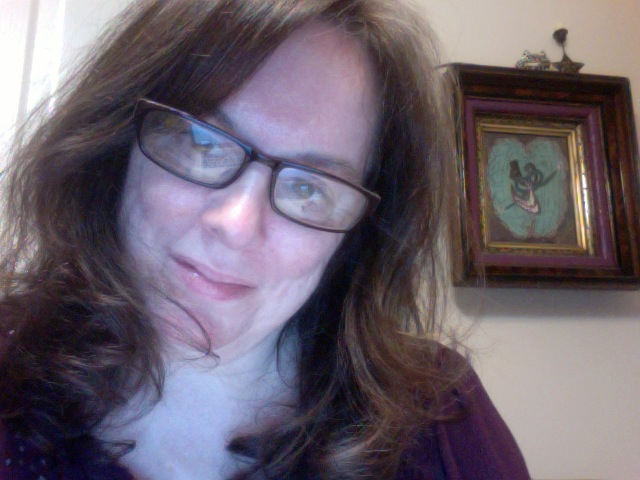
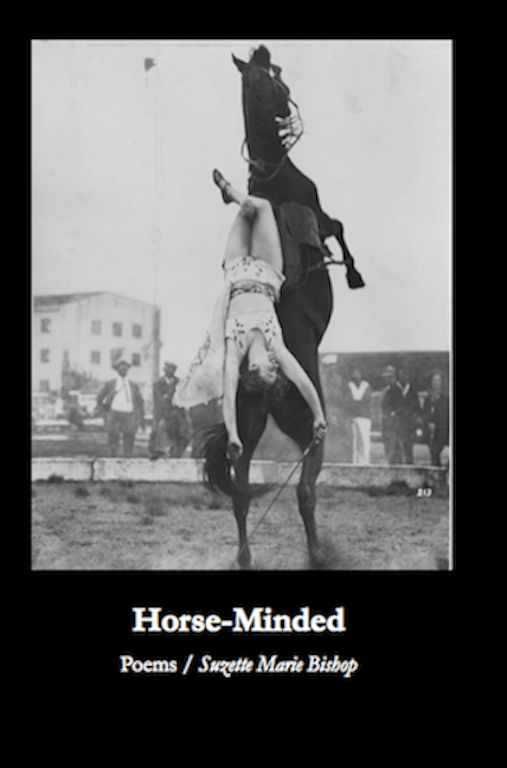
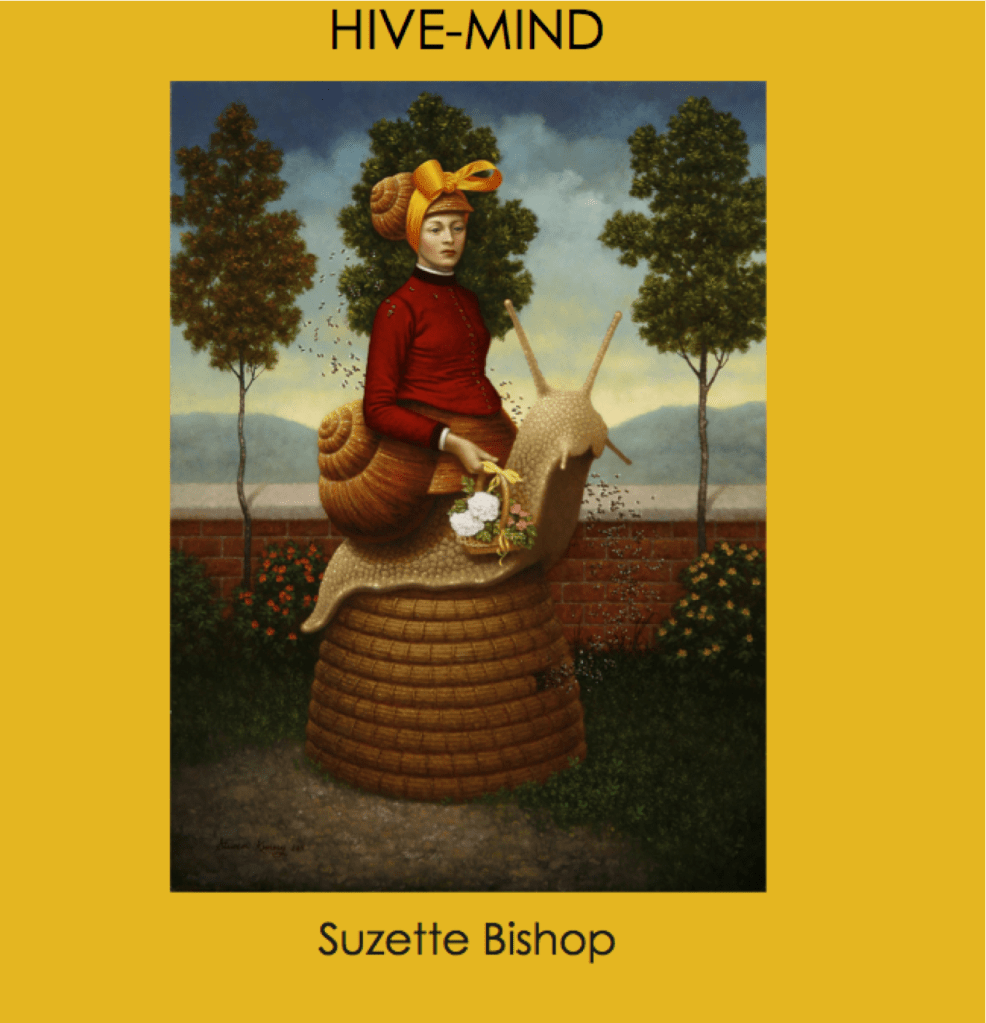
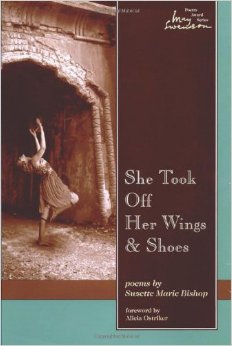
Suzette Bishop has published three poetry books, She Took Off Her Wings and Shoes, a May Swenson Award winner, Horse-Minded, and Hive-Mind. She Took Off Her Wings and Shoes was a finalist for the Eric Hoffer and Texas League of Writers awards, and Hive-Mind was a finalist for the Eric Hoffer Award. She also published two chapbooks, Cold Knife Surgery, and most recently, Jaguar’s Book of the Dead. She has a micro-chapbook, Unbecoming, forthcoming in 2026 from Ethel Press. She has also volunteered as an editor on literary magazines such as The Little Magazine, Iris, and Nimrod. She lives in Laredo, Texas, with her husband and two cats.
Website: https://suzettemariebishop.com/
 Parcham Online
Leave a comment