

- August’24 Issue Editorial by Bhaswati Ghosh
- Of Voids and Voices: A Home In Exile by Sana Shah
- Water is a Song from Memory by Maitreyee Boruah
- Azaan by Lina Krishnan
- The Urge to Sing with Joni by Nadja Maril
- An M. S. Baburaj Piece and a Stream of Quavers by Adish A.S.
- Sounds of The City by Sharmista Sen Gupta
- The Middle Child of Music…the 1980s! by Abhinav Prakash
- Notes from a Revolution by Sukhjit Singh
- Music in the American Civil Rights Movement– And How It Inspired Me. by Santosh Bakaya
- The Siren’s Songs by Jey Sushil
August’24 Issue Editorial by Bhaswati Ghosh
On those nights when sleep eludes me, which, unfortunately aren’t all that few, I turn to Spotify’s Calm station. As if they were a mother’s hand stroking my head, soft, kindhearted notes glide me into sleep.
Our world is insomniac now too, one might argue. Sleep has long been eluding children in Palestine, mothers in Ukraine, vegetable sellers in Lebanon…the list is exhaustingly long.
Music, from Old French musique (12th century), is defined as the science of combining sounds in rhythmic, melodic and harmonic order. When conceiving this issue of Parcham, I thought of the many situations — other than sleeplessness — when music has rescued, kept a vigil on and even cured me. I thought also of the world’s insomnia, not so much a helpless condition, but a stubborn refusal to rest. I wondered if the “harmonic order” — not merely of the octave’s notes, but of gurgling streams, a thrush’s song, the low crackle of keyboard clicks at work — could be the hand that led us back to repose.
While reading the submissions we received, and we’re grateful for the love with which so many contributors sent us their work, I delighted in joining fellow travelers on that road to repose. Reading through this issue, you’ll soak in the ‘therapy of occurring rains,’ find a lonely violin’s night speak to yours, perhaps hear whispers of ‘the songs lovers silently sing in their dreams’ and notice ‘a melody sit on the edge of an eyelash.’ Here we find stories of an accompanist’s indispensable contribution to classical performances, of seeking and finding freedom at a live concert, reconciling with a poet through a woman’s voice and finding music in the unlikeliest of places — the chaos of a metropolis’s university campus, and things — the sound of a siren calling factory workers.
I hope you’ll enjoy the notes and rhythms of this issue as much as I did.

Bhaswati Ghosh writes and translates fiction, non-fiction and poetry. Her first book of fiction is ‘Victory Colony, 1950′. Her first work of translation from Bengali into English is ‘My Days with Ramkinkar Baij’. Bhaswati’s writing has appeared in several literary journals, including Indian Express, Scroll, The Wire, Literary Shanghai, Cargo Literary, Pithead Chapel, Warscapes, and The Maynard. Bhaswati lives in Ontario, Canada and is an editor with The Woman Inc. She is currently working on a nonfiction book on New Delhi, India. To learn more about her publications click here .
Of Voids and Voices: A Home In Exile by Sana Shah
Sunrise.
6.50 am.
No one walks down this alley of memories any longer, except a voice. A sound. A note. A harmony. An ensemble of narratives, of fractured memories, woven together through a set of musical instruments. A story foretold, of waiting, of yearning, of patience, of anticipation. Nights spent through the doorways of oblivion with the solitary companionship of the unfazed moon, overseeing the business of this world, incomplete, unattended.
11.52 pm.
The silence outside punctures the solitude within. The melodies flow again, the tempo untouched by the worldly hands of this pandemic-hit world. The cyclical flow of the days and the nights, touched by these melodies frozen in a distant past, shelter my being from the uncertainties of this suspended world. I am a fractured tale from a fractured land in a struggle to heal my fractured identity. This is a journey toward a fractured end, and I, the victim of inherited memories.
تُو سمندر ہے، میں ساحلوں کی ہوا
Tu samundar hai, mai saahilo’n ki hawaa
This is home, these melodies of that singer no longer with us. The host fills the home with the presence of her absence. It is difficult to come to terms with this loss. I gaze hard at the screen that transports me into another world, a more familiar one, where every curve – unknown, maneuvered through anticipation and thrill – appears familiar, easy to navigate yet full of surprises. The lady, boldly dressed in that man’s world with an unmatched style in a niche which is all her own, dominates the music and the screen. The melodious voice, frozen in the past, from across decades together, speaks to my present as if coming from a distant time in the future. I am dazed as she pulls through a difficult Raag, a combination of notes delivered to perfection. Melodies of Madam Noor Jehan – feelings of home, of having arrived at, of a destination, of a journey. I am home.
A home for the new lovers, for the heartbroken, for the distressed, for the exiled, for the loners, for the solitary, for the travellers, for the lost, for the marooned, for the grief-stricken, for the poets, for the artists, for the art.
I scroll through the screen, pausing at yet another pearl in this ocean of art. The voice is as fresh as ever, however suddenly sounds like a memory of a distant past, an ode to the artists of our times. It is a those love letter to be read carefully, word by word, pause by pause, folded cautiously and shelved away from the clamour of the world, to be preserved in some old teakwood lockers in an antique almirah. Now home.
من بگیا میں آگ بھری تھی، پھول کہاں سے کھلتے
Mann baghya mai aag lagi thi, phool kahan se khilte
asks the voice.
The lyrics house the questions of numerous souls, yearning for answers.
ایک ندی کے دو تھے کنارے، کیسے بھلا پھر ملتے
Ek nadi ke dou they kinaare, kaise bhala phir milte
A conflict-ridden region comes with fewer hopes of a place one can call home, rightfully and with all the rights. As one comes of age in such regions, one also grows with the realisation that an exile awaits the soul, as the homes are converted into prisons of political aspirations. Those who can take the next logical step of leaving, only to discover the spectre of exile following them everywhere. The strain of having to negotiate and live through multiple identities, the spatial politics of such fractured regions, that lovelorn forsaken world, sooner or later end up cutting through the core of one’s being. In such peculiarities where would one find a home if not in these melodies, if not in the memories these melodies carry along, if not in the animated figure that performs these melodies to their perfection?
آپ سے کچھ گلہ نہیں
آپ کو بھول جائیں ہم
Aap se kya gillaa kare
Aap se kuch gillaa nahi’n
As one cannot but helplessly march onwards to journey through this alley of life, what else can be home, if not these melodies? Frozen in time, a consistent companion in life, downloaded carefully and preserved cautiously, to defy the internet restrictions that the state imposes from time to time.
دل دھڑکنے کا سبب یاد آیا
وہ تری یاد تھی، اب یاد آیا
Dil dhadhakk ne ka sabab yaad aaya
Vo teri yaad thi, ab yaad aaya
3.00 AM.
In the restless silence of cold nights, the struggles of exile must provide the soul with enough warmth that all the promises of love fail Yet the poet, in his poetry, will call upon love, both for the beloved and for the revolution! I wonder, did the poetic genius of Faiz Ahmad Faiznot comprehend the poetic injustice inbred in such thematic proclamations as he composed those famous lines?
Perhaps I could only reconcile with the poet through a woman’s voice. Perhaps I befriended Faiz through the voice of Noor Jehan. Noor Jehan did not succumb to the fear – how could her melodies then not be home for people like us?
دنیا نے تیری یاد سے بیگانہ کر دیا
تجھ سے بھی دل فریب ہیں غم روزگار کے
Duniya ne teri yaad se beigaana kar diya
And you?
You refused me your sorrows too
You denied me your farewell as well!
6.00 AM
For the ones who lose their being in love and the ravages of love, what could be a greater consolation than to love someone untouched by the ravage of time, safe from the reminders of mortality? The love for which the borders of India and Pakistan, the arch-rivals since the partition
of 1947, melded into a union, and the No Man’s Land becomes the Woman’s land. The tears that would have reflected a ceaseless yearning for home become home.
Perhaps, there is a place that is refused to the nations and that the nations refuse, one that only love could access. To love in a way that does not require reciprocation and yet speaks of love in return. To overcome the loss of the beloved, the pain of parting with the voice of someone who overpowers every other emotion, every other absence, every other pain just through her melodies. Lovers, after losing the gamble of love, must head back home.
This was home. This is home. This will be home. Indifferent to my absence yet anticipating my arrival.
جدائیوں کے زخم درد زندگی نے بھر دیے
تجھے بھی نیند آ گئی مجھے بھی صبر آ گیا
Judaaiyo’n ke zakhm gham-e-zindagi ne bhar diye,
Tujhe bhi neend aagyi, mujhe bhi sabr aa gyaa.

Sana is a PhD student at the Faculty of History, University of Oxford, UK. Her research interests borders on political theory and philosophy of history.
Water is a Song from Memory by Maitreyee Boruah
The water from the kitchen faucet won’t stop dripping. Plink! Plink! Plink! I closed the tap tight, real tight. My wrist felt a little supple. The tap was closed, but the water was still trickling into the sink — one drop at a time. This time I clenched my fist harder. The handle came off and water splashed all over my face. The plumber had fixed it twice. He replaced the old faucet with an expensive and sturdy one.
It worked well for two days. There was silence. On the third night around 2 am, I woke up. Plink! Plink! Plink! The conversation between the faucet and sink resumed. Slowly, the irritation of broken things within and outside my existence dissolved into water.
The repetitive rawness of the foreign sound turned into music. Plink! Plink! Plink! The background song to my ruminations. I could not sleep. I took a trip down memory lane. My days, months and years in Bengaluru.
It’s been fifteen years. I changed five jobs and was unemployed again. All this while, I was living in the same locality. A crowded, concrete area–where every second young immigrant was aspiring to be an IT professional or was one. I was suspected by strangers on the road and bus stops to be one of them. I carried a backpack wherever I went. I always replied, “Naanu software engineer alla (I am not a software engineer). I am unemployed.” I followed a swalpa (little) bit of Kannada but whenever I endeavoured to ask someone her name in the local dialect, I forgot my own.
I had forgotten my mother tongue, Assamese. Similarly, the textbook Hindi, the English I tried to get an education in and the Kannada I never learnt. Then the bits and pieces of Mishmi, Adi and Apatani (different dialects of Arunachal Pradesh where I had spent my childhood). I had forgotten the songs in all these languages I had learnt across places.
With the erasure of languages and their accompanying songs and music, I was left bereft of my identity. It took me a while to admit the fact. But the truth caught hold of me. I tried to fit into the uniqueness of others without actually ever claiming my own.
I was old and tired to assert my existence. I was equally privileged not to bother enough about official declarations and personal proclamations. Life with or without songs anyway had to be endured. Tujhse naraaz nahin zindagi, hairan hoon mei…( Life, I am not upset with you, I am just amazed…). I was amazed when I cared to understand the song in its actuality. Every word of Gulzar made me cry. It’s the catharsis I needed after enduring the storms of life.
Strangely, I never took any effort to listen to the song. It re-entered my life like some old friend who went missing for a long period to reappear again. The entries and exits–unacceptably and inadvertently. It’s a cycle.
The last time I heard the song was a few months ago. I was walking around the neighbourhood and the radio from the barber’s shop was playing the song. I went closer to the shop and listened patiently. Tears started gushing. The barber saw me sobbing quietly. Maybe I was standing too close to the shop, a few teardrops left a trail on the glass door like the raindrops do every time they roll down a dusty windowpane. The song, the drudgery of life and a puzzled-looking man holding a pair of scissors questioned my confused identity, again.
***
Being identified and claiming one’s own identity were never identical. It happened all around us. I said with confidence and an equal amount of shame and guilt because in my home state, Assam, if a person did not tick the identity markers (decided by decades of hate and genocidal proclivity), the state on mere suspicion declared the person an illegal immigrant — a Bangladeshi/Miya.
Once characterised as a foreigner – hundreds of old men, mothers with toddlers and poor daily wagers were sent to detention centres. The state built prisons within prisons to punish the very act of existence. From such lockups, the only possible song was about freedom rising from the ashes of grief and horror. The song was about death too.
I waited for someone to write a song about the detainees–a specific one. Probably, some censored Miya poet wrote it. I did not hear it. It would be jarring to the ears for the ‘privileged’, including myself whose crises and cries were imprisoned between the pillow and bed sheet – between delusion and dread.
***
My existence even in its smallness never agreed to be condensed in that ‘one special song’. I never had a favourite song. I had many. Those that intersected between the tracks for antakshari games I played with my school buddies. One track led to another. It was always Bollywood. The musical games accompanied by adolescence exuberance started with a gusto – Gata rehe mere dil, tu hi meri manzil and ended on a sombre note, Dheere dheere se mere dil mein aana.
We were not singers or musicians but we pretended to be. Some of us curled our fingers as our hands mimicked mics. Those who aspired to be more authentic in the make-believe world used bamboo logs as mics. Some of us carried notebooks with lyrics written on them.
We swayed our heads in anticipation that our hair would circle around and touch the ceiling. When it came to singing, we were always discordant and that was the fun. As I looked back, I realised we were not trying to be singers, we were making memories.
***
Between my childhood and midlife, there were marks of musical dilemma. My early adulthood remained a mystery to me. It was uncomfortable and better to be forgotten. In those times, I experimented with pop, rock and ghazal. Ghazal stayed with me. Jagjit Singh–the king.
Even when I thought of him in my mind (I couldn’t say just Jagjit or Singh. It had to be Jagjit Singh. It had to be complete. Like the gamut of emotions, he taught me to feel and understand. His songs tapped the tiniest of emotions hiding in my blood vessels), I always thought about his song, Chak Jigar Ke.
It was from an album – Love is blind. It’s not as popular as Tum itna jo muskura rahe ho or Tum ko dekha to yeh khayal aaya. Chak Jigar Ke was quiet. My younger sister and I would listen to the song on a loop. We would rewind the cassette every time it ended. All done without talking to each other. The song played on and on. We continued writing our college notes and learnt that there was no escape from living, no matter what life had to offer us.
***
I knew several places and people in Bengaluru but I had one friend and one home in the city. They were my solo songs. The songs that never required accompanying music. Even if both male and female voices had sung the original version, I made them my own. Between KS Chithra’s Lala, lala, lala and SP Balasubrahmanyam’s Saathiya tune kya kiya, I found my intezaar (wait) coming to an end. In those moments of sublime love and pure ecstasy, the untrained me wanted to be a singer. I was my own singer and audience.
Plink! Plink! Plink!
The water from the kitchen tap continued to provide rhythm to my non-lyrical life. By now I had made peace with it. I tried to write a song. Poetry left me long ago. I tried to recall the songs that I grew up listening to. None suited my situation.
The black-and-white television set from Anini in Arunachal Pradesh played Dev Anand’s song–Main zindagi ka saath nibhata chala gaya. It was Chitrahaar – the 30-minute song bonanza every Wednesday evening (later a Friday slot was also added) from the 80s and the 90s in Doordarshan. I was a regular audience member.
The song was a constant in Chitrahaar. I learnt it over repeated viewing. I was a child of eight or nine and I hummed the song to avoid pondering over life’s difficulties – exam stress, sibling fights, the indifference of boys I liked (not yet crushes in the true sense), the death of a loved one and the unabated tiredness of body and mind that followed me since my childhood.
I went back to sleep and woke up at 5 am when the municipal corporation’s garbage van fitted with a loudspeaker blurted Payaliya ho, hoho, ho… I hated Rishi Kapoor at that moment (his face made an appearance, not his co-actor Divya Bharti). It was pure hatred, and when I remembered that he was dead, I decided to forgive him (death makes even dictators look benign. He was, after all, an actor) for his choice of colourful pullovers to hide his bulging belly to work with a much younger female lead.
I wanted to get up to go to the balcony and shout at the garbage collectors to turn down the volume. But even before I could, the van moved to the next lane and the song took a lesser menacing tone. It slowly turned benign. Then it died. I absolved the garbage collectors, the municipal corporation officials and the heap of garbage that was growing bigger and bigger in the neighbourhood.
How long could one curse? I stayed exasperated in bed. Plink! Plink! Plink! The water in the kitchen continued to jive in rhythm.
***
I fell asleep and dreamt of the musical notes from Anini that I had buried deep in the breasts of its hills. Anini was a small town with a small population.
Nonetheless, the inhabitants had an excellent appetite for “cultural stuff”. The auditorium, strangely called Reco Mandir, in the middle of the bazaar frequently hosted cultural programmes.
The song, dance and drama fests were excuses for long periods of rehearsals – the get-togethers of school students, office workers and homemakers. Tea and snacks started and wrapped up the long nights of rendezvous in one or the other home built in the zig-zag lanes of the town.
The hills surrounding Anini had witnessed and endured the determination of the non-singers, non-dancers and non-actors to perform and entertain each other. Most of the acts were close to comical. Only one name stood out – Sampi.
She was different. She danced like a professional. She danced like a Bollywood actor. She was my Zeenat Aman. Mishmi Zeenat Aman. Mishmis are the local inhabitants of Anini. They all looked beautiful – especially the girls with their flawless skin and gentle demeanour. I knew very little about Sampi because she was not from our school and she dropped out long ago.
She stayed out of Anini for the most part of the year. Like some magic, before every cultural event, Sampi would return. Suddenly the sky would also turn sunny, the air crisp and make way for the helicopter (that was the only mode of transport in absence of road connectivity) to arrive. Sampi was back home.
Her performance was always kept for the end. In her short green sequin dress and black high heels, that day Sampi performed on Aap jaisa koi meri zindagi mein. She was a disco dancer. As her foot stomped the wooden plank of the podium and her kohl-filled eyes looked at the spectators, they too rose from their seats like a whirlwind and swayed along with her. Her body moved at a pulsating rate. She turned like a ribbon in rhythm.
I dreamt that night. I was wearing a green short dress. My Bata lace shoes were replaced by high heels. It was hazy with my eyes painted in kohl. I was singing. I was some kind of a hybrid between Zeenat Aman and Sampi.
The next morning, I tried to imitate Sampi in front of the mirror. Maa saw me and together we laughed. The dream continued for a while in real life too.
***
Back in Bengaluru, waking up to the reality of another morning, it felt like yesterday when Sampi was dancing. I had to start the day and the vegetable vendor in my lane was already singing, “soppu, soppu, soppu…”
Before stepping out, I tore an old gamcha into two parts and wrapped every inch of that around the kitchen tap. It looked like a broken skull bandaged in its agony. For a moment everything stopped, and then the damn water dripped again from some secret corner – Plink! Plink! Plink! My niece told me to take it easy, “It’s water, not blood.”
I shifted my cleaning chores to the verandah sink. I felt exposed. I felt the gaze of the outside world in my intimate moments. Passersby, one by one, looked upwards to our first-floor flat to find a woman scrubbing the grease from the kadhai. In their harmless observation, they took momentary breaks. Inside, the kitchen tap continued to plink — plink and some more plink.
The music never stopped.
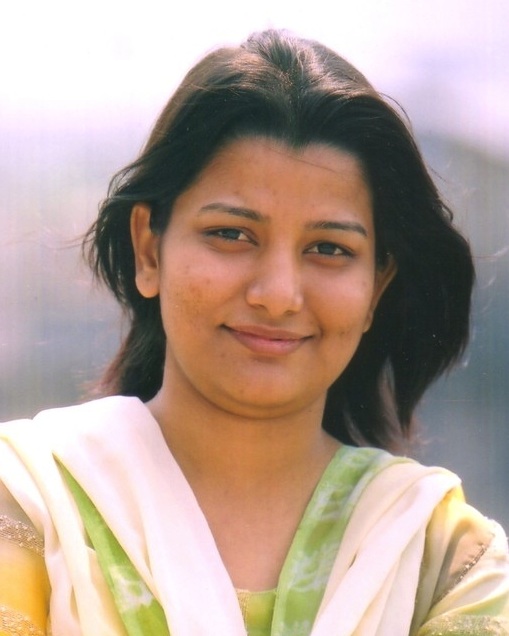
Maitreyee Boruah is a Bangalore-based independent journalist who also writes poetry and short stories. Her short story, Pungbili, has been recently published in an anthology, Riverside Stories, by Zubaan Books. Another of her short stories, ‘Laab’ In The Mountains, was published by Outlook magazine. As a journalist, her work has been featured in various publications like Al Jazeera, BBC, The Telegraph, Scroll, Outlook, The Hindu, Times of India, Deccan Herald and others.
Azaan by Lina Krishnan
For some afternoons now, I have been listening to the azaan. Its hauntingly beautiful melody floats over the houses, slips through the lanes to reach me. I don’t really know where it comes from; it doesn’t sound very near. But sound has a way of getting through. It is perhaps the last namaaz before dusk, and the muezzin seems to put all the power of his meditation into this: the act of calling the faithful to prayer. If this were Malaysia or Dhaka, Lucknow or Bhopal, the whole city would be reverberating with the parallel strains.
Listening to the rhythm in the prayer reminds me of an evening long ago in Goa. At dusk, watching sea waves lapping a riverbank in that uniquely diverse landscape, we heard a bhajan that was so beautiful it was unearthly. As we listened, night came on. The next evening, there it was again, with the power, the passion, and even, it seemed, the voice of Kumar Gandharva.
As we followed the sound, it seemed closer, louder but always that elusive step beyond. Before we knew it we had left the beach, the shacks, the neat bungalows and bakeries of Calangute behind, and entered a new faith line. Here were different looking houses, a tulsi before each home, women in nine yards looking curiously at us.
And the music was now louder than ever. Then, there it was, a traditional thatch roof hall, possibly an adjunct to the village temple, holding as many people as it could. Feeling like sore thumbs, we watched from the shelter of a tree. Nor that it would’ve mattered. The village people were so engrossed in the performance, so mesmerised, that they had eyes and ears only for him. And he, thin, somewhat grey, was holding together his audience within the ambit of his tanpura’s strings, eyes closed. He was a guru in the real sense of the word. The gods who were listening must have been as grateful as we were for this totally unexpected encounter with enchantment.
And like all magic, it vanished without explanation. As we retraced our steps the next morning, all we found were some ladies putting fresh rangolis for the Navaratri festival. The unknown musician had moved on.
The blessing of that night re-echoes for me as I hear the muezzin today. I don’t know where he is; yet there is a chord within.
Lina Krishnan is a poet and artist. These musings were first published in the Unboxed Writers zine.
 Parcham Online
Leave a comment