
Three poems by Paromita Goswami
Learning Bhimgeet in Protest
Like million fireflies
we cluster
under the twilight sky
the vast grounds lit
by a thousand torches.

my first morcha
alongside familiar strangers
not urban naxals or andolanjeevis
but ordinary people
with their charter of
ordinary demands
that should not be demanded at all
	like bridges that survive
	the first monsoon
very ordinary things
	like decency, like dignity
	like life

Drumbeats resound and
young voices thunder
 in a powerful chorus

tujha raktamadhla bhimrao pahije
tujha hrudayamadhe sanvidhaan pahije

The woman next to me
 her hair unbound
sings in a trance
her eyes afire
calls out to her father in her song

Jai Bhim! Jai Bhim!

Farmers, students
Workers, thinker
Singing, swaying from
Side to side

Jai Bhim! Jai Bhim!

Silent,
I watch in tears,
“Sing!” old mavshi urges me

“I can’t, I can’t
I have never sung
Not in five thousand years
I can never sing!”

“Oh, that must be
such a privilege,” she smiles
“But since you have learned to
raise a fist, surely you can
raise your voice!”

A thousand hands hold each other
a thousand voices blend
into a crescendo

my small whisper joins
 the constellation
of voices
Bhimraj ki beti mai bhi
Jai Bhimwali hoon!
****
tujha raktamadhla bhimrao pahije
tujha hrudayamadhe sanvidhaan pahije
Song lines in Marathi. We want Bhimrao to reside in your heart, the constitution should reside in your heart
**** Bhimraj ki beti mai bhi
Jai Bhimwali hoon!
Lines of a popular Bhimgeet in Hindi of which I have changed one word. The lines here mean ‘I too am the daughter of Bhimraj, I too am Jai Bhimwali’.
Zeenat Aman
The summer was hotter than
all other summers
Zeenat danced in and out
of my closet all day
and night

Laila main Laila …

Black waterfall hair
fell straight over her back
Got in the way of
her shimmering bosom
her shrugging shoulders
her baby-smooth armpit

Aap jaisa koi meri zindagi mein …

She danced in red
swathed in soft white feathers
and that silly shiny headband
I wanted to try
Khatouba, Khatouba
Hooo oooo oooo oooo

And her clinking wine glasses
And her swinging guitar
And her heavy eyes

The summer was hotter than ever
and Zeenat kept dancing
all round my bed
and right into my head

flickering and glittering
whirling and winking
and wiggling her
18 inch waist

Chura liya hai tumne jo dil ko …

Dad brought our summer
to end
Caught us red-handed
Zeenat was in her
pink strappy whatever
which did nothing to hide her cleavage
she wasn’t even trying
And the glitter on her lipstick
was obviously wet

Do lafzon ki hai dil ki kahani

Dad tore Zeenat into pieces
Scolded mother
Issued stern warnings
Dream is not reality girl!

Satyam shivam sundaram …

Next summer
I danced out into the sun
18 inch waist
Straight black waterfall hair
Soon to be surrounded by
My very own set
Of weird men

Jiska mujhe tha intazar …
Where did I Go Wrong?
Here I am floating
a tender paper-boat
swirling
against the swift flow
of the night river

Where did I go wrong?
my heart quavers
A major error?
A minor one?
where did I go wrong?

On the other bank
I can hear you
Your sweet fluid notes
now high
	now low
not like my middle-class worries
fixed, flat
dull

My delinquent song has escaped
through unsecure margins

Nothings remains
	Except this instrument
	In my hands
	dishonoured
		I confess, my love
	It has all become quite negotiable.

Paromita Goswami is a grassroots activist who lives and works in Chandrapur, Maharashtra. Her stories have appeared in Jaggery Lit, Out of Print, Muse India, Mean Journal, Himal Southasian and Samyukta Fiction.She won the Rama Mehta Writing Grant (2023). A collection of her short stories has been accepted for publication by Red River Stories.
Memory by Purabi Bhattacharya
Memory-
a sonata full pastoral pond
just-
   not an imagery
   not a blank canvas
a brush or many at work
  not like Kahlo’s knife-
smiles, sadness cut through
a sonata full pastoral pond.


Memory-
independent
  of the modulation
  of your breath
breaking quiescence
hush…
no one knows
you
lent me rhyming scheme.
My warm breast
fills in with honeyed words
fills in with anaesthetic comfort
apart from the ciphering lyrics
quick at disposal
from the technophile
memory-
I only hear love song
up until now
I only know love song.


Memory-
a sonata full pastoral pond
water hyacinth dream detain
warm               unworded
unscripted tale
pile up
between our maudlin gaze
dilated eyes
in commoving conversations on children
mass buried, somehere
 to fill in
spaces
between the greying blue, the cotton clouds
big talks, activists and city streets.


Memory-
is ikebana.
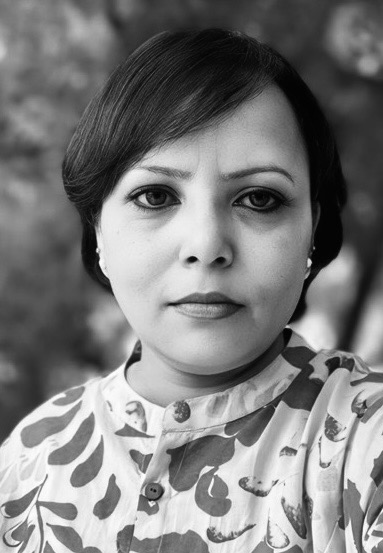
Purabi was born and bred in Shillong, North east India, now lives and works in Gujarat, India. A writer and a poet, a book and film reviewer teaching and writing for over two decades now, she is a Writers Workshop India published author with three collections of poems who loves to recite poems aloud. Purabi reviews books as a panelist for the literary e-journal Muse India. Her contributions can be read in ‘International Human Rights Art Festival publishes’, New York, ‘The Little Journal of North East India’, ‘livewire’, thelakepoetry and ‘And Other Poems’ and have been included in the anthology, Yearbook of Indian Poetry in English 2021 besides other writing platforms.
Inherited Music by Sarah Das Gupta
The trees speak the language of my birth,
they bend to its sonorous syllables.
In autumn gales they resort to ‘boom’ and ‘doom’.
The coppiced hazels in the orchard
whisper, ‘shush’ and ‘swish’
 in answer to the scented wind of summer.

The ancient hills in rocky enclaves,
speak the old tongues of Celt and Saxon.
On wild, winter nights,
the wind roars along rugged crests,
muttering the language
of clashing swords and flying arrows.

The cliffs,
chalky white, red sandstone, grey granite,
echo to storms rolling in from the sea.
Angry consonants sound in fury,
rebounding in the faces of would-be enemies.

In dreams, I build words, phrases in that language.
which shapes and moulds the landscape,
waking and living, those letters and sounds
interpret, vocalise my inner silence.

Cemeteries are quiet places,
the dead lie silent.
Yet they live in the language
they wrote and spoke,
in which they were moulded
and which they shaped too.
Sarah Das Gupta is a writer from Cambridge, UK who has also lived and taught in Kolkata, India and in Tanzania. Her work has been published in over 20 countries, including: US,UK, India, Canada,, Australia, New Zealand, Bangladesh, Nigeria, Ireland, Germany, Romania and Croatia.
 Parcham Online
Leave a comment