
Jalsa by Shibani Phukan
A languorous shiuli-scented morning
Of waking up to the strains of the tanpura
And the metronome marking time
The alaap of an Ahir Bhairav
The melancholy of the nishad
A foil to the grating rustle of the daily newspaper
Harbinger of news of yet another bloody blast.

The slow paced vilambit embroidered in ektaal
Gathering the momentum of a khayal
As the day progresses
And shishyas come together in a unique harmony
Matching sur and taal
For a guru whose voice quivers
to hold steady an old familiar practised note.

Dusk settles in weighed by the day’s heaviness
Mellow like the madhyam
Of a Yaman Kalyan
In a bandish deceptively playful
But the taans gliding through the octaves
Belie the labour of an artist
Gasping for breath.

The dark of the night is set ablaze
With a bhajan in Jaijaivanti
unfurling to a tritaal
A prayer and a plea rolled into one
As all the seven notes and their variations
That compose the raag
Find their way to the ultimate Sam.
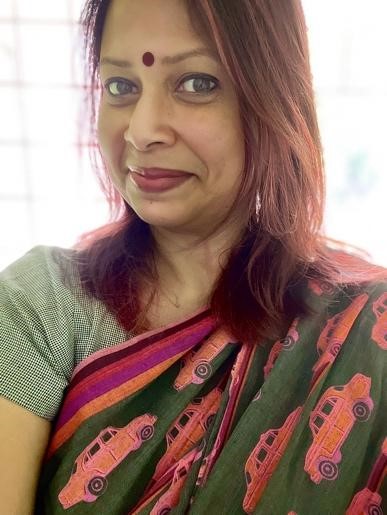
Shibani Phukan is an Associate Professor in the English Department of Atma Ram Sanatan Dharma College, University of Delhi. Her areas of interest include Writing from the Northeast, Women’s Writing, Contemporary Indian Writing, and Translation Studies. She has published articles of academic interests in the mentioned fields in prestigious journals such as Journal of Postcolonial Writing, Wasafiri, and for books published by both national and international publishers for academics and undergraduate students. She also writes book reviews for The Scroll and Livewire, The Wire, periodically. She writes poetry that she reluctantly shares.
The Rhythm of the Raga: A Haibun by Gargi Mehra
Upon a soft mattress on the cold hard floor, my fingers curled around my Walkman, and the earphones – the three ingredients blend together to melt away my melancholy. From the coast of Oman, we’ve flown over blue sea and khaki land, to arrive in New Delhi. Movers and packers rumble around town, but avoid our house, where months have passed since we’ve touched wooden furniture. I plug the little wired buds into my ears, and surrender to the music of the new maestro.

A warm summer dawns, I’m perched upon a cane stool and lost in a strange melody. I hear reggae play host to a woman’s soft voice in the foreground, a rare combo in Indian film music. On the boxy television, the video blares. Pastel colours fill the screen. A fisherman casts a net and reels in a huge fish.

I grab the rope of melody and swing into the land of AR Rahman, the young composer who wears an unassuming air. The songs squeeze out my break-dance skills. I try and stumble. I break out the piano, and bang the keys, forcing it to surrender the tunes, but it doesn’t comply.

In the years to come, the whole world will devour his unique fusion, where ragas from classical Carnatic music set the stage for guitar riffs. The strums, that waft from the terraces of Indian havelis and in the courtyards of old Indian houses, fuse with the vibes of folksy rock. I close my eyes, and this time, the notes obey me. My fingers follow the tune in my head, and the melody comes alive.


Chords of beauty
Fusing the classical notes
With new life and love

Gargi Mehra works in IT and moonlights as a creative writer. Her work has appeared in numerous literary magazines, including Crannog, The Forge Literary Magazine, The Writer, and others. She lives in Pune, India with her husband and two children. She blogs at www.gargimehra.com
Two Poems by Pooja Garg
Megh Malhar
When you arrived, you knew the shape of music
is a body that contracts and swells with notes. Like
the surging afternoon sun. The tiled roof blazing

with your voice. Rising above the parapets, above
the dusty bowl of intimacy lost to time
and distance. Notes that feel stripped away. Bare

and raspy to touch. A reminder to undress the soul
when the body stays still, doesn't move, offers
suppleness. A river in high tide. A cloud filled

with memories. A thunderstorm threatening
to burst open. A threat that feels like an old promise
to wash away everything but the gravel

of your voice. A pelting that I had heard
even before you arrived.
Sing.
Earworm
Music is not in the notes but in the silence between. [Mozart]

Like an earworm, your name came to me
long before you did. A musical note that I twirled
around and around. An infinite loop, a round swollen

roshogulla that I couldn’t have enough of. The sweet
sticky note clamoring to my tongue, making me grasp
the air that you would inhabit later, your ear whorls

pink and upturned when you were born. I whispered
your name to you again and again and again—a litany,
a lullaby that meandered its way into your nights

with Phule Phule Dole Dole and into mornings
with the Ode to Joy. Music was always a secret
language for you, a code you understood

too well. At two, you cried—heart-heavy
after Mozart moved you so much
that your chest hurt. At four, you dropped out

of the school musical and its clashing
cymbals. At six, you ran out of Diwali bhangra
for not its beats but its beating down.

And then at seven, you put your hands
around your brother—a canine
has ears that hear much more, you said and pulled him

with you to sit inside a suitcase that promised
a place of silence—you broke it years later
when you heard the permanence of his heartbeat

go quiet under your hands. A beat
that ticks in you now
Asking you find your own rhythm.

An award-winning writer, storyteller, and poet, Pooja Garg is the Founder and Editor of The Woman Inc, the South Asian Collective, and From My Window Anthology. She is the author of Every Day and Some Other Days, a poetry book that Shabana Azmi called “a must-read.” Deputy Editor for Atlanta-based Khabar magazine for Indian American community, Pooja has previously worked with India Today. At various times, she has been Poetry / Book Review / Fiction Editor for Jaggery Lit and Open Road Review. Among other publications, her poems have found place in Eclectica’s Best of 20 Years of Poetry and the Red River Anthology. As the USC Annenberg Fellow for Writing and Community Storytelling, she explored domestic violence and intergenerational trauma in the South Asian American community. A member of her county’s Domestic Violence Taskforce, she conducts poetry and storytelling workshops for healing. Pooja writes at the intersection of identity, race, gender, culture, migration, political, and personal.
My Mother, Our Mother by Sardonyx Herald Mylliemngap
I learned from Mei,
I learned from Her;
The music that is echoed by the rain,
The waters, the wind, the thunder and the strikes of lightning.
I learned from Her the music of my culture,
The tunes of my faith,
The rhymes of my roots.

The trickling droplets of this soothing rain
Reminds me of her song- “Amazing Grace.”
Dripping from the open gates of the sky,
Soaking the sleeping leaves and grasses;
Dead.
Or waiting for their revival.
My revival, our revival.

The gushing orchestra of ki kshaid- the waterfalls
Plunging to beat the boulders and rocks,
Carried my dreaming soul back to the tales:
The great sorrowful tales of Ka Likai,
U Lapalang, U Kwai U Tympew hapoh ka shang.


Witten by – Sardonyx Herald Mylliemngap


The Wind. The Wind. The Wild West Wind
Has swept the tunes of our fragile East;
Trying to colonize my tongue and my speech,
My hums which runs with the spiritual beats
Of Ka Ksing Ka Bom – our Khasi drums,
Of the mystic chants unique to our land.

But I learned from Mei,
I learned from Her
To peacefully harmonize with the foreign storms;
While mastering the music of my culture my roots,
Retaining the lullabies of Mei’s own flute.

For losing my tunes, my rhythm and rhymes,
Would only erase me from History and Time.

I learned from Mei,
I learned from Her
The music that is echoed by the rain
The waters,
The wind, the thunder
The rhythm of my roots,
The tunes of my culture.


Witten by – Sardonyx Herald Mylliemngap


And the language I speak,
Its glory and sanctity,
The scared music which anointed my identity,
I learned from Mei,
I learned from Her.
I learned from Mei-
My mother,
Our mother.
****Notes:
The poem contains the following Khasi words and expressions.
Ka Ksing ka Bom – a set of traditional Khasi Drums.
Mei – Mother
Ki Kshaid – waterfalls
Ka Likai, U Lapalang, U Kwai U Tympew – tragic folk narratives popular among the Khasis.

An aspiring writer who is pursuing his Masters Degree in English Literature, in North-Eastern Hill University, Shillong. Sardonyx has recently published a bilingual poetry chapbook entitled Na Ki Syrngiew; From the Shades. His poetry engages with the everyday reality of a Gen-Z experience, while emphasizing on the rich Khasi heritage which he embrace. Being inspired by his own local surrounding in the Khasi Hills, he employ vivid imageries to bring into life the emotions of being a Khasi, while writing in a foreign tongue. Sardonyx Herald’s poetry aims to share the local experience of a youth who immerse himself with the expression of the self and the external reality. He writes both in English and Khasi, thereby making his poems an amalgamation of the western and the oriental landscape.
 Parcham Online
Leave a comment