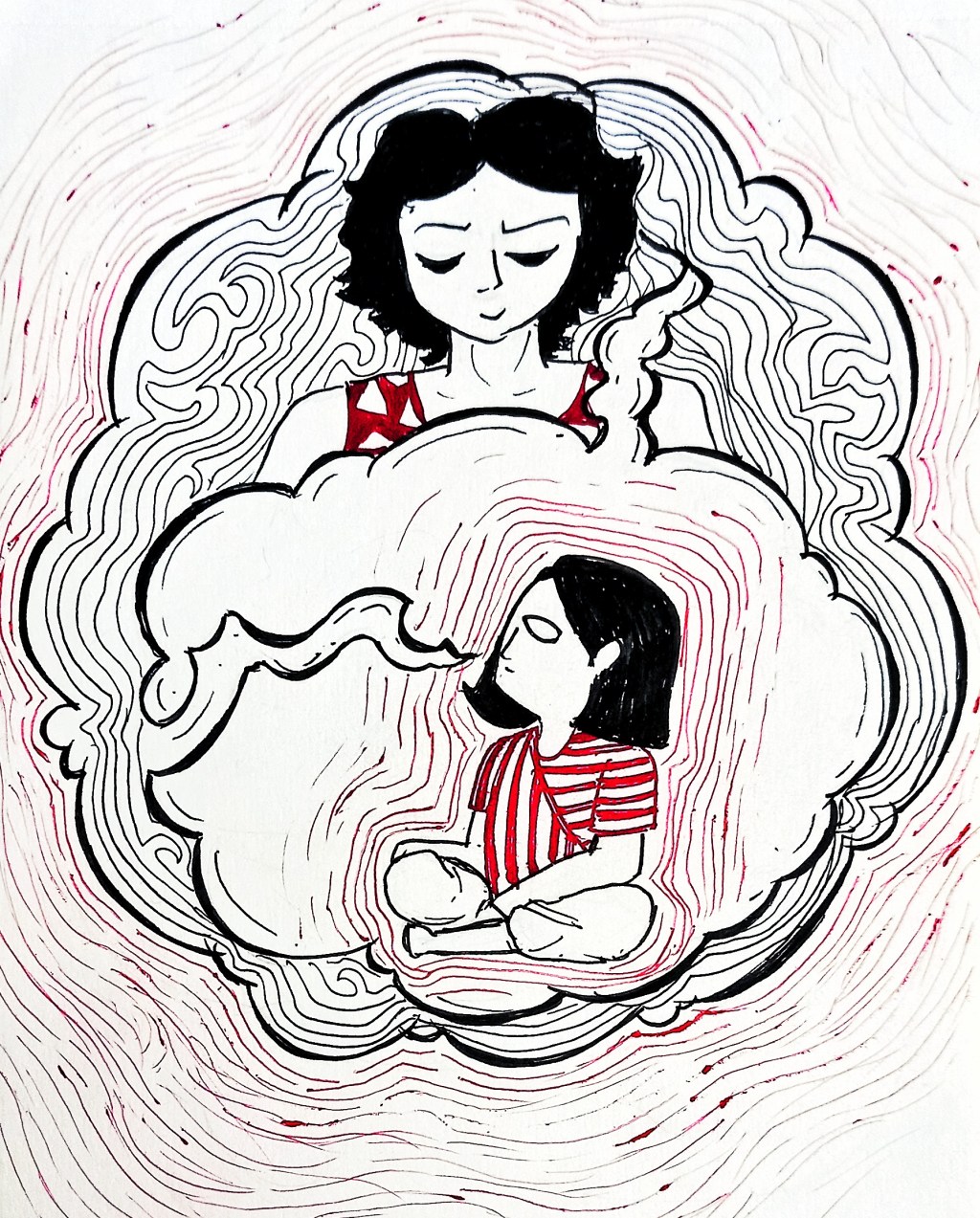
Invisible— Rituparna Mukherjee
Kaaliya, Oh Kaaliya, the dark one, why are you wearing new clothes Kaaliya? Is it your birthday Kaaliya?
The cries and cackles of her cousins woke Krishna up with a start. She rubbed sleep from her face and told herself it was a dream. First came confusion, then incredulity. It was so long ago. Why did she still have such dreams? She and Kartik had gone to sleep around four in the morning and she felt her eyes hurt with the sun peeking from the curtains. Kartik was still asleep. She smiled warmly at him and pulled the bedsheet a little closer to his neck. She knew he turned cold in the mornings. She thought of her name. Krishna…a clipping for Krishnakali, named after Tagore’s eponymous song. Ambitious, wasn’t it? She had always known herself as Krishna, wondered why she had been named after a male God, until the day her grandmother told her that she had named her Krishnakali and sang Tagore’s song to her. To her young mind, the song made no sense, the only word that had reached out to her was kaalo, dark.
She had been an accident, that had no other choice but to be pushed out into the world. The result was not satisfactory. Smaller than most children, dark, with a mass of curls on her head, she resembled neither her parents, nor anyone in the family. Her birth had caused the family much consternation, in trying to relate her to any person from any of her parents’ sides. Her aunt had suddenly exclaimed, “Ah! Its Shejo Kaka, must be his genes”. “Leave her alone! She is Lakshmi, the only girl in this family of boys. She will bring you prosperity”. With those words her grandmother enfolded her in her arms. She would often say to Krishna, “Remember Krishna, Kaalo jogoter aalo, the light of the world shines brighter in the darkness”. To her young mind, and to this day, her grandmother was the wisest person. But Krishna had so many questions, one of them was, “What about the fair-skinned people then, Thammi?” Her grandmother would smile wistfully, “Questions only bring trouble Krishna, remember that.”
Her grandmother was the only one to touch her. Krishna felt so loved in her presence that she wondered why her parents dragged her back with them. She felt invisible and she did not know ways to make the world see her. She had phantom parents and ghostly friends with whom she would talk endlessly in her mind. The beauty of her parents, her cousins would intimidate her, their words would curb her desire to talk. So, she became quiet and it was a struggle to talk even in school. She was very surprised, therefore, when her oldest cousin, newly returned from abroad, wanted to speak to her. He spoke kindly, seemed genuinely interested. She had never seen him before. He was so fair, light brown eyes, with flecks of green, towering over her, that he seemed to her a movie star. She felt slighted and belittled by his beauty and had an impulse to run but he reached out and touched her. Warmth spread through her, like an acknowledgement of her being. She stayed. She called him dadabhai, as she had been taught. He would come once a month, bring her chocolates and lend her books from his collection. She read the tales he brought voraciously, always hungry for more. But she didn’t understand why he would often sit with her in shadowy rooms and terraces, where darkness would envelope them. Was he ashamed of being seen with her? Even in the dark, with the muted street lights in the background, his fair perfect face would shine gloriously. He would often touch her when it was dark. She would both like it and wonder about its strangeness, till one day he touched her so brutally that her phantom mother screamed out in her mind, “This is wrong! Run! Run Krishna!”
And she ran, blinded by the darkness, wounded by the bannister, she ran and crawled under the bed, shaking in fear. She would not want to see dadabhai again, or any man his age for a long time. They filled her with a familiar dread. She chose invisibility, and read a lot and lived vicariously. She eventually became a teacher. The first time she gave a bottle of water to her hiccupping student, she felt seen, she felt a love powerful enough to blight her darkness momentarily. She knew it was wrong for her to want to be seen. It was a fatal flaw. She had grown tired of waiting for her parents to be kinder, so she moved out and settled in a studio apartment. She quickly made a home out of that place– plants in the balcony, bookshelves spilling over, warm bedspreads, it looked beautiful, straight out of Pinterest. But something was not right. Amidst the beauty of it all she still felt small, like the little girl had never grown up, the one who wanted to be seen. The doctors termed her bipolar. She was happy one day, morose the next, exhilarated one day, listless the next. Her friends said she would do well to marry. She eventually did. He was kind, faithful, doting. His name suited him. Kartik, with the mythical beauty of the god he was named after, he was fair, sharp, a winning smile with his crooked teeth and full lips, moreover, he was gentle, content, like he needed nothing more in life but to exist with her. She felt fulfilled but always found herself questioning his choice in marrying her. She never told him anything about it though. There should be some things unsaid in every marriage. The grey skies would fill her with sudden longings and as always, she would picture herself as a child searching for the warmth of her grandmother’s freshly made, sundried mango pickle which she would devour in the terrace while her Thammi would oil her hair.
The day she felt seen again after many years was when he told her she wrote prose well, that she should keep at it, like a habit, like breathing, or eating, or sleeping, like we hold onto joy. She was much older now, yet the child in her was never sated, the void never filled. So, she hurried to clutch parts of this man who said she wrote well, conversed with him at night when she lay beside her husband in bed, smiling into oblivion. Her organized life now was a little in disarray. Dishes remained undone, dust gathered on the furniture, her plants thirsted for water, like she waited by the phone for it to buzz. She was crippled with guilt when one of her hydroponic plants ran out of water and its fresh, green, tender stems withered to a nasty yellow. She filled it with water, begging for it to pull through and promised she would get her life back on track in a couple of days. She just needed two days to get a grip on her mind’s oscillating reality. Kartik had begun to notice but he was too kind to wring words out of her. One night, when she felt particularly restless, waiting with the phone in hand, pacing the roof, looking at the speckled harvest moon for companionship, the sound of the sea playing itself out in earphones, Kartik came and stood beside her. It was two in the morning and sleep evaded both of them. He looked at her with such longing that it baffled her. She found her own longing for this man she barely knew reflected in her beloved friend’s face, for that was what Kartik was, she had no else that really knew her well enough. She told him about her state of mind with as much kindness as she could summon, waiting for the accusations and neglect to follow. He wrapped his arms around her, pulled her closer to him and talked so gently it seemed like a lullaby, “I know. I have seen you smile at the phone”. At that very moment, at a complete loss of words for his understanding, the child in Krishna held out her hand. Kartik took it and smiled. The two of them, with their own longings, stared out into the void. She felt some of the ink leech out of her, dripping out, thick and metallic, and dissipate into the darkness beyond.

Rituparna Mukherjee teaches English and Communication Studies at Jogamaya
Devi College, under the University of Calcutta. She is currently pursuing Doctoral
degree in Gendered Mobilities in West African and Afro-Diasporic Literature at IIIT
Bhubaneswar. She is a published poet, short fiction writer and a passionate
translator. Her work has been published in many international magazines of repute.
She translates Bengali and Hindi fiction into English and is the chief editor at The
Antonym Magazine. Her first complete work in translation, The One-Legged, has
been published from The Antonym Collections in January 2024. She is also an ELT
trainer and an ESL author.
The Bus to Seabrook— Jim Dawson
“Why do you stutter on tape?” Franky asked, “You talk normally. Then the tape clicks on, and you go stuttery. What’s the skinny?”
Glenn, shy like a mouse in a rat’s nest, opened his mouth, wanting to speak, though no words came.
“And your shoulders. Why do they bunch up so high?”
“I’m kinda, sorta nervous,” Glenn said.
“Yeah, well, you look like Lurch,” Franky said, time pressure limiting his patience. The comparison to the TV monster clammed Glenn up.
“I got the equipment for, like, another half hour. Can you do this, or do I find someone else?” Franky asked.
The open-face reel-to-reel video deck and heavy camera intimidated Glenn, but he didn’t want to disappoint his might-be, could-be friend. He didn’t understand Franky, who wore a jean jacket covered in political buttons and seemed way smarter than the teachers. But he treasured Franky’s attention because Glenn’s first month in the new school gnawed him raw.
≈ ≈ ≈
Glenn moved north a week after Halloween. His bike skidded on wet leaves, so he entered the first day of eighth grade with bits of cotton stuck in his road rash. The cold rain numbed his hands on the ride home, and his stiff fingers struggled to slot the keys in the locks. He waited for the water to heat before shoving in his freezing hands. The temperature shock scorched his nerves, forcing him to stuff his hands under his arms and rock in pain on his sleeping bag.
He hated the empty trees and icy wind even before the hacking cold filled his chest. He needed sleep, but his mom crammed his first Saturday with hanging curtains, moving furniture, and unpacking dishes. Sunday, they spent shopping at Marshalls, a new chain store selling factory rejects. His Mom inspected the stitching of every item because each garment needed to last, sending Glen deep into wave-riding daydreams. Even with Hamburger Helper and ‘irregular’ clothes, affording two rooms over a garage proved tight under President Carter’s runaway inflation. But keeping Glenn in a town with good schools gave purpose to her newfound sobriety.
≈ ≈ ≈
Glenn’s first interaction of consequence came after playing basketball during recess. He dug for rebounds, scoring on second shots, and a strong outlet pass to Hank, the school’s bulky bully, led to a winning basket as the school bell rang. His teammates, recognizing his contribution, took an interest.
Daryl, a stringy, open-mouthed follower of Hank, said, “Nice pass, man. You gonna try out for the team?”
“I guess so,” Glenn said, knowing nothing about the team yet pleased by the invitation.
“Frankenstein don’t stand a chance,” scoffed Eddy, a curly-haired millipede. Glenn let the insult pass, hoping the conversation turned away from him.
“What’s that?” Hank asked, pointing to the brace peeking out from the neck of his new sweater.
“It’s one of them poliosis things,” said Daryl.
“Nah, it’s a scoliosis brace, ya spaz. My cousin had one,” said Eddy.
Glenn’s healthy spine curved a bit. He didn’t have scoliosis, yet his doctor recommended wearing a brace to prevent further curving during puberty. Glenn hated the cloth cinched across his shoulders, and discussing his condition mortified him. So, he lied, which didn’t go over.
“I hurt my back jumping off a roof.” The jump off the apartment stairs jammed his knee into his mouth without hurting his back.
Eddy scoffed, “No way.”
“Liar. You got scolinosis,” said Daryl.
“It’s scoliOsis. I knew the kid was twisted.”
After a batch of hunchback jokes, Glenn nearly escaped when Hank pulled on a strap.
“It’s a bra! The geek wears a bra!” Hank yelled, setting the boys free to holler in glee. Hank waited for the redness to peak on Glenn’s face before adding, “We’re just messing with ya. Don’t get bent out of shape,” kicking off a round of laughter that sunk Glenn deep into his inner harmony cave, a mental refuge he built during his parents’ prolonged fights. The cave protected him from the authorities who raided his Florida home last August, so the boy sealed himself away with the boy’s laughter echoing around the thick walls.
≈ ≈ ≈
Glenn stepped to his mark. Or where, to the best of his ability, he stood for the previous takes. No one taught the students about lighting, camera angles, marks, or anything about video. The substitute teacher traveling across the county with the equipment knew little about video production. His ability to hump the bulky gear up and down stairs earned him the gig.
Franky straightened Glenn’s shirt, then skipped behind the camera and called, “Action.”
“I’m here to talk to you about an issue that impacts us all, nu, nuc, nuclure power.”
“Nuclear. It’s Nu-cle-ar. You can say it. I’ve heard you. Try it,” Franky said.
“What?”
“Say it, Nuclear Power.”
“Nuclear Power.”
“Perfect. Let’s go,” Franky said as the second lunch bell rang, giving him twenty minutes until pre-algebra consumed his afternoon. He cranked the two-inch lever to set the tape rolling only to capture another ‘nuclure.’
“Man, I’m sorry. This is my only shot.”
“I know,” Glenn said, looking at his feet.
“I got so little time. I’m gonna do it myself.”
“Ok.”
“Fifteen minutes. Your time ends in fifteen,” the substitute tolled without looking up. Franky snapped into action as Glenn carefully closed the door behind him.
Wandering the river’s edge and throwing stones often muted his loneliness. The electric company owned miles of unused riverfront, letting nature and trespassers grow wild. Glenn loved leaping from gnarled root to slippery rock along the water’s lapping edge, but such subtleties lacked the grit his pain required. Glenn clawed through entwined vines and pricker bushes to vent his seething recrimination. Thorns scratched his arms and neck as he forded into the thicket, repeating out loud, “I’m so stupid, stupid, stupid.”
He knew how to listen and when to talk. He stayed on topic and knew stuff about sports, fishing, and building forts. He wasn’t mean or difficult, yet his conversations went nowhere. He developed timing with Hank on the court and contributed to his group on the Nipmuc project, even though he joined two weeks late. Yet a chasm yawned between the vault of his appetite and the trough of his attachments. Each failed fastening made the next attempt harder, sowing despair into his emptiness.
“What is wrong with me? I’m so stupid, stupid, stupid,’ he said, hounded by his ‘nuclure.’ He worked hard to forge a friendship with Franky, only to ruin it in a word. Glenn never met anyone like Franky, who engaged in a world beyond comics and sports. Franky expanded the realm of the possible for Glenn, and messing up their connection hurt too deeply to face. He vowed to avoid Franky, obscuring the boy in the fog of enduring shame.
Gunshots boomed nearby. Bang! Bang! Bang! Glenn ducked, calling out to let the gunman know his position.
“Who’s there?” a kid responded.
“I’m Glenn. Don’t shoot me.”
“Glenn, the goony kid with glasses?”
He took exception to the description but said, “Yeah. Who are you?”
“Hank with Daryl and Eddy. You can come out. We ain’t gonna shoot.” Glenn knew them from basketball and stepped onto the path, holding his palms up.
“Put your hands down,” Hank chuckled, “I ain’t shooting.” Hank held a .45 pistol alongside his stained jeans. Hank’s oil-stained shirt and scuffed boots contrasted with the preppy chinos Hank bore in school.
“Where’s Daryl?” Glenn asked, checking around him, even up in the trees.
“Setting up the target,” Hank said.
“What’s the target?” Glenn asked.
“Not you, man. Relax. You wanna try,” Hank asked, holding the pistol, grip out. His dad promised to take Glenn shooting plenty of times but never followed through, so the boy stepped forward with his fingers quivering.
“See them bottles?” Daryl asked, appearing at Glenn’s side.
“Oh,” Glenn startled, “uh, yeah.”
“Take ‘em out – if you can.” Glenn’s first shots punctured a leaf and sunk into a tree.
“Duffus,” Eddy chortled. Hank taught him how to hold the weapon, improving his aim. The boys shot bottles, cans, and rocks until depleted of ammo. Glenn shot with them a few more afternoons, though his growing comfort ended when Hank showed off the gun at school. Kids thronged his locker to hold the burnished metal. Glenn steered clear through the last bell, then ignored his instinct and went, after school, to the patch of pine trees between the middle and elementary schools.
“This is too close. Let’s go to the river,” Glenn said.
“Nah, this is better,” Hank said.
“Little kids come through here.”
“Their school ended a half hour ago,” Hank said.
“There ain’t no one here,” Daryl said, “look around.”
Glenn wavered until Eddy called him a freak.
“I shoot first,” Glenn said, grabbing the gun and aiming at the bottles with sunlight glinting off the glass. He missed twice, then pulverized one. Hank took the gun back but didn’t shoot at the bottles because two young girls straggled late down the dirt path with plastic tassels streaming off the handlebars. Hank held the weapon behind his back as the girls neared. He turned back to smirk at his friends, then straddled the path to stop the bikes.
“What are you doing here?” Hank challenged.
“Riding home like – like – always,” the taller girl said. Hank swung the gun in a wide arc to point at the girl’s forehead.
“I’m gonna blow your fucking head off,” Hank said. Glenn expected Daryl or Eddy to stop the insanity, but they sniggered at the girl’s anguish.
The disconnect between the sparkling afternoon and the unspeakable violation froze Glenn, as if nature’s contrast increased, brightening the sunlight and deepening the shadows. The course of his and the lives of two young girls hung on his action, yet he couldn’t move. His mind drifted as Hank forced the girls off their bikes to stand against a tree.
“Put your backs to the trees and face me,” Hank yelled. The gun’s muzzle eyed each girl in turn as Hank’s exploring hand pinned the nine-year-olds to the sappy bark. Their jagged sobs shook Glenn loose.
“Lower the gun,” Glenn yelled to no effect, so he took two long strides to scream into Hank’s ear, “PUT THE FUCKING GUN DOWN!”
Hank stepped back to level the weapon at Glenn’s head. His knees shuttered, and he wanted to flop down and curl up. Instead, he stared into Hank’s countdown eyes while waving the girls away. The children pistoned their pedals as Hank shoved Glenn’s chin up with the gun.
“You fucking pussy, I’m gonna kill you.”
Glenn expected to wink out of existence, but approaching teachers investigating the gunshots unnerved Daryl.
“People are coming, man. We gotta split,” Daryl said.
Eddy bolted. Hank pushed the gun higher, the hot steel burning a ring under Glenn’s chin, who watched pine needles shimmer in the sun.
“Come on, let’s go,” Daryl squealed as he ran off. Hank walked after him, pointing the gun at Glenn until swallowed by the trees.
Glenn sprinted home, catching the end of Gilligan’s Island. He knew the episode, which he could recount when questioned by the police. But the law never knocked. The teachers arrived too late to identify anyone, and the girls kept quiet about the threat to kill, leaving Glenn haunted by the fear distorting their faces. Over the next few weeks, as his worry of arrest dwindled, his fear of Hank increased. Hank mimicked his lanky stride in the hallways, naming him ‘Quasimodo,’ which the class adopted in a shortened form. Hank followed Modo home, threatening to gut him. Twice, Glenn found roadkill draped on his bike.
Glenn stayed close to home through the snowy winter, working on his hook shot but skipping tryouts. He lost the motivation to make friends. He made do by himself, except when emotion flooded in without warning, like when he dropped the shovel on a snow day and buried his face in the couch, where his mom found him.
“Glenn, honey,” his mom said, “I couldn’t pull into the driveway. You didn’t finish shoveling. Please go back and do the job right.” Glenn wiped his face before turning to face her.
“Are you ok?” she asked.
“Yeah”
“I know this is a lot. Your father… He loves you, but…”
“What’d he do, Mom? Why can’t I see him? Is he in jail for drugs?”
“He,” she hesitated, not knowing how to explain the rage and abuse, “loves you very much.”
“That’s what you always say. I know he hurt you. I’m glad you left him, but can’t I know where he is?”
“Oh, honey, not just yet, but…”
“I don’t wanna talk about it,” Glenn said, burrowing back into the couch, unwilling to hear the same evasion.
“I’m here whenever you do want to talk,” she said, the hypocrisy sending a shutter down Glenn’s back. She sat on the edge of the couch to stroke his head.
“I love you so much.”
“I love you too,” Glenn said without facing her, as she bent down to kiss his temple.
“Would you please get the rest of the groceries from the backseat? My feet are killing me, and I don’t want the milk to freeze,” she said as she petted his head, giving him a minute to respond.
“Honey, please. The plows will return, and the car’s sticking out into the street. You need to get up.” Glenn pulled his shoulder away from her hand.
“Get up, Glenn,” she ordered and paced to the sink. She tried to wait longer but had spent eight hours at the depot repeating information to handsy drivers, and her waitress shift started in twenty-seven minutes.
“Could you do the simple things I ask? Bring in the groceries and finish the shoveling. Could you?” She said, her nails clicking on the metal sink. Glenn remained inert.
“I worked all day and now gotta cook your dinner. The least you could do is finish what you started. For the life of me, I don’t know why you always leave things half-done, but I am not asking much.” She waited a whole half-second before snapping.
“Answer me, Glenn Johnson Ellis? Am I asking much of you?”
“No,” he said, holding his hand up to hide his face as he crossed to the coat hooks.
“Don’t make that sign at me. I know what it means,” she spat, teetering over the edge of fury.
“Mom, it’s not a sign. I just raised…”
“You just what? What are you so goddamn just about?” He pulled his hat over his ears and snapped the door shut.
≈ ≈ ≈
A March snow dumped eight inches, and Glenn, clearing the bottom of the long driveway, saw Franky running and sliding down the street on the hard-packed snow. Glenn kept his head down, praying Franky moved past.
“Modo, is that you?”
Glenn pretended not to hear.
“Modo? I mean, Glenn, I know it’s you.”
“Oh, hey,” Glenn said, “What are you doing around here?”
“Going to Ms. Tumble’s. She’s helping me organize students for the Seabrook Occupation.”
“Seabrook?”
“The nuclear power plant? You know, you worked on the video.”
“Oh yeah,” Glenn said.
“You ok?”
Glenn cleared his throat, “Yeah, yeah.”
“You wanna join? The school must approve the use of the mimeograph, school bus, even putting up posters. It’s crazy. It’s not like they pay for it. But, you know, adults like to control.”
“Thanks, but I gotta finish before my mom gets home.”
“You gotta another shovel?”
“In the garage, but….”
“I’ll help you, and you’ll help me.”
Glenn spent the afternoon designing a flyer and came up with the slogan ‘Hell No, We Won’t Glow.’ He knew squat about nuclear power, though the logistical tasks of planning the event appealed to him. And he drank in each moment of his growing friendship. Much of the subsequent planning took place in the kitchen of Franky’s sprawling home.
The house smelled of roasted vegetables and banana bread. Coats piled on the bench in the mud room as friends streamed in and out of the ground floor, which overflowed with sports equipment and art supplies. Franky’s older brother played point guard for the high school and served on the class council. One sister fought to clean up the polluted Connecticut River, while the field hockey sister ran a bit wild, occasionally upsetting the loving demeanor of the untidy home. Franky followed his mother’s passion for eradicating all forms of Nuclear Power, though his mom didn’t hover, leaving the boys to their work. Glenn breathed easier at Franky’s and stayed whenever invited for dinner.
≈ ≈ ≈
The duo knocked on doors to raise awareness in the spring, which proved harder than making posters. Doors slammed. An older woman flipped him off, and one guy bugged when Glenn crossed his grass. Some thanked him, including the woman who invited him for tea.
“You know about the spent fuel rods, of course,” asked the woman wearing overalls and garden mud on her boots.
“Yeah, I think it’s, like, the old fuel.”
“They’re deadly for thousands of years – thousands. If exposed to air, they burst into sun-hot flame, so we store them in water.”
“I know.”
“They use diesel engines from retired oil tankers as backup pumps. If the water drains, the motors kick in to douse the rods with thousands of gallons of water.”
“Sounds okay.”
“Yes, except the old engines need two days to warm up. No one’s tested if they can kick on immediately.”
The untested engines slotted together the various dangers of nuclear power, floating loose in Glenn’s mind. The terror of living fifty miles from potential disaster clicked into place, converting him in a flash. Friendship drove his past work, but zeal compelled him forward. He left his route to tell Franky, who smiled at his friend’s hard-won understanding.
“Awesome, Glenn. I wasn’t sure how you’d handle canvassing. You know, you’re shy. But man, you’re out of sight. Let’s do this last street together.”
“Oh, No. I can’t canvass this street,” Glenn said, glancing at Hank’s house.
“Why not? It’s no different than any other.”
“I, I gotta finish my other street. I’ll catch you at yours,” Glenn said and ran off. After dinner, Glenn explained why he couldn’t canvass Hank’s Street.
“Wow, jeez. So, what happened? I mean, Hank’s still in school.”
“Nothing.”
“What do you mean? What did the police say?”
“I don’t know. How would I know?”
“Because you told them,” Franky said.
“No. I didn’t.”
“You gotta.”
“I can’t.”
“How can you not? What about the girls or the next ones?”
“I went back to look for them.”
“Like the same day?”
“No. Later.”
“What good did that do?”
“I worried, so I looked a few times,” Glenn said. Franky shook his head and advised telling the Police. Glenn never considered going to the police because he didn’t trust them to help. He just felt stupid for telling Franky as the truth always made things worse.
“I’m not sure,” Glenn said.
“It’s simple. My parents will drive. Don’t wait. Let’s go now.”
“My mom,” Glenn said.
“We can pick her up, no problem.”
“She doesn’t know about it. I gotta go.”
“Call me after you tell her,” Frank said as Glenn fled down the carpeted stairs.
He’d wanted his mom’s help for weeks but didn’t know how to ask. He worried about her reaction, possible criminal charges, and retribution from Hank, but mostly feared the police. They questioned him after his dad’s arrest and promised to help, numerous times assuring his safety. He answered the questions honestly and got stowed in a state facility and then some creepy private home. No one told him what his dad did or when he’d see his parents again. Two and a half months later, his mom picked him up and moved him north with no word about his father. The police were the last people Glenn would ask for help.
“Mom, can we talk?”
“Not right now,” she said, covering the mouthpiece of the phone, “I’m talking to my sponsor.”
“I kinda have to speak now,” he said. She shook her head and pointed to the phone.
“I don’t know if I can say it later.”
“Hold on a sec,” she said and pulled the receiver away from her mouth, “Can you check the pasta? We’ll talk later.” Glenn finished cooking and called his mom over to eat.
“Your principal called my work today.”
“Why?” Glenn asked.
“Your grades. You know I can’t take personal calls at work, so how do you think it made me feel to hear your grades have slipped? Can you explain yourself?”
Glenn, pulling against the orbit of his mom’s needs, wove towards the truth through Hank, Eddy, and the girls. She interrupted before the guns and death threats.
“I’m sorry, honey, but middle school is hell. Moving is hard. Everyone struggles with friends. You know the entire eighth grade turned on me over Margie Rithman’s lies. Your job is to get good grades so you don’t get stuck working two shit jobs like me. I’m late for work as it is. A sitter will be here in an hour or so. Will you be ok?”
Glenn nodded as she stood.
“Get back to school tomorrow and lift your grades,” she said, bending to kiss the top of his head. “Education is your ticket out of this frozen hellhole. I love you, sweetie.”
≈ ≈ ≈
Glenn stopped going to Franky’s and slid back into his solo life, suffering through school and tormented by dreams. He stopped shooting hoops. He fell sick, staying home until a doctor called him out for faking. Yet he truly felt sick, and no one believed him – not even his mom. The resulting desperation spurred him to meet the Seabrook Bus on the morning of the occupation, but Franky didn’t allow him to board.
“This isn’t a joke.”
“I know,” Glenn said.
“It doesn’t seem like it. You haven’t been around for weeks. Did you at least fess up to what happened?”
“I can’t tell on Hank.”
“If you can’t stand up to Hank, you can’t handle an occupation.”
“It’s not Hank. I’m, I’m scared of the police.”
“Why?” Franky said, shaking his head in disbelief.
“Because,” Franky stopped, nervous to share another secret.
“Look, it’s not like you’re breaking into a nuclear power plant. The police won’t hurt you.”
Glenn shrugged with tears welling.
“I gotta go. Telling the truth always helps. Witness what happened, then come back to work with me,” Franky said and climbed aboard the bus to join the eleven hundred people arrested for invading the power plant. Glenn pedaled to the precinct, where he sat on a stone wall across the street, wondering who to trust.
Jim Dawson has worked in the arts since wandering into an empty theater at nineteen. He’s mixed music for the free jazz artists of AACM, run rehearsals for Trisha Brown, and designed sound for the Wooster Group and numerous award-winning films. He’s collaborated on texts for devised theater projects and crafted web copy for the United Nations. Galleries in New York and LA galleries show his video art, and after all that, he finally arrived at the art he most loves: writing. His stories have appeared in Flash Fiction Magazine, On-The-High, [Alternatvie Route], The Lifespan Anthology, and Dumbo Press.


Leave a Reply