6. Humayun’s Tomb – Smitha Sehgal
In the yellow alcove of desire
Humayun curls his tongue of verses
A leaf around unripe apricot summer of
Consort’s mouth,
Wasps have exchanged
Night shift with Palace guards,
Empty flutter of
Potbellied pigeons in shadows insist on wearing masks
Noncompliance shall invite detention in
Bonsai garden, they say, distractedly
In the days you have been asleep in your tomb
Laws have undergone numerous amendments
No fault of ours
Breathing and Lovemaking
Amongst prohibitions
If you must know, Schedule 1, order 5, Rule 22,
City is under curfew by a manmade Virus
Her eyelids heavy with burden of wars
Lock with his, Missionary position
Parrots screech on the ancient trees
Darting poison arrows across the dimpling lake
In the shadows of her womb quivers
Last of the Dynasty- the one who never forgot To gather verses in the summer of Exile.
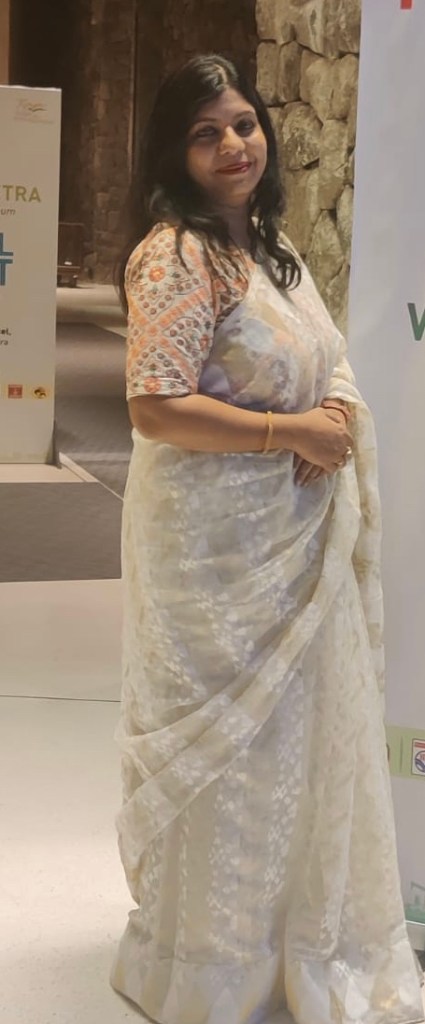
Smitha Sehgal writes poetry in two languages- English and Malayalam. Her poems, fiction and book reviews have been featured in Reading Hour, Brown Critique, Kritya, Muse India, The Wagon Magazine, Usawa, The Criterion, Kalakaumudi, Samakalika Malayalam, Kalapoorna, Shadow Kraft, Da Cheung (Korean Literary Journal) and several anthologies including “40 Under 40: An Anthology of Post-Globalisation Poetry” , “Witness -Red River Book of Poetry of Dissent” .
7. Life’s Paradox – Srijani Dutta
In the circle of gain and loss,
The hungry, in the dustbin, searches for
Leftovers
Whereas the farmer stares
At the cracked soils.
She like a snail
Procrastinates
Whether to come out
Of her shell or not,
Sunrays make a patchwork
Of handlooms on her body
Reminding herself
Of its subtle artistry.
In the world of hit and run,
The coins I place
On my palm
Takes the shape
Of a marooned soldier
When the moon agrees to shed light on it.
Within the maze of chase and pause,
I let loose my hold on the kites
But I catch the train to go Somewhere else.

Srijani Dutta has completed her Post Graduation in English Literature from Visva Bharati University. She lives at Chandannagar in West Bengal. She has published her paper and poems in journals like Yearly Shakespeare, Setu Journal and Contemporary Literary Review India etc.
8. Dusk – Suchita Parikh-Mundul
Dusk is to watch clouds dissolve
into camouflage, to watch vapour rise
from hot plates, maybe in candlelight,
when eyes are fireflies
and lips are soft tomorrows.
Dusk is a feathered sleep
migrating night-wards
with a promise.
Like everything else,
dusk is an ending
and a beginning.

Suchita Parikh-Mundul works as a freelance writer and copy editor. Her poems were recently published in The Bombay Literary Magazine and Outlook India. Some of her articles can be read at The Swaddle.
9. The End – Tali Cohen Shabtai
Look, my father
the road is becoming shorter
there is no sense that will change what is coming!
That’s why I’m preparing a nice note for
a sudden farewell,
see, my father!
Man must make
provisions
for the transition between life and death–
this is purely necessary wisdom,
it makes no sense to
rise early for the morning prayer
and a few hours later
to already be
in burial shrouds
and to eulogize
the mourner’s prayer – here we need a ritual
of differentiation
that will distinguish between
the profane and the holy.
In this transition between
life and death when I tell you
that our road is becoming shorter, Father.
Shortening
There is no option! Even if I suck on
The Lord God
and shed blood
instead of semen
for one of us,
the path is becoming shorter!

Tali Cohen Shabtai, has authored three bilingual volumes of poetry, “Purple Diluted in a Black’s Thick”(2007), “Protest” (2012) and
“Nine Years From You”(2018). A fourth volume is forthcoming in 2022.
Tali began writing poetry at the age of six and her poems express both the spiritual and physical freedom paradox of exile.
10. Nocturnal Trucks and Parabolas – Uttaran Dasgupta
She can describe her climaxes as graphs: some are
an acute curve (x is pleasure, y is time),
like ululation, some are flat, but travel far;
and a rare one is sin (x) — it’ll rise and fall and climb,
sporadic like nocturnal rain:
crests, troughs, Ring Road flyovers breaking the flat notes
of a soporific truck driver. That strain again:
mohabbat karne vaale kam na hoñge[*]. Her throat
is a purple hibiscus, a white harmonium,
a well-oiled roll-top desk. She makes sense of zodiac
charts — no vaccine can prevent this opium
infecting my blood: the aphrodisiac
of aggressive driving, take-no-prisoners road rage:
I dream I’ve drowned in the Meghna sprouting from her knees
I dream I’m eating the ashes of a god’s outrage
I dream a burnt-out factory, stainless steel trees
“Can we allow ourselves a mid-morning break?”
This unthinkable licence, this anarchic scheme:
The azaan of the Hauz Rani masjid will wake
us, the AC compressor drown out our screams.
[*] From the ghazal by Hafeez Hoshiarpuri:
mohabbat karne vaale kam na hoñge
terī mahfil meñ lekin ham na hoñge
(You will not lack in lovers
Though I’ll not be there in your mehfil)

Uttaran Das Gupta has published a book of poems (Visceral Metropolis, 2017) and writes a fortnightly column on poetry (Verse Affairs) for The Wire. His novel Ritual has been optioned for a film or web series. Das Gupta teaches journalism at O P Jindal Global University, Sonipat.
2 responses to “Spring, 2022 Issue: Poems”
-
Reblogged this on TheFeatheredSleep and commented:
I worked on this issue and it is a terrific line up. I hope you will enjoy the poetic talent here.LikeLike
-
… which is where I read it.
Marvellous initiative. Well done.
Kindness – Robert.LikeLike
-


 Parcham Online
Leave a comment